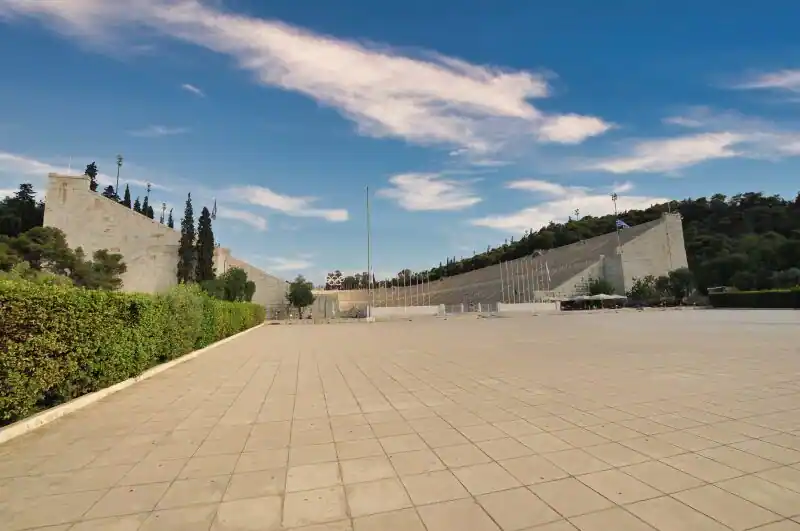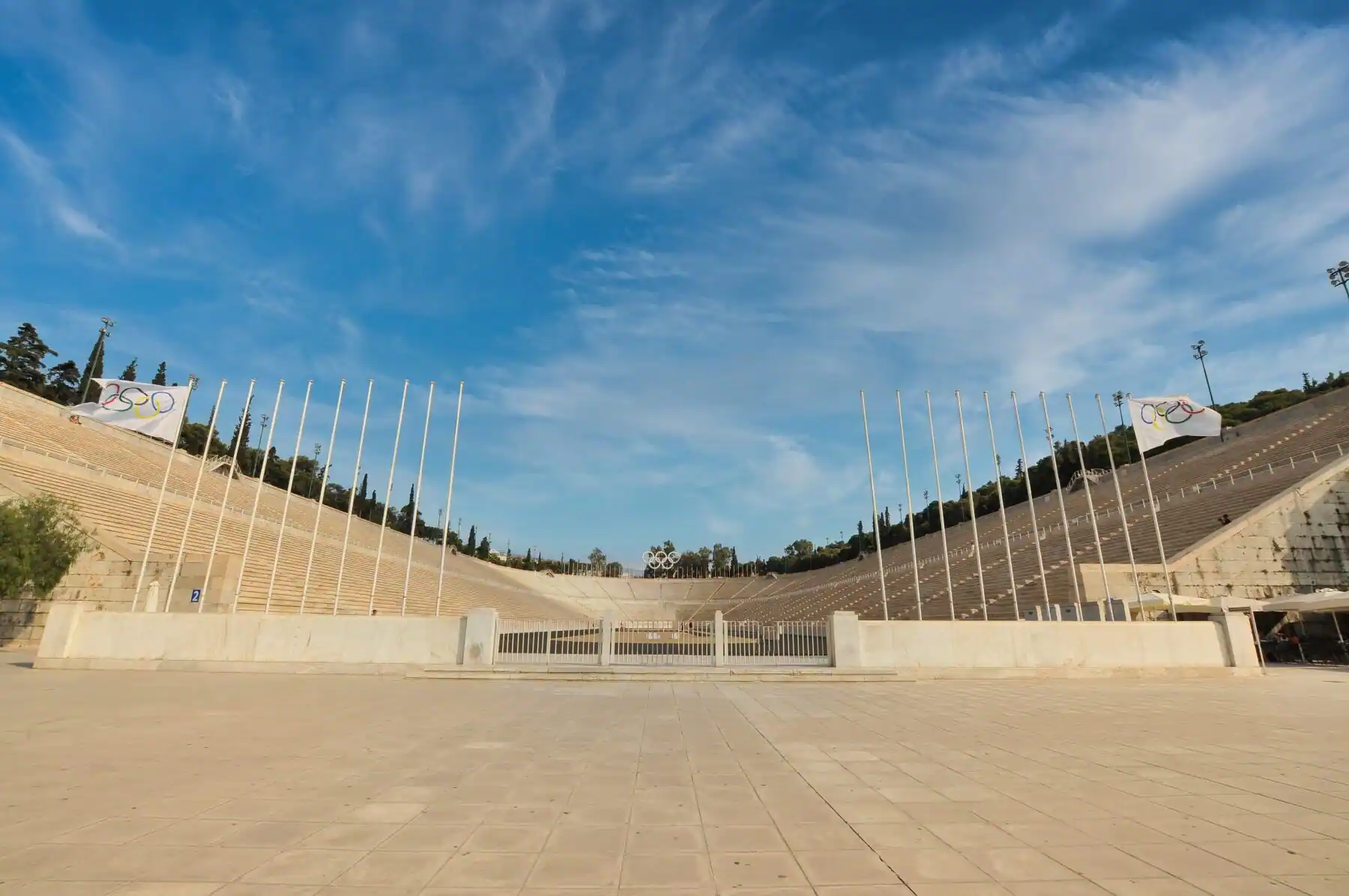
What was the Panathenaic Stadium used for? I think the simple answer is athletics. The deeper answer shows the Panathenaic Stadium across 2,500 years, from ancient religious festivals to the return of the modern Olympic Games.
I have walked past Kallimarmaro Stadium more times than I can count. Sometimes, in the mornings, I jog on the marble track where ancient athletes once competed for olive oil and glory. In the evenings, I sit on the stone seats watching the sun set behind the Acropolis. I feel the weight of history pressing gently against my shoulders.
Let me take you through the history of this remarkable place and show you why this marble stadium means so much to Greeks, to athletes, and to anyone who believes that human beings are capable of beautiful things.
Table of Contents
The birth of a sacred ground
Every great monument has an origin, the day its stones first received meaning. The origins of this stadium go back to the deep silence of a ravine, where ancient Athenians saw an opportunity to build a place where the body of man could challenge the gods through its perfection.
When was the Panathenaic Stadium built?
The ancient stadium was constructed around 330 BC. It was built under the rule of Lykourgos at a natural ravine between two hills, the Agra and the Ardittos, with the Ilissos River running alongside it.
The stadium's original structure was simple: the arena had a rectangular form with earthen sides, and spectators sat on the natural slopes of the ravine. There were wooden benches for officials. The track itself was about 204 metres long, as was the rule in Greek athletic games.
It was much later that the stadium took on its present shape, not finally completed until 144 AD when the wealthy Athenian Herodes Atticus (a Roman senator who was born in Athens and very much in love with his city) had it reconstructed in gleaming white Pentelic marble. He wanted to leave a lasting monument to his city and transformed a simple athletic facility into a seat for 50,000 spectators.
Herodes is also responsible for the stadium's horseshoe shape. He covered all the seats in marble and built subterranean passageways for athletes and judges. He made provision for wild animals as well, since by this time the stadium was also being used for spectacles that the ancient Greeks could hardly have imagined.
The history of Kallimarmaro Stadium through the centuries
Athletic games continued in the stadium after Herodes Atticus rebuilt it in 144 AD, but it also took on a more grisly role as a venue for gladiatorial contests and hunts for wild animals. Runners and wrestlers were replaced by blood and death.
Christianity became the official religion of the Roman Empire in the 4th century, and the old festivals were outlawed. Emperor Theodosius closed the temples and banned the sacrifices. The last Olympic Games were held in 393 AD, and the Panathenaic festivals probably continued a few more years before they died out forever.
The old stadium was gradually abandoned and left to ruin. The marble benches were removed and used in the construction of churches. Later, in the Ottoman period, mosques and private houses were built from stone.
The stadium lay forgotten for over a thousand years. The ground was recognized by a few travelers, but their reports are sketchy. The glory of ancient Athens seemed lost forever.
What does Panathenaic mean?
The word Panathenaic comes from the Greek word Panathenaia, which means of all the Athenians. The name Panathenaic reveals the stadium and its games.
Today, the stadium is also called Kallimarmaro, which means "beautiful marble" in Greek. Walk through its entrance on Leoforos Vasileos Konstantinou, and you will understand why. The white marble gleams in the Athenian sun, just as it did when Herodes Atticus first unveiled his gift to the city.
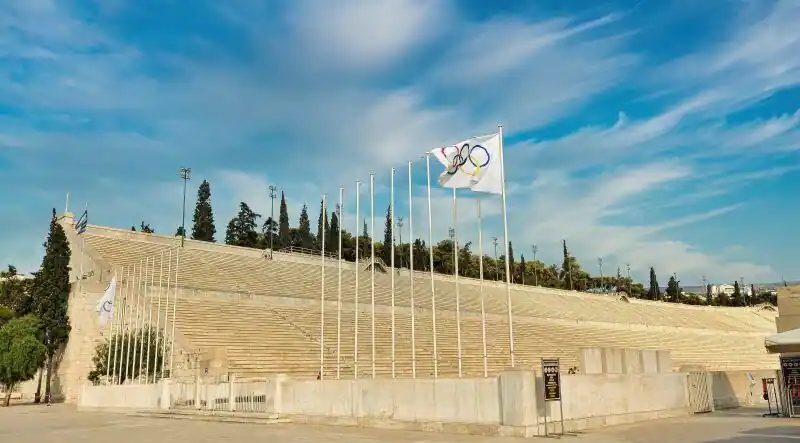
The heart of ancient athletic glory
Sport in ancient Greece was a form of prayer through the human body, a tool to worship and thank the gods by testing its possibilities. The games organized in this stadium were among the most prestigious in the ancient world, attracting competitors from all over the Mediterranean basin who vied for prizes rich in material value but also in religious significance.
Why were the Panathenaic Games important?
The Panathenaic Games were a quadrennial festival in honor of Athena, the goddess of wisdom and warfare, who gave her name to the city of Athens. Second in importance only to the Olympics, in some ways, the Panathenaic Games were even more impressive.
While Olympians could win nothing but olive wreaths, the winners at the Panathenaic Games received amphorae of sacred olive oil. A chariot race victor might claim 140 of the huge ceramic vats. Each would hold about 40 liters of oil. It was a small fortune.
And the amphorae were beautiful. One side showed Athena in her warlike aspect, spear in hand. On the other side was a scene of the event in which the athlete had triumphed. These Panathenaic prize amphorae have been discovered all over the Mediterranean world, evidence that athletes from faraway cities would come to Athens to compete.
What role did the stadium play in ancient Greek society?
The stadium was more than just a place for sport. It was a place for the people of Athens to demonstrate who they were, what they valued, and how they related to the gods.
The great Panathenaic festival that kicked off each year started with a procession that involved the entire city. A new peplos was carried through the streets to be placed over the ancient wooden statue of Athena in the Erechtheion on the Acropolis. The event is depicted on the marble frieze of the Parthenon, which can be seen in the Acropolis Museum today.
There were poetry readings, musical competitions, and the sacrifice of one hundred oxen. The meat was divided among the citizens as a reminder that the gods provided for them. Then came the games in the stadium where young men showed their physical excellence.
Athletic competition was a type of worship for the ancient Greeks. A beautiful, perfectly trained body was a gift to the gods. Victory brought honor to the athlete, his family, and his city. Statues were erected to commemorate champions, and songs were written in their praise that are still read today.
What is the difference between the Olympic and Panathenaic Games?
The Olympic Games and the Panathenaic Games were both Panhellenic festivals, which means that they attracted competitors from all over Greece. However, there were some important differences between the two.
The Olympics were held at Olympia, a sanctuary in the Peloponnese, in honor of Zeus. The Olympic Games were strictly "stephanitic", which means that the only prize given to victors was a crown made of olive leaves. Their prize was the glory.
The Panathenaic Games were "chrematistic," meaning that material prizes were awarded. This made them more popular with professional athletes, who could earn enough prize money to support themselves and their families. The sacred olive oil made at Athens was considered to be the best in the world, and the beautifully painted amphorae were valuable collector's items.
The Panathenaic Games also had competitions for artists that were not found at the Olympics. These included musicians playing the aulos (a double flute) and the cithara (a type of stringed instrument), and poets reciting Homer's Iliad and Odyssey. In this way, the whole range of human excellence was celebrated, and not just physical strength.
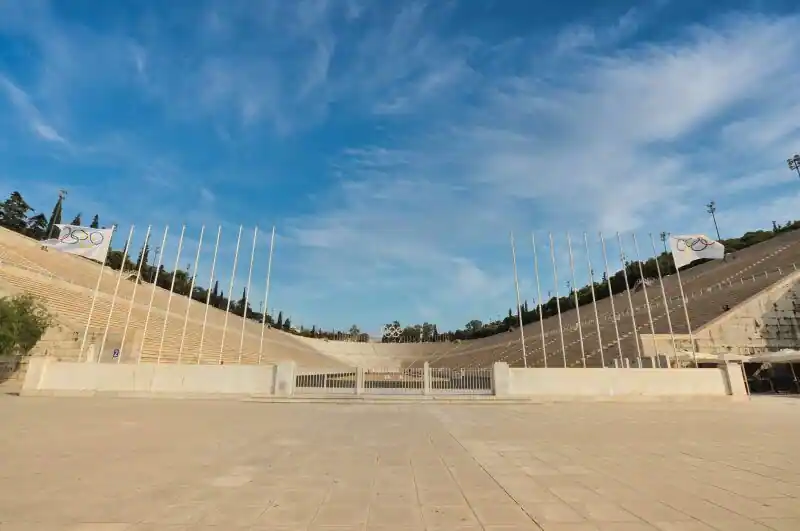
Resurrection and the modern Olympic dream
There are sites that refuse to be forgotten. After a silence of more than a millennium, the stadium was reborn in the 19th century. Visionaries and patriots saw in its stones the opportunity to recreate an activity the world had thought lost forever. The result was one of the most magnificent restorations in history, a legacy from the past to the future.
The Awakening of the Old Stadium
Excavation of the site began in 1836, less than a decade after Greece gained independence from the Ottoman Empire. Traces of the marble magnificence built by Herodes Atticus were uncovered.
In 1869, the German architect Ernst Ziller conducted a more extensive excavation, which uncovered the full extent of the ancient stadium. A wealthy Greek patriot, Evangelis Zappas, had a vision to reinstate the Olympic Games as a living tradition. He financed the excavation and partial restoration of the stadium, and the Zappas Olympics were hosted in 1870 and 1875 on the ancient track. Thirty thousand people watched the Games in the stadium. The revival was complete in 1896.
The Frenchman Pierre de Coubertin organized the first modern Olympic Games, and Athens was chosen to host the Games. A Greek businessman from Egypt, Georgios Averoff, provided the huge amount necessary to restore the stadium to its original state, rebuilding it completely with fresh Pentelic marble. The architect Anastasios Metaxas studied Ziller's excavations and reconstructed the dimensions and design of the Roman-era building. In April 1896, the original ancient stadium was ready to host the world, and eighty thousand spectators filled the marble seats for the opening ceremony.
The triumph of 1896
On April 6, 1896, King George I of Greece announced the opening of the first modern Olympic Games. There were competitors from 14 nations, who contested nine sports. The American James Connolly won the first gold medal in the triple jump.
But the moment that touched the heart of every Greek came on April 10, when Spyridon Louis, a water carrier from the village of Marousi, strode into the stadium at the head of the marathon pack. He had just run 40 kilometers from Marathon, following in the footsteps of Pheidippides. As he crossed the finish line, Crown Prince Constantine was at his side to run the last few meters with him. The crowd roared its delight.
Louis was an instant national hero. Gifts of every sort were offered to him, but he asked only for a donkey and cart to help him in his work carrying water. His gesture endeared him to the Greek people all the more. Even today, Greek schoolchildren are taught his story as a lesson in true greatness.
Is the Kalimarmaro still used?
The stadium is not a frozen museum or monument; it is a working stadium that regularly hosts events year-round. Every November, tens of thousands of runners cross the finish line at the Authentic Athens Marathon at the Athens Marathon Stadium. The course takes them from Marathon to Athens on the original marathon route, and the finish line inside the stadium has been in the same place since 1896. Finishing a marathon in this stadium is a spiritual experience for some.
The stadium is also the place where the Olympic flame handover ceremony ends in Greece. Each time the flame is lit in ancient Olympia before the Olympic Games, it is carried to Athens, and the flame is passed in a solemn ceremony to officials from the host country.
Visiting the stadium today
The stadium is located on Leoforos Vasileos Konstantinou, a short walk from central Athens. It is 1,000 meters from Syntagma, Akropoli, or Evangelismos metro stations and accessible by bus as well.
Upon purchasing the entrance ticket, you will be given an audio guide device. The 30-minute audio tour takes visitors on a journey through the history of the Panathenaic Stadium in Athens, from ancient to modern times.
Feel free to walk on the track, sit on the marble seats, and take a picture with the Olympic rings in the backdrop at the winners' podium. There is also a small museum with a permanent exhibition "Memories from Olympic Games: Posters and Torches from 1896 till today". The collection features torches and posters from every modern Olympic Games.
Other echoes of the ancient city
But the Panathenaic Stadium is not alone. It is one voice in a chorus of ancient places, and if you listen, Athens will lead you to them. Start where all visitors start: the Acropolis. This hill-top citadel looms over the city like a diadem, and from the upper rows of the stadium you can see the Parthenon shining in the late afternoon sun.
Beneath the Acropolis, cut into the southern slope of the rock, is the Theater of Dionysus, where Greek drama was invented, where audiences first wept for Oedipus and laughed at Aristophanes. A few meters away is the Odeon of Herodes Atticus, which shares its patron with the stadium itself, as it was Herodes who first clad the stadium in marble.
If you walk north from the Acropolis, up Panepistimiou Street, you will find the Ancient Agora, the political heart of ancient Athenian democracy. Here Socrates held forth on virtue to young Athenians, and citizens came to vote on the future of their city.
A few hundred meters away, to the west, is the Roman Agora, and the story of what happened after Athens was conquered, when Greece was ruled by Rome, and Greek culture conquered Rome. Between the two agorai is a library, a grand building, constructed by an emperor who fell so deeply in love with Athens that he tried to make it the intellectual capital of his empire. His name was Hadrian, and the library he built on the banks of the Ilissos River is called Hadrian’s Library.
For a quieter experience, visit the Kerameikos Cemetery. This is where the ancient Athenians buried their dead, along the road that led out of the city. The marble grave markers are some of the most moving pieces of Greek art.
In another part of Athens, visit the Temple of Zeus, which stands in austere ruins and is a reminder of how long it took (600+ years) to complete a vision. The remaining columns are among the largest in Greece. If you have time for a day trip, drive south along the coast road and visit the Temple of Poseidon at Cape Sounion. Perched on a cliff above the Aegean Sea, you will understand why the Greeks put temples in such places.
Back in the city, do not miss the Athenian Trilogy on Panepistimiou Street. These three neoclassical buildings (the Academy, the University, and the National Library) show how modern Greeks paid homage to their ancient past. And if, when you return to Athens, you are in the center of town, near Syntagma Square, seek out the Russian Church of Sotira Lykodimou. This Byzantine jewel, built of red brick and set in a quiet courtyard, is a moment of peace amid the city. Athens has many layers. The patient traveler finds them all.
Frequently Asked Questions
Is the Panathenaic Stadium free?
No, you will need a ticket for entry. If you happen to visit Athens on Athens Marathon day in November, the stadium is open for free to the public to watch the runners finish. There are some days during the year that it is free.
How much is the ticket?
Regular admission costs 12 euros and includes entry to the stadium, the track, and the museum, plus an audio guide.
How long does it take to see the site?
Visitors to the stadium spend on average 45 minutes to 1 hour. The audio guide tour takes 30 minutes and covers the highlights.
Can I run in the stadium?
Yes, during the morning hours from 7.30 to 9.00, the stadium is open for free jogging.
Where marble remembers and time stands still
What was the Panathenaic Stadium used for? It was a place for worship, for competition, for the celebration of human excellence. It was the stage for ancient games dedicated to a goddess and modern games dedicated to international friendship. It saw empires rise and fall, religions change, and centuries pass. And still it stands, white marble gleaming in the Greek sun.
When I sit in those seats in the quiet of early morning, I sometimes close my eyes and try to hear the ancient crowds. I picture the athletes warming up for their races, the priests tending to their sacrifices, the poets declaiming Homer. I picture Spyridon Louis storming into the stadium in 1896, haggard but triumphant.
The stadium connects all of them, and all of us. It reminds us that human beings have always strived to be better, faster, stronger. It reminds us that we honor that striving with beauty, with marble, with songs and stories that outlast us all.
If you are in Athens, do not miss this place. Walk on the track. Sit in the seats. Feel the marble under your hands. And for a moment, you will be part of something that started 2,500 years ago and has no signs of ending.