Cities of the present. Cities of the past. Athens is both. It doesn’t just respect its history. It incorporates it. That is what makes Athens special.
Visiting the capital of Greece means seeing history up close every day. Groups of tourists and locals crowd around the ruins and archaeological sites. Meanwhile, locals live their lives around them. It’s a beautiful, dizzying experience to walk through the oldest city in Europe and feel its history come alive around you.
Planning a trip and wondering which are the best attractions in Athens? I want to tell you something first. Athens is not a place to rush through. It is not a checklist. It is a dialogue between the old and the ordinary, between ruins and rooftops, between silence and noise. The best way to experience it is slowly, with open eyes and no hurry.
This collection of the best things to do in Athens takes you through the city's historic heart, ancient wonders, and hidden gems. If you only have time to explore a few, these will help shape your visit and give you the perfect Athenian experience.
Table of Contents
The Acropolis: A sacred rock that still watches over Athens
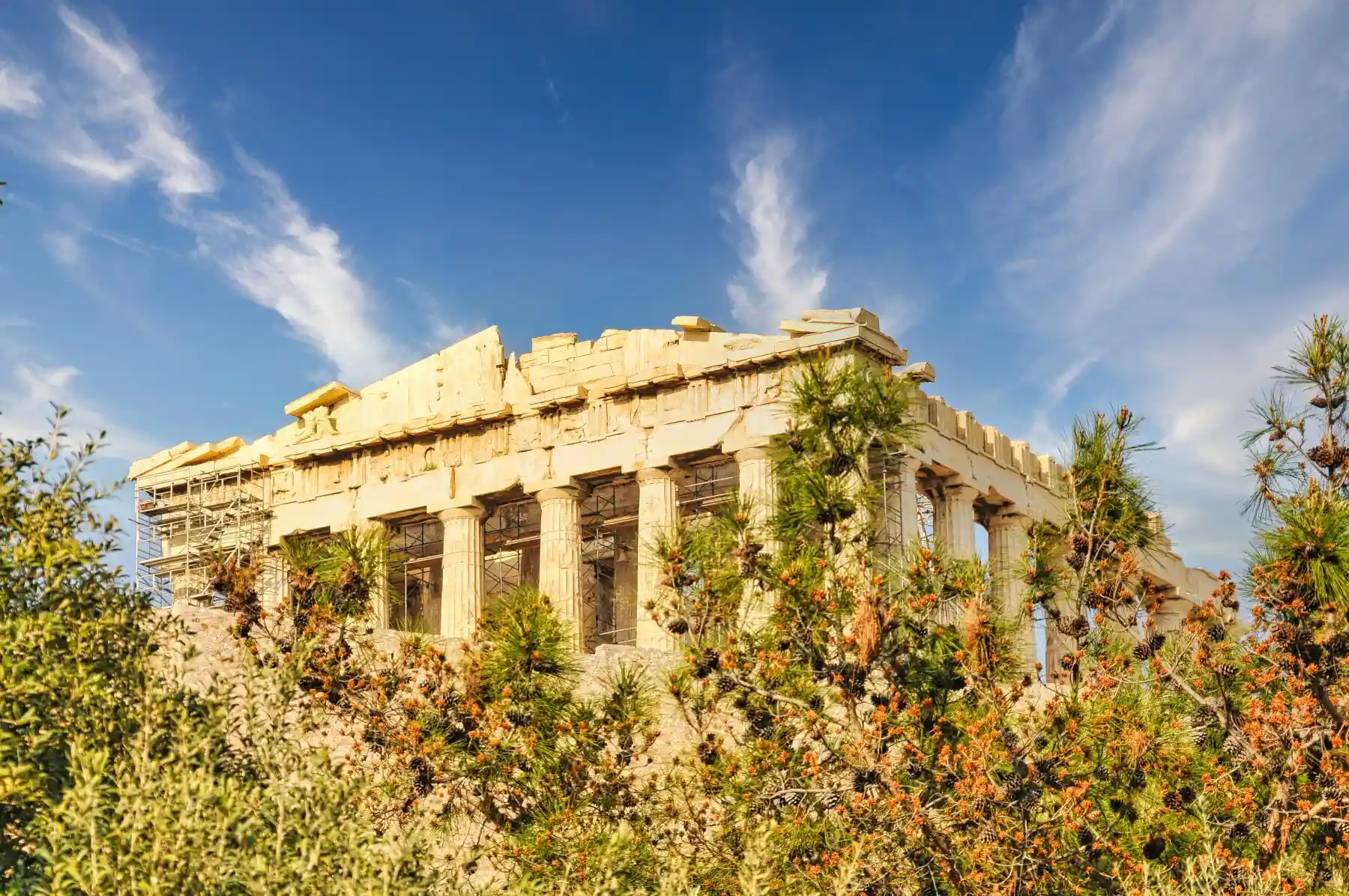
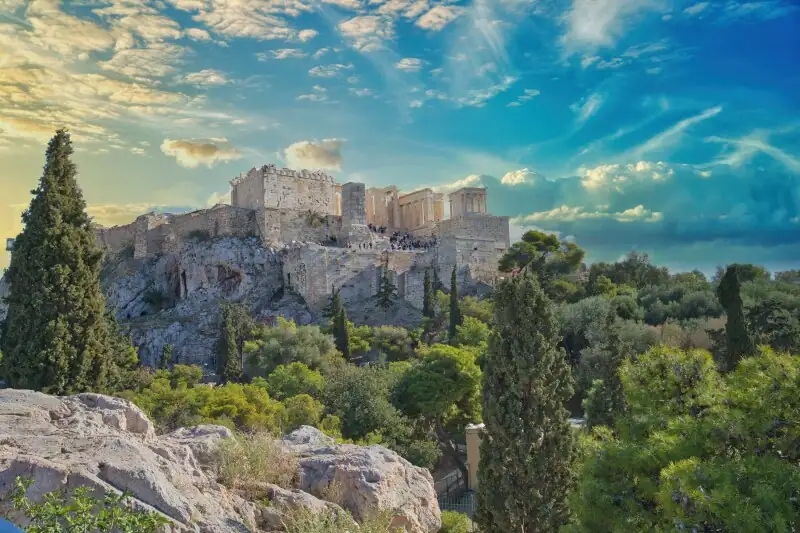
The Acropolis is more than a ruin. It’s a sacred rock that has guarded Athens for over 2,500 years. High up on top of the Acropolis is the Parthenon. There’s also the Erechtheion, and those iconic Caryatids, the Temple of Athena Nike, and the Propylaea, the majestic gateway into the site. Each of them has its own story to tell. Each of them holds a different part of this city’s soul.
If you want to learn more about the history, the best times to visit, and what to see, I’ve put together a complete guide to the Acropolis, where you can find out all of the above, and more.
The ancient agora: Where Socrates argued, and the city listened
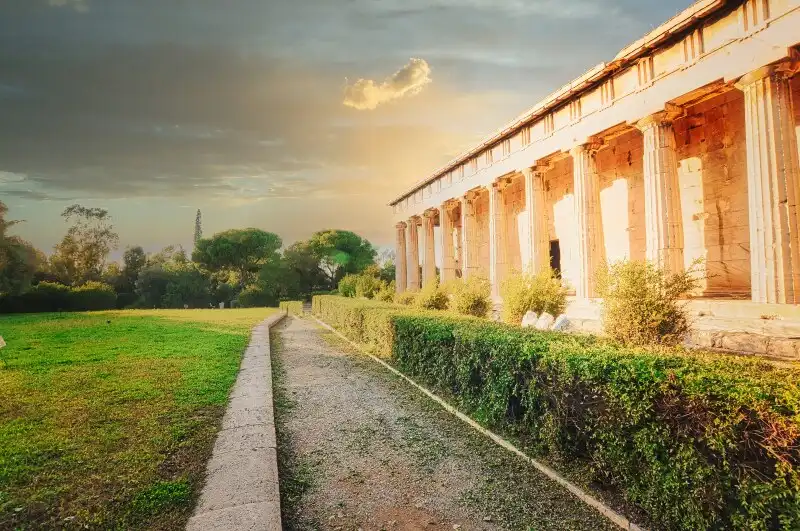
If the Acropolis was the spiritual center of Ancient Athens, then the Agora was its beating heart. This is where everybody was gathered. Where they argued. Traded. Voted. Told stories under the shade of old trees. Socrates walked here. So did Plato.
I love the Ancient Agora because it feels like a living, breathing place. Most archaeological sites do not. Maybe it is the trees. Maybe it is the open space. Maybe it is knowing that this was not a temple for the gods but a place for people. Regular people, living their lives.
I have a detailed article about the Ancient Agora if you want to plan your visit properly.
The temple of Zeus: Columns that stand like giants who refused to leave
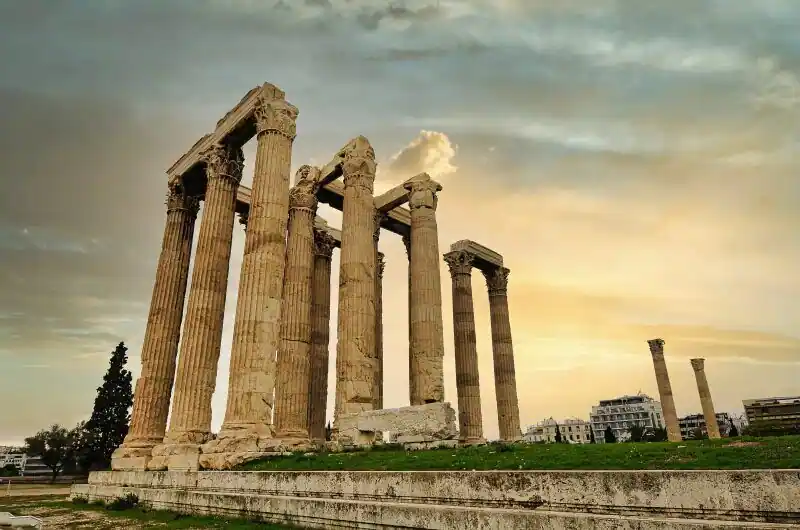
You notice the columns first. Fifteen of them, still standing tall and proud in the heart of modern Athens. Like gargantuan skeletons who stubbornly refused to go away. The Temple of Olympian Zeus was once the largest temple in Greece.
In fact, the temple was never finished, until almost 700 years after it began. From the 6th century BC to the 2nd century AD, it took the Greek and then the Roman emperors centuries of hard work. In the end, it was the Roman Emperor Hadrian who completed the job. Seven hundred years. Generations of builders, and emperors, and dreamers. All working towards a single goal.
Read my complete guide to the Temple of Olympian Zeus for tips and history.
The Panathenaic Stadium: The quietest place that was once the loudest
The Panathenaic Stadium is the world’s only stadium made completely of marble. It’s in a natural location between two hills, horseshoe-shaped, white and dazzling in the Athenian sun. This is where the first modern Olympic Games took place, in 1896. Before that, in ancient times, the Panathenaic Games were held here, in honor of the goddess Athena.
I’ve sat on those marble benches more times than I can count. There’s a hush in that place that catches you off guard. You think you’re entering a sports arena, but what you find is something that almost feels holy. The curve of the seats, the open air above, the magnitude of everything that transpired here. It’s more than a stadium.
For the full experience, check out my article about the Panathenaic Stadium.

The Acropolis Museum: Where the past looks you in the eye through glass
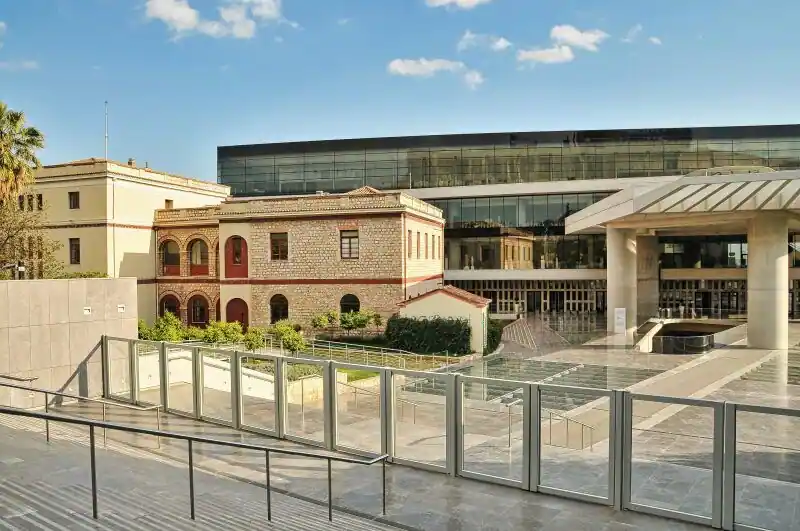
If the Acropolis leaves you speechless, the Acropolis Museum will help you to know why. This is one of the most beautiful museums I have ever been to, and I do not say that lightly. The building itself is a work of art. Glass floors allow you to see ancient ruins below your feet. Natural light floods in from all angles. And the collection inside tells the story of the Acropolis from its very beginnings to the present day through sculptures, pottery, and fragments that are full of centuries of history.
The top floor is special. It is in the exact dimensions of the Parthenon, and the remaining original frieze panels are exhibited in their proper place. Where there are gaps (many are still in the British Museum), white plaster copies take their place. It is a moving sight. Beautiful and heartbreaking at the same time.
The museum is less than a 10-minute walk from the Acropolis entrance. For more information and what to see inside, check out my guide to the Acropolis Museum.
The National Archaeological Museum: The place that turns history into something you can touch
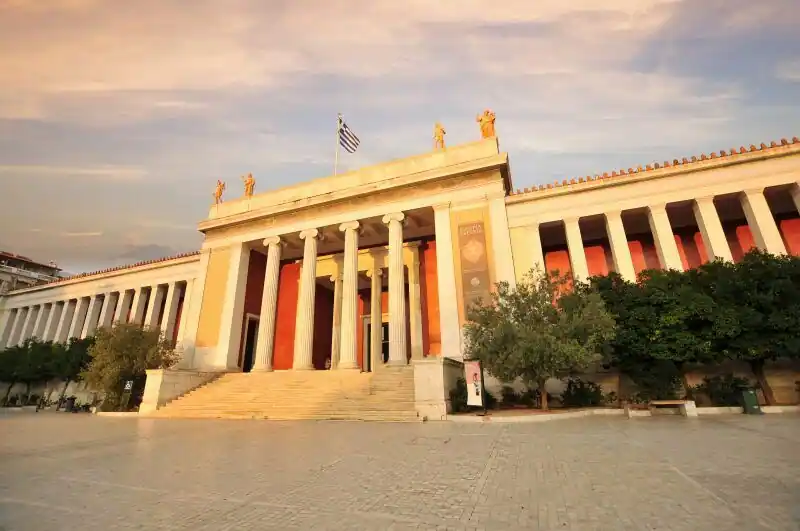
The National Archaeological Museum is the largest museum in Greece and one of the world’s most significant archaeological museums. It contains thousands of artifacts covering the entire history of Greek civilization from prehistoric times to the classical era and beyond.
The museum is situated in the Exarcheia neighborhood, slightly north of the city center. For a deeper look at what to see inside, read my full article about the National Archaeological Museum.
The Temple of Poseidon: A temple built where the earth runs out of land
This temple is not in Athens. It is about 70 kilometres (43 miles) to the south, at the very tip of the Attica peninsula, on a cliff above the sea, at Cape Sounion. And it is absolutely worth the trip.
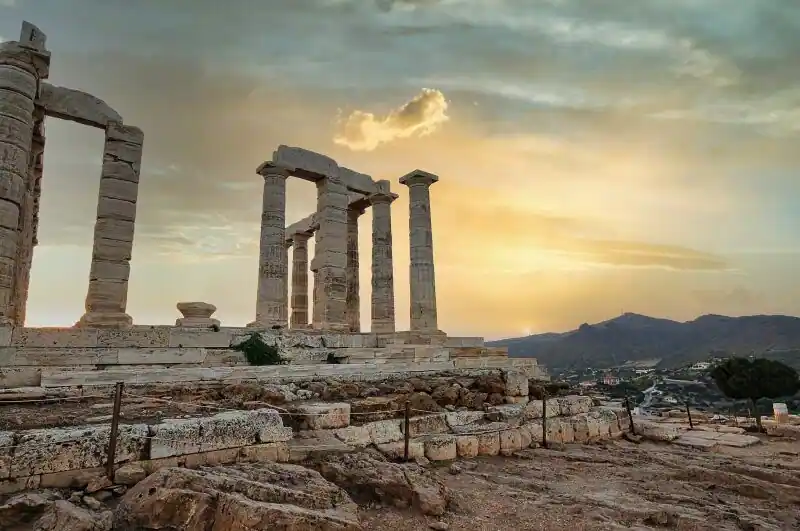
The Temple of Poseidon sits on a rocky headland, high above the Aegean, and has nothing around it but sky and water. It was built in 440 BC, around the same time as the Parthenon, and was dedicated to Poseidon, the god of the sea. Sailors would have seen it as they passed by in their ships, a white glow on the edge of the world.
The drive along the coast is beautiful, and when you get there, the temple is there waiting for you, quiet and old and patient. At sunset, it is one of the most beautiful sights in all of Greece. The columns turn orange, and the sea is deep blue, and you stand there, knowing that people have watched this same sunset from this same rock for thousands of years.
Read my guide to the Temple of Poseidon at Cape Sounion for everything you need to know.
Plaka: Narrow streets that hold a thousand quiet stories
Plaka is the oldest neighborhood in Athens. It’s located right at the foot of the Acropolis and is full of winding, cobblestoned alleys, pastel-colored buildings, bougainvillea draping over ancient stone walls, and tiny churches tucked away in hidden nooks.
Plaka has a different vibe than the rest of Athens. Quieter. Calmer. Buildings are low to the ground, most streets are pedestrian only, and when the lanterns light up at night, and the Acropolis shines above, the whole neighborhood feels like a page out of history.
Anafiotika: A Cycladic whisper on the slopes of the Acropolis
Hidden into the northeastern slope of the Acropolis, you would almost miss it if you weren’t looking for it. White-washed houses. Blue doors. Narrow streets that you can barely walk two abreast. Cats are sleeping on the sun-warmed steps. It looks like it should be on a Greek island. It’s Anafiotika, and it’s one of my favorite places in Athens.
There are only about 45 houses, and you can walk through them in a few minutes. But those few minutes are a nice escape. From the noise, from the crowds, from everything. You walk in, and the city disappears.
Monastiraki flea market: A beautiful mess of old records, copper pots, and Sunday mornings
Monastiraki is noise and color and life. It’s one of the most energetic places in Athens where old and new collide in the craziest, most charming ways possible.
The flea market extends from Monastiraki Square and down Ifestou Street, but is especially crowded on Sundays when it attracts vendors, antique dealers, and anyone looking to sell vinyl records, vintage cameras, handmade jewelry, old books, and whatever else you never knew you needed.
I come here whenever I need to feel the city’s pulse. Monastiraki has an energy you can’t find anywhere else in Athens. It’s loud. It’s crowded. And it’s wonderful.
Beyond the market itself, the area is also packed with small bars, street food spots, and rooftop cafes with views of the Acropolis. On a warm evening, there’s no better place to be in Athens than on a rooftop with a cold drink in hand and the Parthenon lit up above you.
Monastiraki also makes a great base for exploring nearby Plaka, Psyrri, and Thissio – three of the most walkable and interesting neighborhoods in the city center.
National Garden: The pause between the ruins and the rush
The garden is right behind the Greek Parliament on Syntagma Square. Created in the 1830s as a royal garden for Queen Amalia, over the years it has become a public space that truly belongs to everyone. Step inside, and the temperature drops. The sounds of the city fade. The light filters through the leaves in soft green patterns, and for a few minutes, you forget there are four million people on the other side of the fence.
There are no lines. No tickets. No audio guides. Just paths that wind through trees older than most of the buildings around them, past a small botanical garden, a duck pond, and a few old statues half hidden in the shade. It is the kind of place where you walk without a plan and end up exactly where you need to be.
For anyone spending any time near the Acropolis, the Panathenaic Stadium, or Syntagma Square, the garden is right there. It asks nothing from you except a few minutes of your time, and it gives back more than you expect.
You can learn more about this in my info guide of the National Garden, and also, if you want to discover more green spaces in Athens, check my complete article on parks and hills.
Lycabettus Hill: The highest point where the city becomes a painting
Standing at 277 meters above sea level, Lycabettus is the highest hill in central Athens. You can reach the top on foot by climbing a pine-tree shaded path, by funicular from Kolonaki, or by car. The walk from the bottom takes 30 to 40 minutes and is entirely worth it. The path winds up through the pine trees, and at each bend the view opens up a little more.
By the time you reach the top, the city below belongs to you. As you walk up, you pass a tiny white chapel, the Chapel of St. George, and you reach the top. On a clear day, the Saronic Gulf, the port of Piraeus, and the mountains that ring the basin of Attica are visible. It’s one of those views that makes a sprawling, chaotic city suddenly make sense. From up here, everything makes sense. But what really makes Lycabettus special is the view at sunset.
For the full story on how to get there and the best time to visit Lycabettus Hill, check out my guide to Lycabettus Hill.
Philopappos Hill: The quiet hill that holds the most honest view of Athens
Every city has a place that will show you what it really looks like. Raw. Unfiltered. No frills. Just the place, as it is. In Athens, that place is Philopappos Hill.
Philopappos Hill is on the southwest side, just across from the Acropolis. It’s not as high as Lycabettus. It’s not as famous as the Acropolis. But it has something that the other two don’t. A view of the Parthenon so close and so clear and so stunningly framed by pine and olive trees that it almost feels like a mirage.
A gentle path snakes up from the pedestrian street of Dionysiou Areopagitou, meandering past trees and wildflowers in the spring, over old stone and dry grass in the summer. The climb is easy. Ten, maybe fifteen minutes at a slow pace. And as you go higher and higher, more and more of Athens reveals itself around you.
I have written more about this hill and what to see along the way in my full guide to Philopappos Hill.
The Athenian Trilogy: Three buildings that carry the spirit of a civilization
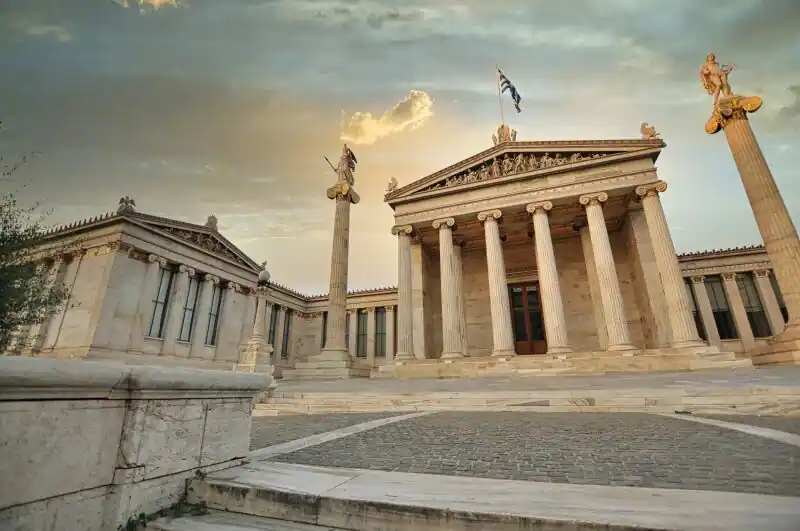
Three Buildings. Three brothers. Side by side in a row, standing at attention at the center of Athens. All white marble and classical columns. A symphony in white. A set of landmarks. They are called the Athenian Trilogy, and they are three of the most photographed buildings in Athens.
The three buildings are the Academy of Athens, the University of Athens, and the National Library. They were all designed by Danish and Greek architects in the 19th century, in the style of ancient Greece. The buildings are beautiful in a proud, ancient way.
These buildings are not old. But they bring the spirit of ancient Athens into the modern city, and they do it with elegance. They remind you that Athens never stopped building, never stopped reaching.
For more information and the full history, check out my article on the Athenian Trilogy.
The Odeon of Herodes Atticus: Where a love story became a stage for the whole city
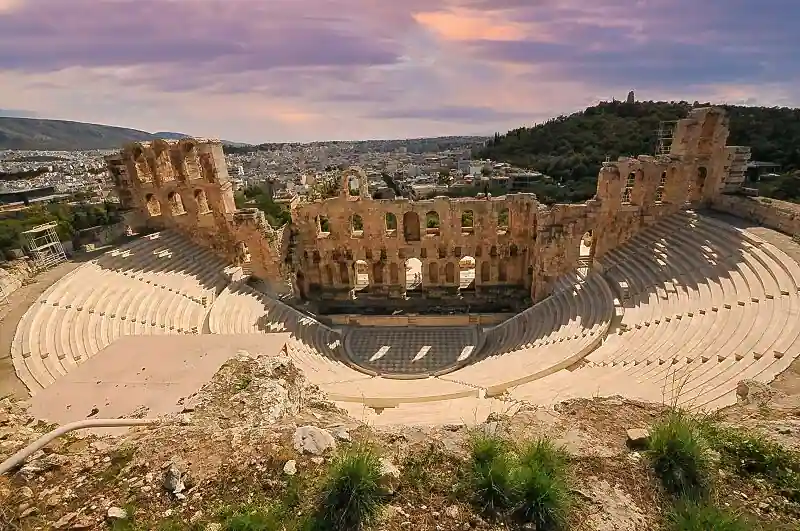
The Odeon of Herodes Atticus is located on the south slope of the hill. It is easily one of the most dramatic theatres you will ever see. It was constructed in 161 AD by the wealthy Roman Herodes Atticus in memory of his wife. The theatre had the capacity for around 5,000 spectators.
The thing about the Odeon is that you can see performances there. Yes, it is still in use. Every summer, it is the home of a number of concerts, operas, and open-air theatre as part of the Athens and Epidaurus Festival. I have attended performances there on balmy summer evenings and have sat on the ancient stone seats watching the action on a stage set behind floodlit arches with the city lights spreading out in front of us. It is an experience I will never forget.
You cannot enter the Odeon during the day unless there is a scheduled performance. However, the Odeon is clearly visible from the Acropolis walkway, and it is well worth stopping to look.
You can read all about visiting the Odeon on my guide to the Odeon of Herodes Atticus.
Frequently asked questions about Athens attractions
What are the best 5 attractions in Athens?
If I had to pick five, they’d be the Acropolis, the Acropolis Museum, the Ancient Agora, Plaka, and sunset from Lycabettus Hill or Philopappos Hill. Five very different things, but they give you history, culture, beauty, and that sense of actually being here.
Are the attractions walkable from each other?
Yes, most of them. The Acropolis, Ancient Agora, Temple of Zeus, Plaka, Anafiotika, Monastiraki, Philopappos Hill, and the Odeon are all within a 15 to 20 minute walk of one another. The National Archaeological Museum and Lycabettus Hill are a bit further out but also accessible on foot.
Can you visit attractions for free?
Several sites offer free admission on certain days, especially during national holidays and on select Sundays in winter. Philopappos Hill and the National Garden are always free. The view from Lycabettus Hill is also free. And wandering around Plaka, Anafiotika, and Monastiraki is completely free and will reward you endlessly.
What is there not to miss on the first visit to Athens?
Do not miss the Acropolis at sunrise or shortly after opening. Do not miss the view from Philopappos Hill in the late afternoon. Do not miss a slow stroll through Plaka at night. And do not miss sitting in a quiet square, sipping a Greek coffee, watching the city go about its life. The last one is not an attraction. But it might be the thing you’ll remember the most.
One last thing
Athens is a city that does not shout. It does not have to. It has 2,500 years of stories written in stone, painted on walls, and built into its streets. The best attractions in Athens are not things to simply see. They are things to feel. Places where the past reaches up through the ground and touches you gently, if you let it.
I have written this guide from a lifetime of living here, of watching this city change and stay the same, of falling in love with it again and again. I hope it helps you plan your visit. But more than that, I hope it helps you feel something for this place before you even arrive.
Because that is what Athens does. It reaches you before you are ready. And it stays with you long after you leave.