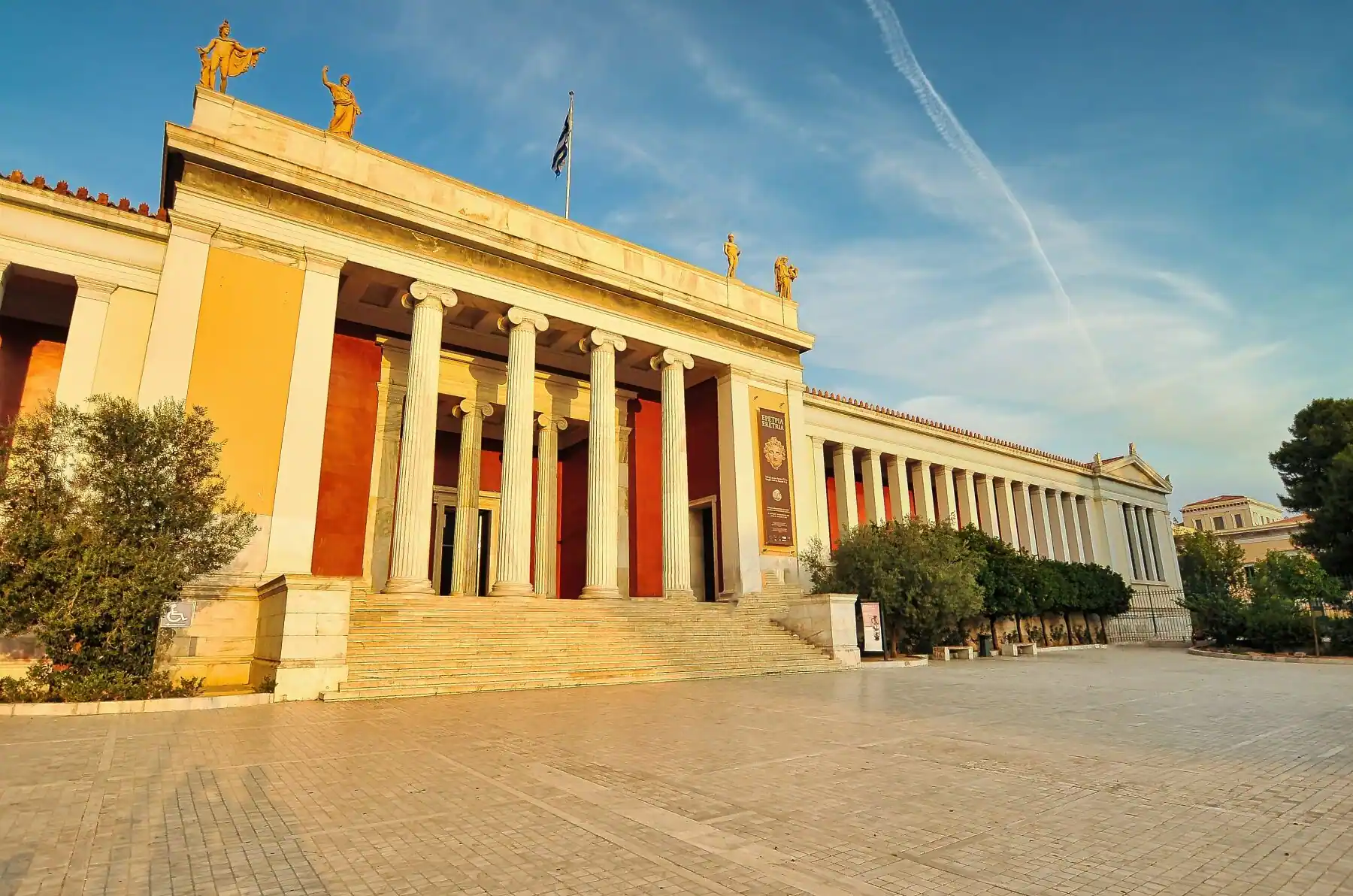
A lot of museums allow you to observe history through glass walls. The National Archaeological Museum in Athens allows you to inhale it. I remember the day my parents first brought me here as a child. I didn’t understand a lot of what I was looking at.
I remember the bronze god with his arm raised, frozen in a throw that will never land. I remember feeling small, not in a bad way, but in the way you feel small when you stand at the edge of the sea and realize how much is beyond what you know.
I still walk through those doors with that same feeling today, years later. If you’re looking for a National Archaeological Museum Athens guide that tells you what it actually feels like to stand in those rooms, to walk through the quiet halls and look into those faces, you’re in the right place.
This is not a list of exhibits and hours (though you’ll find those too). This is a walk through one of the most important museums in the world, as told by someone who thinks of it as a second home.
Table of Contents
The building where Greece keeps its oldest stories
It is the largest archaeological museum in Greece, and one of the most significant in the world. Founded in the 19th century with the express intent to collect, protect, and exhibit the ancient Greek antiquities that were scattered across the nation, it today houses more than 11,000 objects, spanning over 7,000 years of history, from the prehistoric era through late antiquity.
Its size is impressive, but it’s not really the size that matters. What makes this museum so special is that, unlike some other institutions that focus on specific periods or areas, it provides a deep dive. You can follow the entire arc of Greek history here, from the earliest Neolithic settlements to the majesty of classical Athens and beyond.
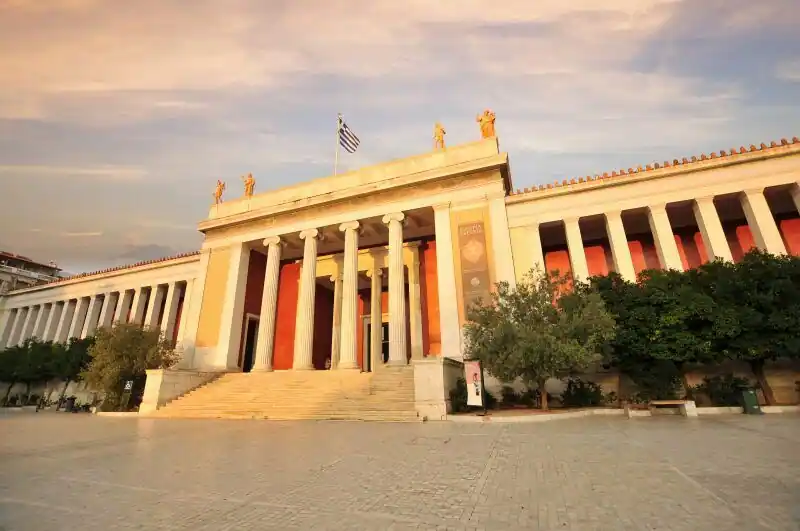
The building itself, an imposing neoclassical structure on Patission Avenue, is almost a monument in its own right. Walking through its doors, one feels as if one is entering a world most of us only read about in books.
What surprised me most, even as a local, was how personal the objects felt. These were not abstract “artifacts.” These were the tools people used, the jewelry they wore, the offerings they made to the gods. That human connection is what makes this museum different from any other cultural attraction in Athens.
How to find the museum
It is located at Patission Avenue 44, in central Athens. Close to Omonia Square and on the border of the Exarchia neighbourhood, which is one of the most fascinating parts of the city.
Getting there is very easy. By metro, Omonia station (lines 1 and 2) is about a 10-minute walk, and Victoria station (line 1) is even closer, about 5 minutes on foot. If you are coming from the city centre, it is about 20 to 25 minutes on foot from Syntagma Square, along the Stadiou Street and then uphill on Patission.
The treasures that live inside these walls
Every museum has its icons, the artworks and artifacts that people travel the world to see. The National Archaeological Museum has more than most. But it’s not just the individual objects that make walking through these rooms such a powerful experience. It’s the way they echo and answer each other across time and space. Gold from Mycenae speaks to bronze from the sea. Stone figures that have been rigid and still for centuries start to learn to move as you walk from room to room. And in a quiet corner, a corroded lump of metal turns out to be the most surprising object of all.
The Mycenaean Hall, where gold still shines after 3,000 years
Room 4 is the emotional centre of the museum. This is where the gold objects from the shaft graves at Mycenae are on display, and the effect is immediate. You step inside, and the outside world falls away.
Mask of Agamemnon: A king's last expression, pressed in gold
The museum's icon. A gold funerary mask from the 16th century BC, discovered in Grave Circle A at Mycenae. Heinrich Schliemann, the man who found it, famously sent a telegram back to Germany saying “We have gazed upon the face of Agamemnon”, though in fact modern scholars believe the mask to predate the Trojan war by centuries.
None of that matters when you are standing in front of it. The detail of the beard, the closed eyes, the peaceful expression, it is one of those objects that makes the ancient world feel suddenly, impossibly close. The gold is so well preserved that it still catches the light after more than three millennia.
The treasures that surrounded the mask
The Mycenaean collection is contained in rooms 3 to 6, and the mask is only the tip of the iceberg. Golden cups, diadems, seal rings, and hunting/war scene-decorated weapons fill the display cases. The craftsmanship is just unbelievable. They were powerful people, and they wanted everyone to know it, even after they died.
There is pottery, frescoes, and Linear B tablets from Mycenaean sites all over Greece. If you've ever read about Mycenaean civilization, this is where those stories come to life. The swords they fought with. The cups they drank wine from. The jewelry that their queens wore.
One piece that is often overshadowed is the gold Vapheio cups, found in a tomb in Laconia. They are tiny, decorated with scenes of bulls being captured, and the detail is so fine that you could spend 10 minutes just on the relief work on one cup.
The sculptures that learned to breathe
Spread across the entire ground floor, the sculpture collection is a chronological walk through the development of Greek art. As you make your way from room to room, it's as if history is unfolding in fast-forward.
You start with the stiff, formal kouroi of the archaic period, young men standing rigid with one foot forward, wearing that mysterious archaic smile. Then, as the galleries progress, it happens. Suddenly, the figures start to move. Muscles loosen. Bodies rotate. Faces emote.
The archaic room
The Kouros of Sounion is one of the earliest and largest of the kouroi. Over three meters high, the sculpted figure was found near the Temple of Poseidon on Cape Sounion, and is dated to around 600 BC. I am always struck by the size and simplicity of the work. Several smaller kouroi and korai are grouped nearby. Notice how the fascination with the ideal male/female body, first evident here, would become the defining feature of Western art for the next 2,500 years.
Classical grace, the calm center of Greek sculpture
The "Mourning Athena" relief is a small but moving work. The goddess leans on her spear, head lowered and head bent as if in contemplation. The piece is dated to around 460 BC. There's a gentle, human side here you don't always associate with Greek warrior deities.
In the later classical rooms, the style is fully arrived. The proportions are perfect, the poses feel natural, and it’s as if the stone has forgotten that it was once quarried from some godforsaken hillside.
Hellenistic drama, the final act of Greek sculpture
The last rooms of sculpture become something else, more passionate. The Poseidon of Melos is a huge marble statue, captured in an extravagant swirl of energy. Little bronze satyrs and frolicking children make you remember that Greek art was never only about the gods and heroes. It was also about life, in all its different guises.
Bronze sculpture discovered underwater
Some of the museum's most valuable treasures have not been dug from the ground but pulled from the sea. Two shipwrecks, off Cape Artemision and near the island of Antikythera, returned objects that had been lost for more than two thousand years.
Artemision Bronze: Zeus or Poseidon, the question no one can settle
Discovered in the waters near Cape Artemision in the 1920s, this enormous bronze statue shows the figure of a god poised in mid-throw, his arm raised, his body balanced on one leg. For decades, scholars have argued over whether this is a representation of Zeus hurling a thunderbolt or Poseidon flinging his trident.
I vote for Zeus, but in fact, no one knows for sure. We do know, however, that this is one of the greatest surviving ancient Greek bronze statues. Seeing it in real life is a totally different experience from seeing a photograph. The proportions, the way his muscles are taut yet relaxed, the serene power of his face: it is breathtaking.
The Jockey of Artemision: The boy who has been racing for two thousand years
Recovered from the same shipwreck as the Artemision Bronze is the Jockey of Artemision, a statue of a young boy on a galloping horse. The dynamism of this piece is staggering. The boy leans into the wind, his face creased with effort, while his horse is captured mid-stride, reaching out as it gallops. This is one of the few large-scale bronzes from the Hellenistic period to survive, and the sense of movement in it seems almost cinematic.
Youth of Antikythera: The figure that feels more like a person than a statue
Recovered from the other famous shipwreck, this bronze statue of a young man raising one hand, perhaps holding an object that is now lost, is striking for the lifelike quality of its subject. The rendering of his hair, the glance in his eyes, his stance, and expression give him the quality of a person standing across the room from you. He is less dynamic than the Artemision Bronze, more introspective, and, in a way, even more compelling to look at.
Cycladic figurines, older than the pyramids
The Cycladic collection contains those eerily white marble figures that date from about 3000 BC. Minimalist and abstract, they could be modern. Simple and spare, they look as if they were just chiseled. From Brancusi to Modigliani, they have inspired artists, and when you stand before them, you can see why.
Some are diminutive, almost a hand's length. Others are nearly life-size. Each is a quiet enigma. We still aren't sure what they were used for - as religious offerings, as companions for the dead, or what? That unanswered question is part of their mystery.
The Antikythera mechanism, a computer before computers existed
Housed in its own case, far away from the gold and marble of the rest of the museum, is the oddest object in the place. The Antikythera Mechanism doesn't seem to be anything much to look at first, just a clump of corroded metal pulled from the wreck of a Roman-era ship near the island of Antikythera in 1901. For years, no one could work out what it was.
Then, using X-ray images and modern analysis techniques, researchers figured it out. It was the world's first analog computer. Using a system of at least 30 interlocking bronze gears, it could predict the positions of the sun and moon, calculate lunar and solar eclipses, track the Metonic cycle (a 19-year Greek calendar), and even record the dates of the Panhellenic games, including the Olympic games.
It dates to the 2nd century BC. Nothing this sophisticated would reappear in the historical record for over a millennium. The museum shows it to you, along with explanation panels and digital reconstructions, so you can get a sense of the scale of what this machine could do.
Every time I stand in front of it, I feel a little giddy. It’s hard to explain, but it’s like a reminder that the ancient Greeks weren’t just poets and philosophers. They were inventors. And some of them could see further than any of us have ever managed to imagine.
Is the National Archaeological Museum worth visiting?
Yes, without a doubt. For the traveler who wants to understand a place, rather than see it, this museum will change how you think about Athens and about Greece. I have heard some visitors express the fear that it will be too much, and it is indeed vast. But you do not need to see everything. Choose a collection that interests you, take the time to spend real time with it, and let the rest wait for another day. That is what the Athenians do. I have never even attempted to “do” this museum in a single visit, and I do not recommend it.
Compared to other museums in Athens, the National Archaeological Museum’s greatest strength is its breadth. The Acropolis Museum is narrow and brilliant, with every object relating in one way or another to the Acropolis and its monuments. The National Archaeological Museum is all about ancient Greece, from prehistory through the Roman period. So if you have time for only one museum, the right answer will depend on your interests and your itinerary.
The Archaeological Museum and the Acropolis Museum, one tells the story of a hill, the other tells the story of a civilization
The Acropolis Museum is, as its name suggests, entirely dedicated to the hill of the Acropolis and its monuments. It has the sculptures, friezes, and offerings found on the Acropolis or around it, and presents them all very nicely, in a very modern glass structure with views of the Parthenon. If you really want to dig into the Acropolis itself, that is the museum to see.
The National Archaeological Museum is much more expensive. It covers all of Greek history, from prehistory to the Roman period, and the artifacts come from all over the country. That's the museum to visit to get a handle on ancient Greek civilization as a whole, not just one place.
The museums that complete the picture
The ancient world doesn't tell the whole story of Greece, and neither should your visit. The Byzantine and Christian Museum has centuries of religious art, icons, and mosaics from the years after antiquity.
The National Historical Museum begins where the Byzantine era ended and takes you all the way to Greek independence.
The War Museum of Athens covers the battles and campaigns that made Greece from ancient to modern times. Each one fills in a different piece of the puzzle that the others leave behind.
Practical information
When is the best time to visit to avoid crowds
Weekdays are better than weekends. Tuesday and Wednesday are usually the least crowded. Mondays, the museum is sometimes closed (check the schedule).
The best months in general are October, November, April, and May. The weather in Athens is still quite nice, the tourist crowds have subsided, and the museum has a much more contemplative atmosphere than when it’s operating as a high-volume tourist attraction. I really enjoy visiting in late October when the light in Athens is golden, and the galleries are nearly empty.
Opening hours
1 November - 31 March
- Monday 9:00 am – 4:00 pm
- Tuesday 1:00 pm – 8:00 pm
- Wednesday – Sunday 9:00 am – 4:00 pm
1 April - 31 October
- Monday 8:00 am – 8:00 pm
- Tuesday 12:30 pm – 8:00 pm
- Wednesday – Sunday 8:00 am – 8:00 pm
How much does it cost to enter?
A regular adult ticket is approximately 12 euros. Reduced rates are available for EU students and seniors. Admission is often free for EU visitors under 25 years old. The museum also allows free admission on the first Sunday of each month from November through March.
Prices are subject to change, so confirm before you visit via the official website. There are some dates throughout the year when the museum offers free entry.
How long do you need to visit it?
Most people spend two to three hours. Three to four if you want to see everything. If you just want to focus on the main highlights two hours is fine. If you're with kids, you can do it in an hour and a half. Let their interest guide you and don't try to do it all in one visit.
Photography rules
Yes. Photography is permitted in the majority of galleries. The only restrictions are that you cannot use flash or a tripod. Some temporary exhibitions may be off limits. If so, the museum will have a notice at the entrance to each room.
You really just need your phone camera. The natural light in certain halls, in particular the sculpture rooms, creates stunning photographs.
Is there a cafe or restaurant?
There is a small cafe on the ground floor that serves coffee, a cold drink, or a small snack. It is not fancy, but it does provide somewhere to sit and rest your feet between collections.
If you are looking for a good place to eat a full meal, there are lots of good options in the streets surrounding the museum, particularly those heading towards Exarchia.
Contact info
- Address:Patision 44, Athens
- Phone: + 30 213 214 4800
- Official Web site of the museum
Final thoughts: a museum that makes you feel something
I have been to museums in every corner of the world. In dozens of countries, I have spent hours staring at treasures and pieces of the past. And still, it is the National Archaeological Museum in Athens that I return to year after year. It is not out of obligation. It is because the museum gives something new every time. A detail I missed the last time. A connection I did not make before. A feeling I did not expect.
It is not a museum to “do” and cross off a bucket list. It is a museum to sit with. A place where, for a moment at least, the gap between you and the ancient world disappears. The golden mask stares right back at you from across three millennia. The bronze god stretches out a hand across the room. The small Cycladic figure, older than the pyramids of Egypt, lies in its case with a stillness that seems almost holy.
If you are in Athens, find the time to visit this museum. Not because every travel guide says you must, but because it will alter your perspective of this city and the civilization it once birthed. Go early, when the halls are still empty. Take your time. Let the pieces speak to you. That is what the best museums do. They do not instruct. They allow you to feel.