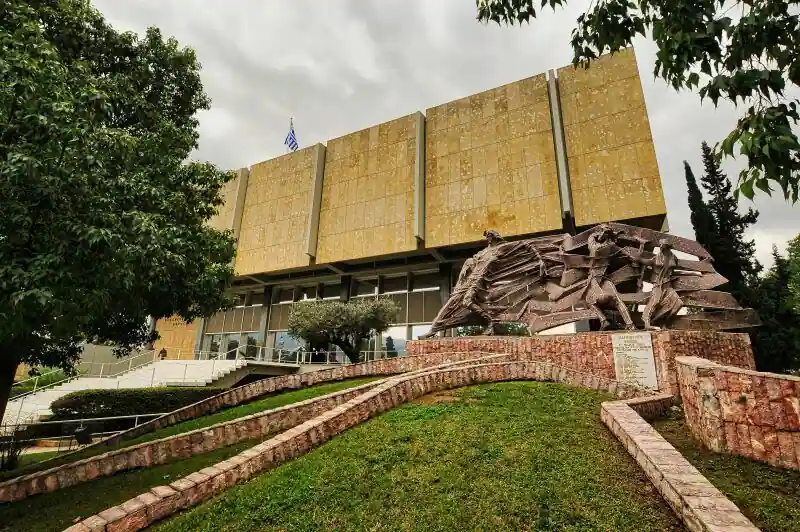
If you walk down Vassilissis Sofias Avenue, as most tourists do in Athens, you probably won’t notice the building I am about to describe. It’s located between the Byzantine Museum and the National Gallery, a short walk from Syntagma Square. From the outside, it’s a fairly angular structure, almost brutalist. Fighter jets and old cannons are parked in the courtyard like sleeping beasts of burden. Tourists march past, heading in all directions but this one. Off they go to the Acropolis, the Plaka, or the postcard-perfect neighborhood of Anafiotika.
But I always take a step when I pass by this building. The War Museum in Athens is not the kind of museum that shouts from a hilltop. It doesn’t have the golden glow of the Archaeological Museum, or the white marble drama of the Acropolis Museum. But what it has is different. It has the story of a small country that spent most of its history struggling to remain alive. And that story, told so quietly here in uniforms and swords and sepia photographs, is one of the most moving experiences in this city.
To walk through the rooms of this military history museum is to hear all of those voices speaking again, all gathered in one place and preserved so the rest of the world can listen to their stories.
I’m going to tell you a little bit about the War Museum of Athens. Not just a list of rooms and a ticket price, but a walk through this place as I see it, as someone who was born in Athens and who feels the city’s history in his bones.
Table of Contents
A museum born between dictatorship and democracy
The War Museum is the official military museum of the Greek Armed Forces and the largest military museum in Greece. The museum is located in the corner of Vassilissis Sofias Avenue and Rizari Street in the Kolonaki district of Athens.
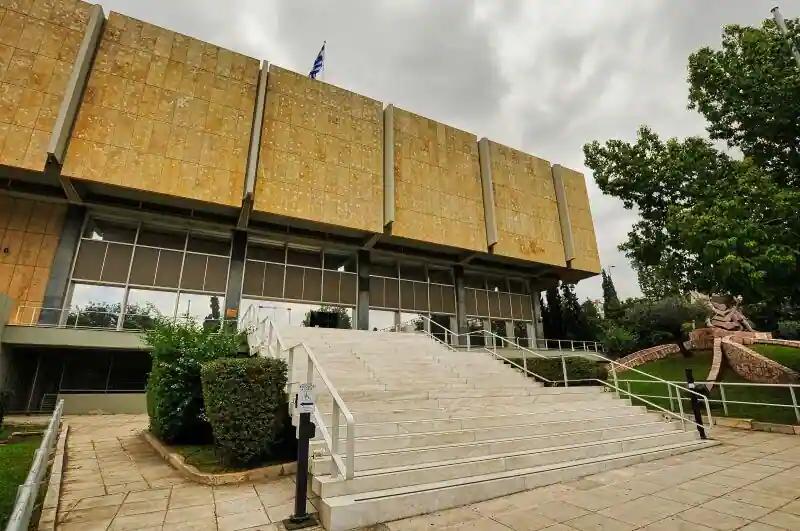
In 1964, the Greek state established the foundations for the construction of a site that would honor those who fell in the fight for the country’s freedom. Architect Thucydides Valentis created a neoclassical building with simple lines and sharp angles. The floors above are wider than the base, which gives the museum an atypical mushroom shape. The museum opened to the public on 18 July 1975, a year after the collapse of the Greek military dictatorship. It was a nation that was beginning to teach itself how to remember without repeating.
The museum’s exhibition spaces occupy four floors and cover the country’s military history from the Neolithic period to the late twentieth century. The core of the initial collection was the Petros Saroglou weapons collection.
Is the War Museum in Athens worth visiting?
Yes, and I say that as someone who has visited many, many times. It isn’t flashy or world-famous, but it fills a niche that most visitors don’t realize is missing.
If you’re coming to Athens, you will, of course, be coming to see the Acropolis and the Ancient Agora. You’ll stroll the streets of the classical past and try to wrap your head around five thousand years of history. But what about all the stuff in between, the centuries of struggle and occupation and revolution and sacrifice that separate the ancient Greeks from the Athens of today? The War Museum is where that history comes alive.
The thing that really hit me the first time was just how personal it all is. Handwritten letters from soldiers. Family photographs ripped apart by war. A wall chart demonstrating that Greece lost 8% of its population during the Second World War. You find yourself standing in front of that, and it’s no longer a number. You see faces.
The other thing is just how uncrowded it is. You don’t need to jostle with the hordes to get a good look at the exhibits. The galleries are quiet enough that you can take your time and really sit with the weight of what you’re looking at.
The collections that carry a country's memory from stone to steel
The exhibits in the War Museum are laid out in approximate chronological order over four floors. The best way to see the museum is to start at the top and work your way down, following the story of Greece from ancient times to the present day. Each room is devoted to a different period and has its own feel. This is what you will see.
From stone tools to bronze swords: The ancient world
Your tour starts at the top of the museum with the oldest artifacts in the collection. Neolithic (about 7000 years old) rock tools are on display in glass cases along with Cycladic stone implements and the bronze weapons of Mycenae. These are not objets d’art. They were made for hunting, for self-defense, for survival.
As you move around the room, the material changes. Stone is replaced by bronze. Bronze by iron. Replicas of the weapons used by the Persians and the Greeks during the 5th century BC fill the cases, and you begin to see how warfare molded the classical world. Copies of the metopes from the Parthenon and the frieze from the Temple of Apollo at Bassae, both showing mythical battles between Lapiths and centaurs, Greeks and Amazons, give you an idea of how a real battle of the time might have looked.
If you’ve already been to the Acropolis or the National Archaeological Museum, these exhibits give you a different perspective on what you saw there. The same civilization but seen through its weapons rather than its temples.
Alexander, Byzantium, and the centuries in between
The next rooms take you through the Hellenistic period and into the Byzantine era. There is a gallery on Alexander the Great, replete with replica weapons used in his campaigns, and a documentary film about his expedition that you can sit and watch. Alexander is a story that every Greek child grows up with, and seeing the paraphernalia of his army spread out before you gives that story tangible heft.
The Byzantine collection follows, with replica weapons and shields, and a model of the Theodosian Walls of Constantinople, the vast fortifications that guarded the capital of the Eastern Roman Empire for more than a millennium. There are also replica shields and arms from the European Middle Ages as they were enacted in the Greek world, including one emblazoned with the emblem of Constantine XI Palaiologos, the final Byzantine emperor who died defending Constantinople in 1453.
The museum section does double duty, connecting two worlds. On the one hand, it links up with the glory of the ancient past. On the other hand, it leads inexorably into the long, dark centuries of medieval occupation. For a country like Greece, those centuries are not footnotes in its history. They are the roots of everything that came after.
The revolution of 1821: When shepherds and monks picked up weapons and changed history
After four hundred years of Ottoman occupation, the Greeks revolted. And the room devoted to the Greek War of Independence is one of the most powerful in the entire museum.
The room is dominated by weapons from the revolution: beautiful swords, rifles, pistols, powder holders, yatagans carried by revolutionaries over the mountains and islands of Greece. There are paintings of famous battles, most of them copies of paintings done by 19th-century Greek painters who captured the events on canvas. You will see Theodoros Kolokotronis, the great military leader, and, just across the room, a painting of the hanging of Patriarch Gregory V at the gates of the Ecumenical Patriarchate in Constantinople. This was an act of Ottoman retaliation that horrified the Christian world.
I think about this every time I walk through this room: how personal all of these objects are. These are not weapons from a military supply catalog. These were made by hand, and every one has a story. Every powder holder was carried by a man who may not have made it home. This was not a war fought by professional soldiers. It was fought by shepherds, monks, merchants, and farmers who decided they would rather die free than live under occupation.
In the corner, there is a small cannon and, surrounding it, safekeeping and relics from all over Greece. Each one was a village, a family, a community that decided to fight. This is the room where modern Greek identity was forged.
The new Greek state and the Macedonian struggle
The young Greek state was a vulnerable country. Exhibits in this room, which run from 1828 to 1911, illustrate attempts to consolidate an effective state and bring additional Greek populations under Greek rule rather than that of the Ottomans.
The revolutions in Crete, Epirus, and Thessaly are all featured here, each an installment in the long march to unification. Weapons, paintings, lithographs, sculptures, and other items tell the story of a state that was still coming into shape. The room then segues into the Macedonian Struggle of 1904-1908, a conflict between Greece and Bulgaria over control of Macedonia and access to the Aegean Sea.
Paintings by Thalia Flora-Karavia, an extraordinary Greek artist, take up most of the space in this part of the museum. She worked as a war correspondent, right on the front lines, and painted what she saw with her own eyes. There is an immediacy to her work that sometimes is missing from photographs of the era.
This is a part of Greek history most foreign visitors will know very little about, but which helps explain a lot about the country's relationship with its northern neighbors, as well as its fierce attachment to the name and identity of Macedonia.
The balkan wars and world war I
The Balkan Wars of 1912-1913 were the moment when Greece finally became the country we recognize on today's map. The exhibits here celebrate the victorious battles and naval engagements that allowed Greece to expand its borders, liberating Thessaloniki, Ioannina, Crete, and the islands of the northern Aegean.
There are small replicas of the first military aircraft used during this period, a reminder that warfare was changing rapidly. The world was entering the age of machines, and Greece was playing catch-up.
World War I follows, with exhibits showing Greece's complicated and divided involvement in the Great War. This is a period that many Greek families still feel strongly about, and the museum presents it with care.
Smyrna, 1922: The wound that Greece never learned to close
Of all the rooms in the War Museum, this is the one that affects me most. The Asia Minor Campaign, the Greco-Turkish War of 1919 to 1922, ended with what Greeks refer to as the Catastrophe of Smyrna. In the span of a few weeks, a Greek civilization that had lived on the coast of Asia Minor for 3,000 years was extinguished, and the people were displaced.
The weapons, medals, uniforms, and personal belongings of the soldiers who took part in that campaign are on display here. There is Major General Nikolaos Trikoupis’s revolver, and General Anastasios Papoulas’s telephone, made from the cartridge of a Turkish cannon they captured. It’s little things like these that are so loaded.
The military defeat was followed by the population exchange of 1923, one of the largest forced migrations in modern times. Over a million Greeks arrived in Greece from Asia Minor as refugees, bringing with them their music and their recipes, their grief and their memories. The neighborhoods of Athens, Thessaloniki, and Piraeus were changed overnight.
World War II: The galleries where words feel too small
This is the largest section of the museum. It opens with the Greek-Italian War of 1940-41, the Mussolini-led invasion through Albania, and the retreat by the much smaller, less equipped, and infinitely more determined Greek army. The battle-cry “OXI” (No), which is still celebrated every October 28th, is the Greek refusal to surrender. Weapons, uniforms, and sketches from the Albanian front reconstruct the cold and heroism of those months.
The German invasion in April 1941, the Metaxas Line defense, the fall of Athens, and the Battle of Crete then follow. Occupation was a disaster. One wall-chart is titled “This is how the conquerors passed through Greece” and displays the bill: 8% of the population killed.
From the Korean front to the shores of Cyprus
The last halls of the museum are dedicated to Greece’s recent military history. One section is dedicated to the Greek Expeditionary Corps that served in the Korean War from 1950 to 1953. A large variety of photographs, videos, personal relics, and artifacts narrate this lesser-known story that is an important chapter of Greece’s participation in the wider Cold War saga.
The Cyprus section follows on, as we trace the island’s history from antiquity to the EOKA struggle for independence, up until the Turkish invasion in 1974. Weapons, photographs, books, art, and works of literature take you through a story that, sadly, remains one without a happy ending even today. The Cyprus issue is one that, for many Greeks, is not so far away. It is personal, it is here, it is close, and it is felt.
The Saroglou collection: Samurai armor, Persian swords, and a lifetime of passion
Downstairs is one of the museum's most idiosyncratic elements: the Petros Saroglou Collection. Saroglou was a Greek army officer and enthusiastic collector. He spent his life amassing thousands of weapons and weapon parts from all over the world.
There are defensive arms and spear weapons from Asia, Africa, and the Pacific, European firearms from the 18th and 19th centuries, a spectacular 14th-century Japanese samurai armor, elaborately decorated 15th-century Persian armor, and an Imperial Russian Guard helmet that looks right out of a movie.
But the most significant pieces in the collection are the weapons of the Greek Revolution: pistols, rifles, yatagans, and swords that were used in the battle for independence. Standing in front of them, you know that this is not ancient history. These are the instruments that built the country you are standing in.
The courtyard where fighter jets sleep under the Athenian sky
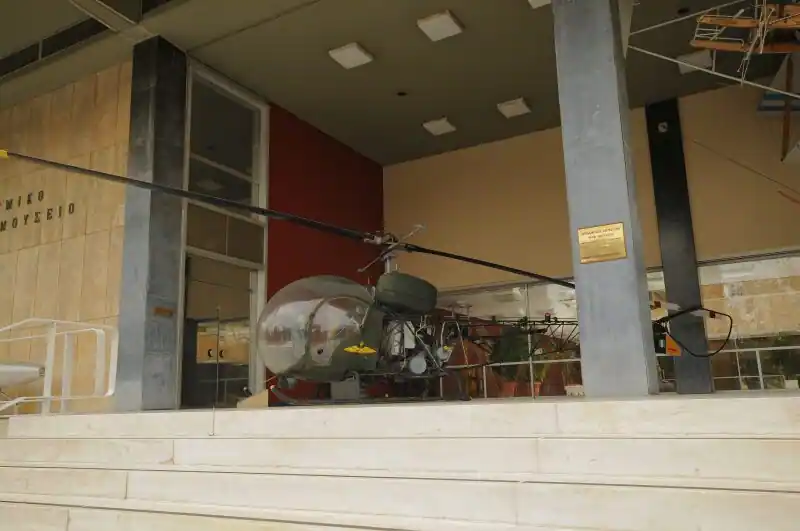
Before you go, or even before you enter the museum, be sure to visit the outdoor exhibition area. Admission is free, and it is among the most eye-catching parts of the museum. There are fighter jets from various periods of the Greek Air Force, including an F-104 Starfighter, an F-84F Thunderstreak, an F-5A, and a Canadair Sabre, as well as cannons, artillery pieces, and field guns that were used by NATO countries throughout the 20th century.
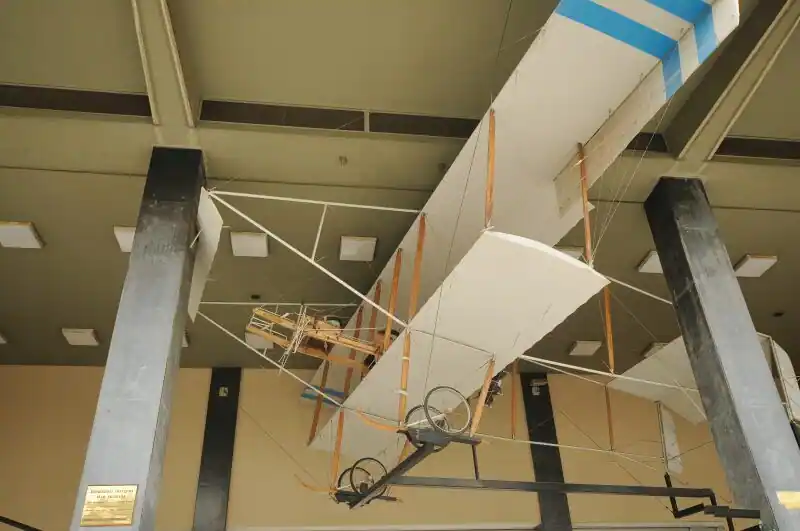
And there is a replica of the Henry Farman III, the first military aircraft of Greece, that somehow looks fragile and otherworldly next to the steel monsters surrounding it. Kids love this area. For some reason that I don't understand, but is impossible to ignore, standing next to a real fighter jet makes history tangible and real in a physical sense, and I have seen kids run between the aircraft with the kind of abandon and excitement that no indoor exhibit has ever matched.

The practical things worth knowing
How much does it cost to enter?
The price is €6 for adults and €3 for students and seniors over the age of 65. Citizens of EU countries under 19 can enter free of charge. There are some dates during the year when it is free.
Opening hours
- Summer (April 1 – October 31): 09:00 – 19:00 (Mon-Sun)
- Winter (November 1 – March 31): 09:00 – 17:00 (Mon-Sun)
Closing Dates
- January 1st
- May 1st
- Orthodox Easter Sunday
- December 25th
How to get there
The museum is located at Vassilissis Sofias Avenue/Rizari 2 in one of the most central and easily accessible areas of Athens. You will know you are in the right place when you see the fighter jets and cannons in the courtyard. It is hard to miss.
By metro: The museum is close to Evangelismos station on Line 3 (the blue line). The walk from the station exit to the museum takes about five minutes. If you are coming from the Acropolis or Monastiraki area, you can take Line 1 to Monastiraki, change to Line 3, and travel one stop to Evangelismos.
On foot: The walk from Syntagma Square to the museum takes about 15 minutes and goes east along Vassilissis Sofias Avenue. The walk is not just about getting there, but a nice one in itself, as it takes you through the National Garden and past the Hellenic Parliament.
By bus or trolleybus: The Rigillis bus stop is closest to the museum and is served by several bus and trolleybus lines. Current bus and trolleybus routes and timetables can be found on the OASA website.
How long do you need to visit it?
Allow at least two hours. Three if you want to read everything and watch the documentary films. Begin at the top floor and follow the narrative down. There's no hurry here, and the quiet galleries allow you to linger.
Photography rules
Photography is permitted in most of the museum, but there may be some rooms where flash photography is not allowed. Keep an eye out for signs in each room, or ask the staff. There are no restrictions on the outdoor exhibits, which are also very photogenic.
Is there a cafe or restaurant?
There is a café in a building attached to the museum, but it's not always open. I would suggest just getting a coffee in Kolonaki after your visit, which has some of the best cafés in Athens.
Is the museum good for kids?
Yes, and they love it more than you'd think. The outdoor planes and cannons are cool for all ages. Inside, the VR in certain exhibits is kind of a cool interactive bonus, and the documentary videos are very visual and short. The dioramas are well done and a great way to illustrate a point for kids too young to read the placards.
Overall, it is a good rainy-day family activity in Athens. The changing of the guard at the Hellenic Parliament is right across the street (5-10 minutes walk), and it's a pretty cool ceremony that the kids really love as well.
Contact info
- Address: 2, Rizari Street, & Vass. Sofias Avenue, Rigilis
- Phone: + 30 210 725 2974
- Email: info@warmuseum.gr
- Official Web site
What is near the War museum, and how to make a full day of it
The Byzantine and Christian Museum is right next door, separated from the War Museum by little more than a garden wall. It covers a completely different chapter of Greek history, the Byzantine centuries, and the rich tradition of Orthodox Christian art, and a visit to both in the same morning or afternoon gives you a remarkably complete picture of Greek culture from antiquity to the modern age.
A short walk further along the avenue will bring you to the Museum of Cycladic Art with its haunting collection of prehistoric figurines from the Aegean islands, and the Benaki Museum, one of the most loved cultural institutions in Athens.
The National Gallery of Greece is also just 350 meters from the War Museum, housing an outstanding collection of Greek painting and sculpture from the post-Byzantine period through the 20th century.
If you need something quieter after the intensity of the War Museum, the National Garden is just a few minutes' walk to the west. A beautiful, shaded space in the middle of the city where you can sit on a bench, let the children play, and process what you have just seen.
What visitors want to know
Does the war museum have a gift shop?
Yes, there is a gift shop on the ground floor, close to the entrance. It has books on Greek military history, postcards, replica medals, and other souvenirs. It's small, but well-stocked.
Is the war museum wheelchair accessible?
Yes, the museum is wheelchair accessible. It has elevators, and the galleries are spacious and easy to navigate if you have reduced mobility. The outdoor areas are accessible too.
Does the museum offer guided tours?
Guided tours are available at the museum, but you need to pre-book them by phone. A self-guided visit is probably best for most people, as the permanent collection is laid out chronologically and the descriptions are in both Greek and English.
Does the war museum cover the Greek Civil War?
A question that comes up often is whether the museum covers the Greek Civil War (1946-1949), and the answer is no. It is one of the great taboos of recent Greek history, and isn't covered in the museum's permanent collection. If you want to learn more about that conflict, the Political Exile Museum in Athens offers a different perspective on the Greek Civil War.
The rooms that stay with you after you leave
I have been to the War Museum many times. As a child, I was dragged along on a school trip. As a teenager, I was bored and restless. As an adult, I was finally old enough to understand what I was looking at.
The last time I went was on a quiet autumn afternoon. I stood in front of the WWII photographs for a long time, looking at faces I did not know but somehow recognized. Old women in black. Children in rubble. Soldiers too young to be holding rifles.
There is a particular sadness that comes from walking through a place like this in the city where you were born. These stories happened here. On these streets.
If you come to Athens, find time for this place. After you walk through these rooms, the streets will feel different. The cafe's warmer. The sunsets more precious. Because you will know what it took to keep them.