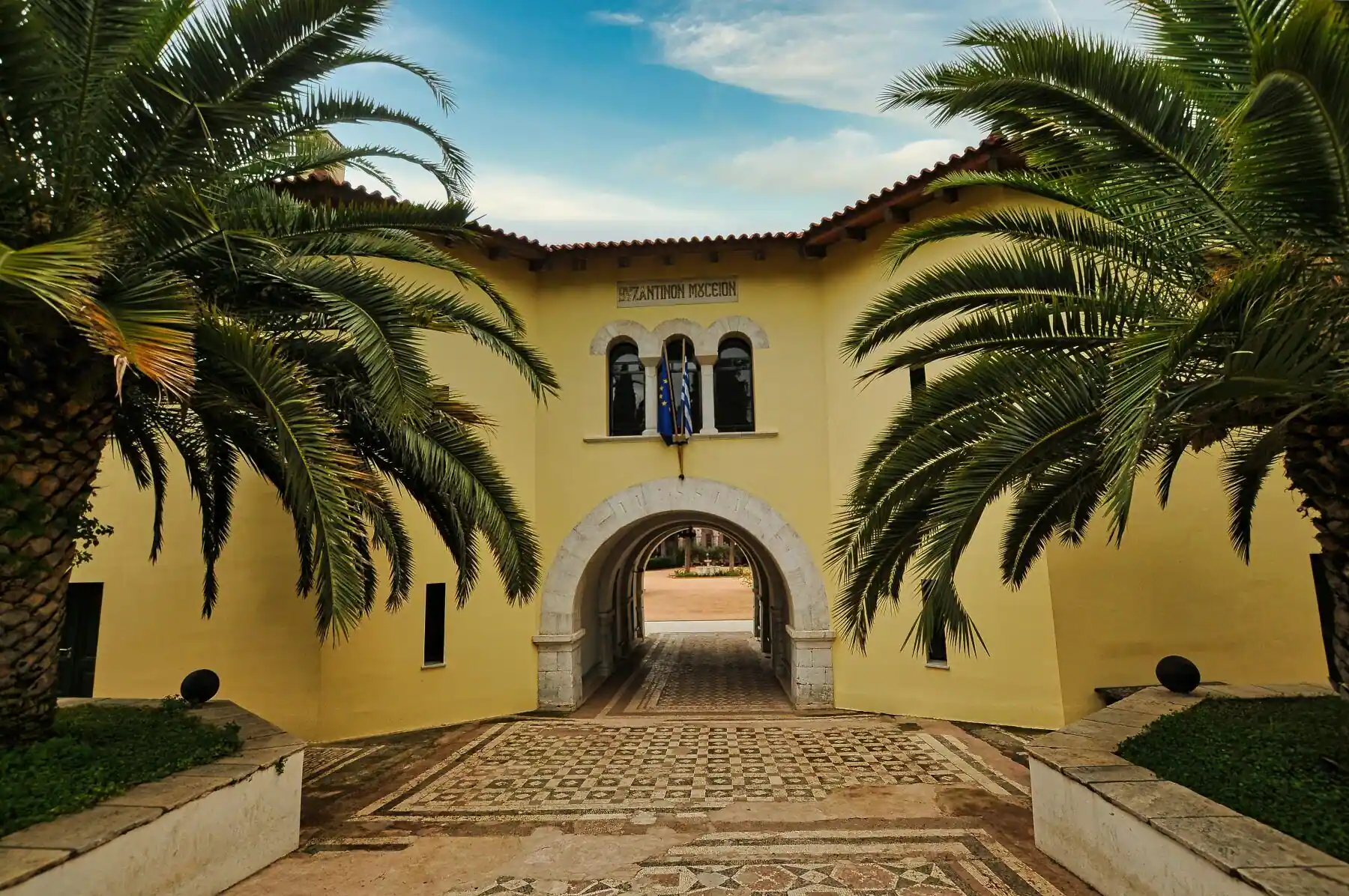
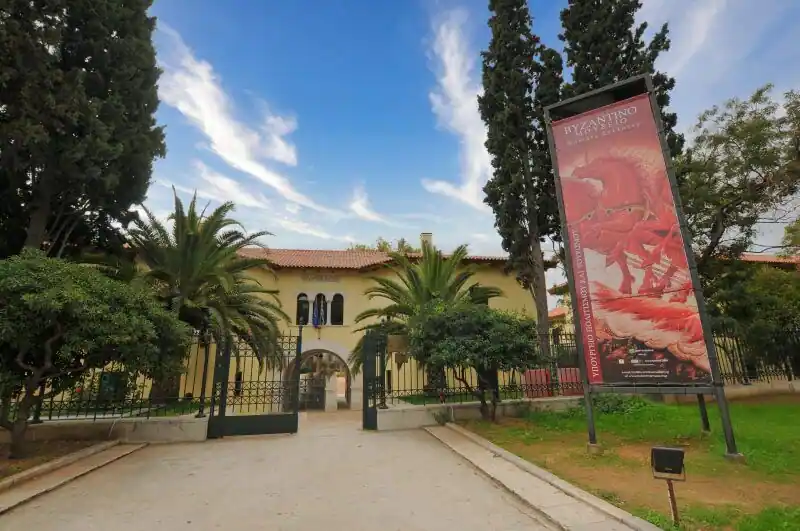
In the heart of central Athens, there is a museum of a thousand years of faith, gold, and silence. It is behind a wrought-iron gate on Vassilissis Sofias Avenue, half-hidden by trees, and the roar of traffic outside. Most tourists will walk past it on their way to Syntagma Square. And that is a shame. The Byzantine and Christian Museum in Athens is one of the most beautiful, peaceful, and underrated places in this city.
I have lived in Athens my whole life. I thought I knew every corner of it. But the first time I walked into the courtyard of the Byzantine Christian Museum, I realized there was a whole chapter I had been ignoring. Not the ancient chapter. Not the neoclassical one. The Byzantine chapter. The one painted in gold and written in prayer.
This is a complete guide to the museum, its collection, the story of the building itself, and how to plan your visit. I will also share the other places in Athens where the Byzantine world still breathes, from medieval churches tucked between apartment blocks to collections of sacred art that glow in the half-light.
Table of Contents
Is the Byzantine Museum worth visiting? The answer lives in the silence of the first room
Yes. Without a doubt. This is not because it has a huge collection, or because the building is stunning. It’s because this museum provides an experience that you can find at so few places in Athens. It provides stillness.
Athens is a noisy city. It is vibrant, chaotic, loud, and bright. The Acropolis is spectacular, but it is always crowded. Monastiraki’s streets teem with energy. Even the big National Archaeological Museum is a bit much sometimes with its enormity. But the Byzantine and Christian Museum is different. It is a place where time seems to slow. The rooms are cool and quiet, and the golden faces of the icons look at you with a peacefulness that has endured for centuries.
This may be the kind of museum that you pass by if you are only here to check off the main sights. But if you are the kind of traveler who wants to linger and absorb, who wants to feel a place instead of just photograph it, this museum will stay with you long after you leave Athens.
It also houses one of the most significant collections of Byzantine art in the world. This is no small thing. The Byzantine Empire influenced the culture, the faith, and the very identity of Greece for more than a thousand years. You can’t really understand this country without understanding that era. And this is the place where all of this comes together.
For me, the Byzantine Christian Museum is one of the five best cultural spaces in Athens. It is a must for the thoughtful traveler, right up there with the Acropolis Museum and the other great archaeological collections.
What to see at the Byzantine Museum: A walk through centuries of sacred beauty
The permanent exhibition contains over 25,000 objects and spans a period from the 3rd century to the 20th. It is a staggering sweep of time. You can spend hours and hours in the museum and never see it all. But I am going to guide you through my personal favorites. The works and the rooms that I find myself visiting again and again, and the pieces that seem to most deeply affect people.
From the ancient world to Byzantium
The journey through the museum begins underground in the modern wing that was added in the early 2000’s. The first section of the permanent collection tells the long and slow, but utterly fascinating, transition from the world of the ancient Greeks and Romans into the new world of Christianity. You see here the way that pagan and Christian beliefs existed side by side for centuries and how old temples were gradually transformed, and a new visual language began to emerge.
One of the pieces that you will see here that I think is just striking is a marble stele from the 4th or 5th century that depicts the figure of Orpheus playing his lyre surrounded by animals. It is a work that, to me, beautifully straddles the old world and the new. Orpheus, of course, is a figure from Greek mythology, but he was also adopted early on by Christians as a symbol of Christ. Standing in front of this piece, you can almost feel that transition in the air, not so much as a break but more like a slow turning of the page.
In this section, you will also see a reconstruction of a 5th-century Christian basilica with its carved marble columns and fragments of its mosaic floors. This gives you a real sense of what early Christian spaces for worship looked like, which is something that is hard to imagine from ruins alone.
The heart of the museum, and the heart of an empire
This is the museum’s heart, and for me, this is where the magic really resides. Here in the galleries are icons, frescoes, mosaics, and sacred objects from the Byzantine Empire at its height. The light is low and warm, and the gold on the icons seems to glow from within.
Byzantine painters used gold to depict divine light, the light of heaven breaking through into the material world. As you stand in front of them in these quiet rooms, you begin to see why. Watch for a rare 13th-century mosaic icon of the Virgin Mary, which originally came from Constantinople. It is one of just about 40 mosaic icons that are known to have survived from the Byzantine period. The tiny coloured stones create a face of such sweetness that it is hard to believe that it was made 800 years ago.
There are also fragments of wall paintings rescued from churches all over Greece. Some are mounted on floating panels so that you can walk around them and see the brushwork close up. Faces of saints, scenes from the life of Christ, patterns of deep blue and faded red. Each one of them was once part of a little village church in the Greek countryside, and now they live here, preserved and protected.
After the fall: How faith survived the end of an empire
The second main gallery is devoted to the centuries after 1453, the fall of Constantinople, through the Ottoman occupation and into the modern Greek state. It's a period of Greek history that most of my visitors have heard little about, and the museum presents it beautifully.
You can see the continuation and development of Byzantine artistic traditions, despite the pressures of Ottoman occupation. Icon painters like Emmanuel Tzanes and Emmanuel Lambardos maintained the older traditions even as they were absorbing new influences from the Italian Renaissance, which reached Greece especially strongly in Crete, which remained under Venetian control for much of this period.
The post-Byzantine icons here are some of the finest I have seen in any collection. There is a sadness and strength to them that somehow seems to reflect the people who made them, keeping their faith and their identities strong through centuries of change.
Before you leave, let the garden hold you a little longer
Don’t bypass the gardens. Many pilgrims see them as a quick route to the front door and bypass what is in effect a small open-air museum in its own right. The Byzantine Museum’s grounds are shaded by fruit trees and scented by aromatic herbs.
There are fountains, stone benches, and three small themed exhibitions dotted around the lower garden. One explains the water supply in Athens from antiquity to today, around an old well-cistern cut into the rock. Another exhibition interprets the Byzantine concept of Paradise. A third exhibition tells the story of the Ilissos River that once flowed right by this point in the city. Nowadays, it is invisible, buried under the streets and sidewalks of modern Athens.
The museum also has early Christian tombs, which were found in other parts of Athens and re-erected here. Some are still inscribed with carved symbols: the fish (the ancient Christian code for Christ) and the simple cross. These are small, modest graves, but they are among the oldest surviving material evidence of Christianity in Athens.
After your visit, rest at the Ilissia Café in the garden courtyard. Order a Greek coffee, look up at the villa, and allow what you have seen to settle. There is no rush. The Byzantine world has waited this long. It can wait a little longer.
Villa Ilissia: A Florentine villa in the middle of a Greek city
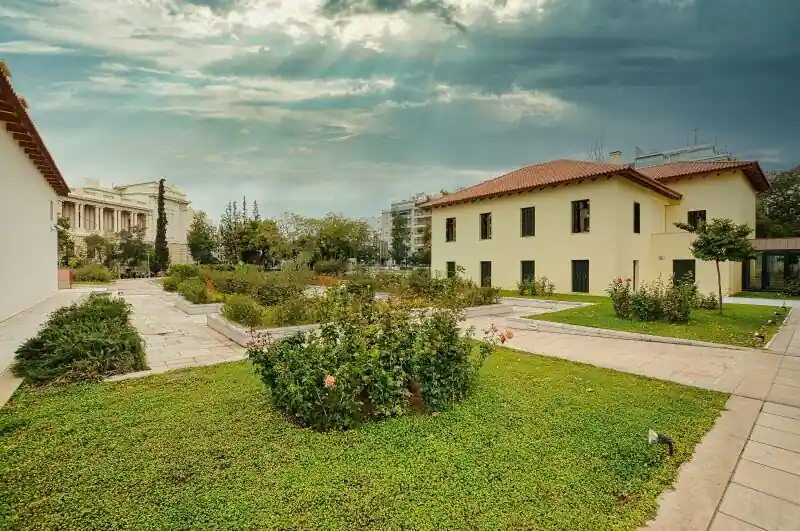
Articles on the Byzantine Christian Museum tend to concentrate on the collection housed in the building. The building itself is, however, of interest, and I think it does something to enrich the experience of the visitor. This is Villa Ilissia, one of the most attractive buildings in Athens, and one of the very few that remain of its type. It was built between 1840 and 1848, to a design by the architect Stamatios Kleanthis, in the Florentine Renaissance style, with elements of the neoclassical also present. It is a complete departure from the rest of Athens. With its arcaded loggias, its warm stone walls, and its courtyard, which is more Tuscan monastery than Greek museum, it is from another world.
Sophie de Marbois-Lebrun: The woman behind the villa
Villa Ilissia was the winter home of Sophie de Marbois-Lebrun, Duchess of Plaisance. Here is a tale of the forgotten details that make this city so endlessly fascinating.
Sophie was born in Philadelphia, Pennsylvania, in 1785 to a French diplomat and the daughter of the Governor of Pennsylvania. She married into French nobility and might have lived comfortably in Paris. Instead, she developed a passion for Greece. In 1830, during the Greek War of Independence, she and her daughter arrived in Nafplio, the first capital of the new Greek state. A year later, she began to acquire property in Athens.
The death of her daughter in 1837 set her on a path of building. Villa Ilissia was the crowning jewel, a place of serene beauty on the banks of the Ilissos River, which at that time still flowed openly through the city. She lived there until her death in 1854.
The building then passed to the Greek state. It served at various times as a military academy and the seat of various government offices. In 1926, it was given over to house the Byzantine and Christian Museum, and it has remained so ever since.
A house built by dreamers, now filled with centuries
Walk around the Villa Ilissia’s courtyard, with its stone archways, and through its garden full of birdsong and shade, and it’s possible to understand a bit of what Athens must have been like in the 1840s and 1850s. Small and newly independent, with a population of dreamers from across Europe who were united in their belief in Greece as an idea, Athina Onassis Kalergis, aka Sophie de Marbois-Lebrun, came here. She invested her money and her energy and ultimately her life. Villa Ilissia is her legacy. It’s a beautiful one.
The museum got a big facelift in the early 2000s, when the subterranean modern wing was built and now houses most of the permanent collection. But the original villa remains at the center of the complex, and sets the tone. There is a gentleness to this place that begins with the building itself.
Planning your visit: Everything you need to know
How much does it cost to enter?
The general admission is 8 euros. Admission is free for children under 5. Free admission also applies to all under 18 and EU citizens under 25 with a valid ID/passport. There are some dates throughout the year when the museum offers free entry.
Opening hours
- Monday: 08:30-15:30
- Tuesday: closed
- Wednesday-Sunday: 08:30-15:30
Closing Dates
- January 1st
- March 25th
- May 1st
- Orthodox Easter Sunday
- December 25th & 26th
How to get there
The easiest way to get to the museum is by metro. Take Line 3 (blue line) to Evangelismos station. It is a five-minute walk from the station, along Vassilissis Sofias Avenue. The iron gate and the garden wall are on your right.
If you are arriving from Piraeus cruise port, take Metro Line 1 to Monastiraki and then transfer to Line 3 and ride one stop to Evangelismos.
The hop-on hop-off bus also stops near the museum, at Benaki Museum station, which is next to the Byzantine Museum entrance.
If you are walking from Syntagma Square, it is about a 15-minute walk along Vassilissis Sofias, and the walk itself is very nice, passing through one of the more elegant areas of central Athens near the Kolonaki neighborhood.
How long do you need to visit it?
I would allow two hours as a comfortable minimum for the permanent collection. If you are the sort of person who reads every label and studies every icon at close range (and here you will want to do both), allow three hours. Add 30 minutes for the gardens and the outdoor exhibits, and time for a coffee in the garden café if you want to imbibe the ambiance.
If you are pressed for time, concentrate on the underground galleries of the permanent exhibition and the mosaic icons. These are the objects that are hardest to find elsewhere in the world.
Photography rules
Photography without flash with handheld cameras and smartphones is permitted in the permanent exhibition. The use of professional equipment such as tripods or video cameras requires special permission from the museum.
Is there a cafe or restaurant?
Yes. The Ilissia Café-Restaurant is set in the garden courtyard, in the shade of Villa Ilissia. It's a pleasant spot to have a coffee or light meal after your visit. The garden itself, with its fruit trees and stone arches, is one of the more tranquil places to sit in central Athens.
Contact info
- Address:22 Vas. Sofias Ave., 106 75 Athens
- Phone: + 30 210 213 213 9517
- Email: info.bma@culture.gr
- Official Web site
Byzantine churches in Athens: Traces of a forgotten empire
Athens is a city of ancient ruins. The Parthenon, the Roman Agora, the Temple of Zeus. These are the city’s most famous monuments, but nestled between the old and the new, hidden in plain sight between the columns and the concrete, is an entire layer of the city that most visitors will overlook. The Byzantine layer.
In the 11th and 12th centuries, Athens experienced a renaissance. All over the city, new churches were built. Many of them are small and elegant, clad in elaborate brickwork and topped with the unmistakable Athenian dome, an octagonal red-tiled dome that you can still see in a thousand attics if you know where to look.
These are some of my favorite Byzantine churches in Athens, each one a quiet witness to a thousand years of faith.
Panagia Kapnikarea: The church that refused to disappear from Ermou Street
This small church stands in the middle of Ermou Street, Athens' main shopping thoroughfare. Constructed around 1050 over the remains of an ancient temple, it is one of the oldest churches in Athens. Daily hordes of shoppers pass it by, but if you enter the church, the din of the street is left behind.
It contains icons by Fotis Kontoglou, one of Greece's greatest modern hagiographers. It is an archetypal example of the cross-in-square type that is the hallmark of Athenian Byzantine architecture.
Agii Apostoli: A Byzantine prayer in the middle of ancient ruins
The church inside the Ancient Agora, this 11th-century church was the only medieval building to have survived archaeological excavations in the area. The building was restored to its original floor plan in 1954, and it is home to frescoes dating from the 17th century.
Standing here in the middle of the ruins of the ancient marketplace, you can feel the layers of Athens on top of each other as each generation paves over the bones of its predecessors.
Panagia Gorgoepikoos: The smallest church with the longest memory
Hard to find, this diminutive 12th-century church is hidden next to the imposing Athens Cathedral in Syntagma. But don't miss it - pop inside to see the walls of this church. They are a collage of carved marble reliefs from ancient and early Christian structures, symbols from various centuries past. This is one of the most photographed churches in Athens, and for good reason.
Sotira Lykodimou: Where Byzantine walls hold Russian prayers
The Russian Church, on Fillellinon Street, a short walk from Syntagma Square, is one of the most unexpected Byzantine buildings in Athens. Built in the 11th century, it is a typical middle Byzantine church, and the largest surviving medieval church in the city.
It was purchased and restored by the Russian government in the 1850s for the city's Russian Orthodox population. The wide, domed interior is atmospheric, with a mix of Greek and Russian styles in the iconostasis. Most visitors hurry past, and it is usually very quiet. It's one of those little hidden corners of Athens that make one's day whenever they're discovered.
Daphni Monastery: The UNESCO treasure hiding at the edge of Athens
15km west of the city center is another UNESCO World Heritage Site: the Monastery of Daphni. Considered one of the best preserved and most impressive examples of middle Byzantine architecture in the country, its golden mosaics – particularly the famous Christ Pantocrator on the dome – are among the finest works of medieval art in Europe.
Museums near Syntagma Square: A walk through centuries along one avenue
The Byzantine Museum lies in one of the richest museum corridors in Athens. When you are staying near Syntagma Square, you can visit several world-class collections on foot, without the need for a taxi or metro.
Right next door is the War Museum, chronicling Greek military history from ancient battles to the modern era. A few minutes along the avenue, the Museum of Cycladic Art contains an unparalleled collection of 5,000-year-old marble figurines, and just across the street from it, the Benaki Museum traces the entire sweep of Greek culture under one roof.
Even closer to Syntagma, the National History Museum tells the story of modern Greece from the fall of Constantinople to the 20th century. A short metro ride or 20-minute walk south leads to the Acropolis Museum, the most visited museum in Athens, and a little further north, the National Archaeological Museum has the largest ancient collection in the country.
All of these are within easy reach of the Byzantine collection. That is one of the best things about Athens for culture lovers: so much is concentrated in a small area, layered on top of itself, just like the city's own history.
Everything else you might want to know
Is the Byzantine Museum good for kids?
It's a peaceful, quiet museum, which will appeal more to older kids interested in history or art. Younger ones may enjoy wandering around the museum gardens (a pleasant, open space) and the thematic outdoor exhibits (the well-cistern, the tombs), which can feel like a bit of a little adventure.
What is the closest metro station?
Evangelismos station on Metro Line 3 (blue line). It's about a five-minute walk from the station along Vassilissis Sofias Avenue.
Can you combine it with other museums nearby?
Yes, and I'd recommend it. The War Museum is next door, the Museum of Cycladic Art and the Benaki Museum are about a five-minute walk away.
Does it have a gift shop?
Yes. There's a small museum shop near the entrance. It's well-stocked with books about Byzantine art and history, reproduction icons, postcards, and other souvenirs. It's nicely curated and worth a browse if you're looking for something a little more meaningful than the usual tourist shop plastic stuff.
Is there wheelchair access at the Byzantine museum?
Yes, the museum is accessible to visitors with mobility needs. There are lifts in the modern underground wing, and the main exhibition spaces are wheelchair-friendly. Garden paths are generally flat, although some with gravel or uneven stone might be difficult to navigate.
Can I visit the museum's garden without a ticket?
The garden and the courtyard area are occasionally accessible without admission to the exhibition itself (this varies by day and with who is manning the entrance). If you only want to see the outside exhibits and tombs and are planning to have coffee at the café, it is worth inquiring at the gate.
When is the best time of day to visit the Museum?
Mornings are best in my opinion, and even better if it is a weekday. The light is soft and warm in the courtyard area, the galleries are near empty, and you can take your time with the icons without anyone behind you jostling to see the next one. Late afternoon is also nice, especially in summer when the garden is filled with long shadows and the heat of the day has begun to cool. Avoid arriving in the last hour before closing, as some rooms may close early.
A quiet place in a loud city, and why it matters
I’ll never forget a moment I had at the Byzantine Museum. Standing in one of the underground galleries, I was alone, in front of a row of icons. The room was empty and quiet. The faces of the saints and holy figures on the wooden panels, rendered in gold and deep red, stared back at me with what can only be called patience. Centuries old, they have been waiting for this moment. Waiting to be seen, understood, and felt.
That is what this museum gives. Not just artifacts behind glass, but a key to a part of Greek history that many travelers completely overlook. The Byzantine era is not as well-known as the ancient one. It does not have a Parthenon or marble statues that fill postcards. But it does have something else: an unearthly, quiet glow, asking for nothing more of you than your attention.
Give this museum an afternoon when you come to Athens, and I think you will feel like you have discovered something that has always been there, hidden in plain sight, waiting for you to notice.