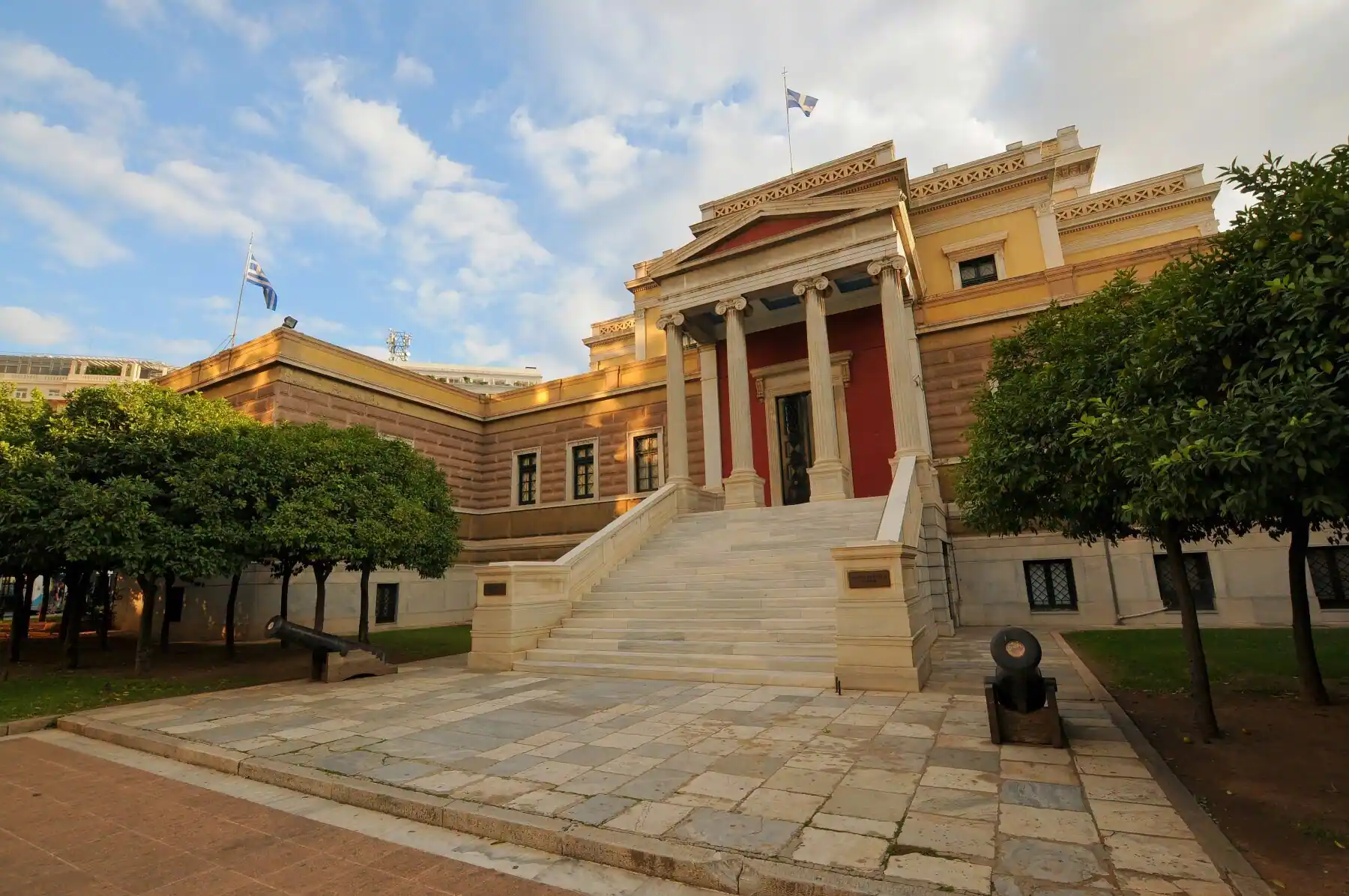
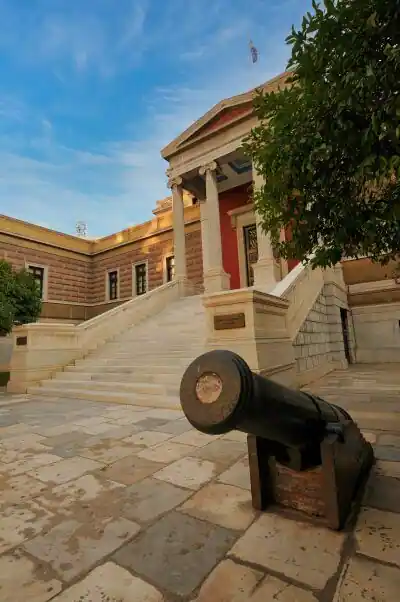
There is a building on Stadiou Street that most visitors never give a second glance. It sits inconspicuously between the Syntagma fuss and the Omonia madness with an old bronze horseman at the entrance. No tour groups. No selfie sticks. Just a neoclassical facade, two 1821 cannons, and the kind of silence that weighs heavily.
The National Historical Museum in Athens is not a museum for postcards. You will not find marble gods here or golden Mycenae masks. What you will find is something different. Something that goes closer to the bone. This is where modern Greece tells its own story. Not the ancient one that the world already knows, but the newer, harder, more human one. The one about revolution and sacrifice, about a small nation that fought to exist, and the people whose names now live on every street sign in this city.
I have lived in Athens my whole life. I have walked past this building hundreds of times. But the first time I actually walked in, something shifted. Because inside the Old Parliament Building, in the very rooms where Greek democracy found its first voice, I found the faces of the people who made this country possible. And I have gone back many times since.
Table of Contents
National Historical Museum: A museum born from the ashes of revolution
The National Historical Museum is Greece’s first historical museum. It was established in 1882 by the Historical and Ethnological Society of Greece, which began collecting items and personal belongings from the families of revolution fighters just a few decades after the Greek War of Independence.
The museum tells the story of modern Greece from the Fall of Constantinople in 1453 to the Greco-Italian War of 1940. The permanent exhibition is housed in the rooms and corridors of the Old Parliament Building on Kolokotronis Square, in central Athens. Paintings, weapons, flags, personal belongings, traditional costumes, manuscripts, and historical documents lead the visitor along the long and difficult path from Ottoman rule to the establishment of an independent Greek state.
This is not an ancient history museum. It is a museum about the Greece of today, and the centuries of struggle that made it possible.
The building that was a palace, a parliament, and a promise
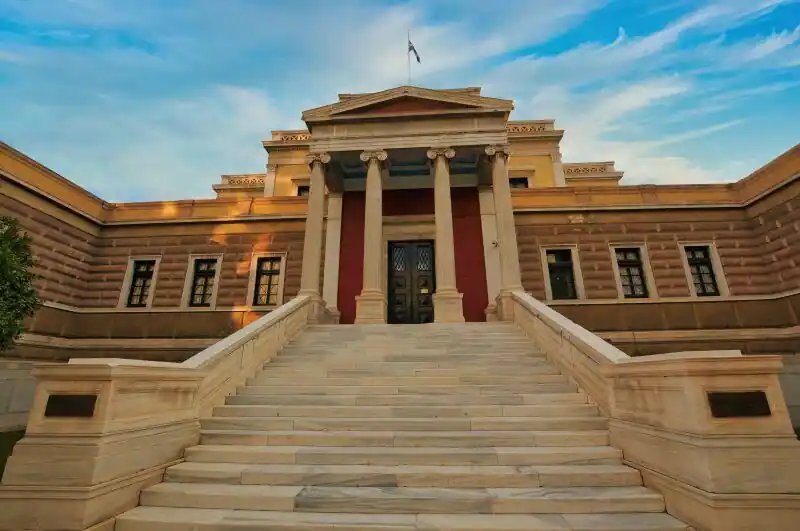
This is the part of the story many of you are going to miss. It might be the most important part of the whole story. The building is not a mere vessel for history. It is history. Every wall, every corridor, every stone step here has a memory of something that happened here. Before a single display case had been brought into this building, this building had lived more lives than most.
A mansion, a king, and a fire that erased it all
Queen Amalia provided the answer to that question. In 1858, she laid the cornerstone for a new building on the same site, designed by the French architect François Boulanger. The ambition was to build a neoclassical palace to house Parliament and the Senate, and to give the young Greek state a home befitting its ideals and hopes.
As usual, ambition and money went hand-in-hand. The funds were exhausted almost immediately, and construction was halted in 1859. The half-built skeleton of the building remained silent for years, like so much else in Greece, waiting for the moment when things could begin again.
A building reborn after a king was gone
When that moment finally came in 1862, with the ousting of King Otto, the old plans had to be revised. The Senate had been abolished, so the original plan of the architect Boulanger no longer made sense. The project was taken over by the architect Panagiotis Kalkos; Boulanger's plans were revised (the Senate amphitheater was removed), and construction was restarted.
By 1871, construction was finished, and the building was officially opened on 11 August 1875 as the seat of the Greek Parliament. Prime Minister Charilaos Trikoupis presided over the ceremony. For the first time, the elected representatives of Greece had a permanent home.
Arguments, votes, and one murder on the steps
For the next sixty years, this building was the political heart of Greece. Laws were written, governments were toppled, constitutions were argued over, and the fate of a young nation was decided one vote at a time. It was not always dignified. Greek politics has never been known for its quiet. But it was real. It was here.
It was also here that tragedy struck. On June 13, 1905, Prime Minister Theodoros Deligiannis was stabbed on the steps of this very building by Antonios Gherakaris, a professional gambler who was unhappy with the prime minister’s recent crackdown on gambling houses. Deligiannis died from his injuries. The marble steps still bear the stains of that day. If you stand outside the museum today, you are standing where a leader of this country breathed his last breath.
The day Parliament moved, a museum was promised
In 1935, Parliament moved to its current building in the Old Royal Palace on Syntagma Square, and the building in Stadiou Street stood empty for the first time in sixty years. The building was ceded to the Ministry of Justice, and it seemed as if that was the end of the story.
Not so, according to Eleftherios Venizelos, one of the most influential political leaders in modern Greek history. By his decision, the building was given to the Historical and Ethnological Society of Greece to house the National Historical Museum. The intervening war held up progress.
On the eve of the Second World War, the Society's collections were transferred and hidden in the basement of the Polytechnic and in private apartments around Athens, a discreet but spirited act of protection in those dangerous years.
After the war, the collections were temporarily located in a rented space on Queen Amalia Street until a permanent location was found. In 1960, the Society occupied the Old Parliament. The building was restored, the rooms were prepared, and the museum was finally opened to the public in 1962.
Where democracy and memory share the same rooms
So as you enter this museum, you are not entering a neutral space. You are standing in the very room where Greek democracy grew up. The walls remember the speeches, the arguments, the votes that shaped a nation. And now those same walls hold the swords and flags and portraits of the people who made that nation possible in the first place.
Revolution fighters and parliamentarians share the same corridors, separated only by time. It is a beautiful kind of logic. The people who won the freedom, and the people who tried to figure out what to do with it, all under one roof.
What awaits you inside the National Historical Museum?
The permanent exhibition is displayed in chronological order throughout the building's rooms and corridors. You go through time as you go through space, and by the end, you have covered almost five hundred years of Greek history.
The fall of Byzantium and the long centuries of foreign rule
The visit starts in the first corridors. These rooms are where the story of modern Greek identity begins. Constantinople fell in 1453. That was the end of an empire that had endured for more than a thousand years. The people who survived it, however, did not allow their identity to be extinguished.
In these rooms, there are maps and manuscripts, and portraits of Greeks who maintained their language and culture under Ottoman and Latin rule. Here are the Phanariots: the wealthy Greek families of Constantinople, who served in the Ottoman state. Here are Greek scholars who fled to the West, taking their learning with them across borders. You see here how language, Orthodox faith, and the obstinate act of remembering kept a scattered people together for four hundred years.
The rooms are quiet, almost meditative. They do not shout. They show you what patience looks like when it extends through generations. Through clandestine schools, through monasteries, through songs passed down from grandparents to grandchildren, Greek identity endured centuries of foreign rule. That persistence is the foundation on which everything else in this museum is built. Because what comes next, the revolution, only makes sense if you understand how long the waiting was.
1821: The year the silence broke
This is the core of the museum. Rooms 4-9 are devoted to the Greek War of Independence and house the most emotionally charged part of the collection.
Weapons and other effects of the men and women who fought for their freedom are on display. Revolutionary flags, some bloodstained, others in tatters. Breastplates. Swords and flintlock pistols. The faces of the revolution leaders look down at you from oil portraits. Faces you have seen your whole life on street signs, but somehow never like this. They are real to you in a way they never were before.
The most famous artifacts belong to Theodoros Kolokotronis: his breastplate, pistols, leather weapons belt, and British helmet from Zakynthos. On one wall is a reproduction of Delacroix’s The Massacre at Chios. A corner is devoted to the philhellenes, of course, including Lord Byron, who died at Missolonghi in 1824.
I will be candid. These rooms are not places you speed through. Each object has a name attached to it, a person who carried it, who believed in something enough to risk all. I have stopped in front of some of these cases more than once with a feeling I can only call gratitude.
What do you do with freedom once you have it?
Post-revolution, the museum takes you through the more trying years of statehood. Rooms 10 to 14 are dedicated to the reigns of King Otto and King George I, the first two monarchs of independent Greece.
You’ll see the throne that both sat on, the personal office of King George I, and costumes worn by the ladies in waiting of Queen Olga. There are exhibits from the Balkan Wars and the territorial expansion of Greece in the early 20th century. Medals and official documents in beautifully written script, the work of a young nation still desperately trying to look and feel like it belonged among the countries of Europe.
If the revolution galleries felt chaotic and something of an oddity to Greek life, these rooms feel more like real Greece, formal, a bit political. Here is the country you recognize beginning to form. Uniforms, state ceremonies, constitutional debates, the slow grind of government. A throne that two kings shared. A constitution was argued over and rewritten.
It’s less dramatic than the revolution, of course, but in its own way just as important. Winning freedom is one thing. Building a country from that, with laws and institutions and borders that other nations respect, is something else entirely. That quieter, harder work begins here.
Traditional costumes and folk art
Rooms 15 to 17 contain one of the museum’s most aesthetically arresting collections: folk art. Here are traditional Greek costumes from various parts of the country, dating from the mid-18th to the late 19th century. Wedding dresses, day-to-day wear, children’s clothes, festive dress. The fabrics are sumptuous, richly embroidered with designs that whisper of Byzantium, and even older things. Adorning the costumes are handmade pieces of jewelry, household objects, woven textiles, and other decorative items from everyday life.
The costume of a woman from the Peloponnese looks nothing like that of a woman from Macedonia or the islands. The materials change, the embroidery changes. And yet something unites them all, a common sense of beauty and care that is inarguably Greek.
Above all, this collection reminds you that history is not only made by generals and kings. It is also made by the women who wove these fabrics, the families who passed them down, the hands that shaped the silver and stitched the thread. A child’s vest, lovingly stitched by a mother’s hands. These are not the possessions of famous people. They are the possessions of everyone, and that is what makes them worth seeing.
The wars that shaped the Greece we know
The last rooms are dedicated to the most tragic pages of recent Greek history. Artifacts from the Asia Minor Campaign and the Greco-Turkish War, which ended with the catastrophe of 1922 and the enormous population exchange that transformed Greek society forever.
Whole neighborhoods in Athens, Piraeus, and Thessaloniki were built by families who arrived with nothing but their memories. Walking through this section, you can feel the weight of the Great Idea, the vision of a Greater Greece that came to nothing but smoke and exodus.
Room 18 is about the Greco-Italian War of 1940. You will find one of the museum’s most famous paintings here: “The Women of Pindus” by Ektor Doukas, depicting women transporting supplies through the mountains to the front in Albania. Alongside wartime posters created in the first days of the conflict by the Athens School of Fine Arts, these are vivid and urgent.
The last room is a bit more tranquil, with furniture used by historical figures, watercolors by the Scottish painter James Skene depicting Athens from 1836 to 1845, and costumes from the court of Queen Amalia. A gentle way to end a visit like this, to remind you that, between all those wars, there was also everyday life.
The hall that still echoes with arguments and hope
Before you go, though, be sure to enter the great central Hall of the Assembly. The Greek Parliament actually met in that room for sixty years. It has been restored and is still in use for conferences and cultural events.
When you are in that room, standing beneath the galleries, looking at the curved tiers of seating, you will have a sense that no museum case can provide. You will feel the weight of decisions. The arguments that shaped the laws. The voices of men who passionately disagreed about what this country was to become.
This is not a museum exhibit in the normal sense. This is the real room where the real votes were cast. Where governments rose and fell, where the future of this country was debated in real time. The acoustics are still good. The light still enters from the same windows. If you stand silently in the center and close your eyes, you can almost hear it.
It is one of the most quietly powerful rooms in Athens, and most visitors walk right past it. Do not be one of them. Give yourself a few minutes here. This is not where history is displayed. This is where history happened.
Planning your visit to the National Historical Museum
How much does it cost to enter?
Tickets for the permanent collection cost 10€ for adults and 5€ for students, seniors, and children. Temporary exhibitions are 10€ (reduced 5€).
There is a combined ticket for both permanent and temporary exhibitions for 15€ (reduced 8€). There are some dates throughout the year when the museum offers free entry.
Opening hours ( September - June )
- Tuesday - Friday: 9:00 am – 4:00 pm
- Saturday - Sunday: 10:00 am – 4:00 pm
Opening hours ( July - August )
- Tuesday - Sunday:10:00 am – 4:00 pm
Closing Dates
- January 1st
- March 25th
- May 1st
- Orthodox Easter Sunday
- December 25th & 26th
How to get there
The address is 13 Stadiou Street, Kolokotronis Square, in the center of Athens, a 5-minute walk from Syntagma Square. The closest metro stations are Syntagma (Lines 2 and 3) and Panepistimio (Line 2), both a few minutes away on foot.
From Monastiraki, it is about a ten-minute walk along Ermou Street and then uphill toward Stadiou. If you are arriving from the cruise port in Piraeus, take Metro Line 1 to Omonia station and walk about ten minutes south.
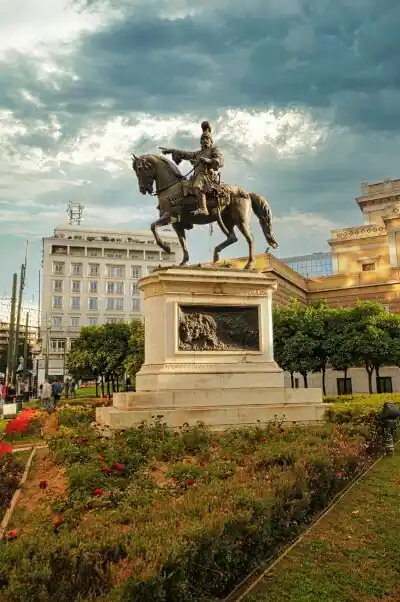
You will know it when you see the big bronze equestrian statue of Theodoros Kolokotronis in front of the museum, next to two old cannons from the Greek War of Independence. The statue was made by Lazaros Sochos and erected here in 1954. It is one of the most recognizable symbols of central Athens.
How long do you need to visit it?
The average visit is an hour to an hour and a half. It’s not a very large space compared to the National Archaeological Museum or the Acropolis Museum, but it is full of information and is dense and satisfying.
If you are into the Greek Revolution, you can easily spend an hour in those rooms alone. I would spend a little more time than you think you need to, at least in the costume galleries and the old parliament hall. Take your time. The museum is never crowded, and the silence is a joy.
Photography rules
Photography for personal use is allowed, although flash photography and tripods are prohibited. Some temporary exhibitions may have different rules, so check at the ticket desk when you arrive. The lighting isn't always the brightest inside, so a phone camera will be fine for most things, but it's not really gallery-quality lighting.
Is there somewhere to sit and rest inside?
There is no full restaurant or sit-down cafe within the museum itself. There may be a small refreshment area or vending machines, but if you want a coffee or meal, you're better off leaving the building.
It's in the heart of central Athens, so you won't be short of options. Kolokotronis Street and the surrounding blocks around Syntagma and Ermou all have cafes, bakeries, tavernas, and restaurants within a few minutes' walk.
The small shop by the entrance
The museum has a small shop at the entrance, where you can buy books on Greek history, postcards, replicas of historical items, educational materials, and other tourist souvenirs.
If you want to avoid the typical tourist t-shirt and fridge magnet, it's worth browsing here. In particular, they have a good selection of books if you want to read up on the Greek Revolution or modern Greek history when you get back to the hotel.
Is this a museum that works for families?
It is family-friendly for kids who have reached high school age. The Greek traditional costumes, the everyday life of the 18th and 19th centuries, and the history of the Greek flag are all very familiar to them, as this is the material their teachers use in schools.
The museum has a whole educational program for schools, and the topics are exactly the ones I mentioned, so I assume that if your kids were younger, there is some way to organize a visit that is more interactive and engaging for them. The museum also organizes daily visits for young people, but they have to be part of some school program and are not open to the public.
Contact info
- Address:13 STADIOU STR. 10561 ATHENS
- Phone: + 30 210 3237617
- Official Web site
What else can you see near the National Historical Museum?
Another thing that I love about this museum’s location is its proximity to so many other central Athens attractions. A few minutes’ walk from here, you will reach Syntagma Square. The Parliament building sits there and is the site of the changing of the guard in front of the Tomb of the Unknown Soldier. It’s almost poetic stepping out of the old parliament building and then continuing straight to the new one, with history unfolding before your eyes.
From there, it’s a short walk along Panepistimiou Street to the Athenian Trilogy, the three neoclassical buildings that make up the University of Athens, the National Library, and the Academy of Athens, some of the most beautiful buildings in the city.
A short distance further along the same street is the Numismatic Museum, housed in the former mansion of Heinrich Schliemann. Other museums within walking distance include the Byzantine and Christian Museum and the War Museum, both of which you can visit along Vasilissis Sofias Avenue, as well as the Museum of Cycladic Art and the Benaki Museum. You could easily plan a day around museums in this area of Athens.
If you prefer to walk around something a little greener, the National Garden and Zappeion are both a short walk to the south and are a good spot to rest your feet after a morning of history. For something a little more neighborhood-based, you can head down the hill to Plaka and Monastiraki, both of which have lots of narrow streets, old churches, and good food. For a broader perspective on all of the things to do in Athens, check out my full Athens travel guide or my guide to the best museums in Athens.
Things visitors often ask about the museum
Is the National Historical Museum in Athens worth visiting?
Yes! One of the most underrated museums in Athens. So most people who come to Athens want to see the ancient sites and, of course, the Acropolis. But what we are missing out on is the story of what happened between then and now. To understand how Greece became the Greece we see today, the museum is where the best story is told. And the whole experience is enhanced by the Old Parliament's setting, which adds a dimension few museums can claim.
What is the difference between the National Historical Museum and the National Archaeological Museum?
The National Archaeological Museum’s collection centers on ancient Greek history, which runs from prehistoric times to the end of the Roman period. Exhibits include sculptures, vases, and bronze work from the Mycenaean, Cycladic, and Classical Greek civilizations. The National Historical Museum, in contrast, covers modern Greek history, from 1453 to 1940. In short, they offer two different periods of the same story, and if you want to get a complete picture of Greece’s past, you have to visit both.
What is the National Historical Museum famous for?
The most famous collection in the museum is the artifacts from the Greek War of Independence of 1821. Weapons, flags, and personal effects of revolutionary leaders like Theodoros Kolokotronis are on display. The museum is also well known for being housed in the Old Parliament Building, the first permanent home of the Greek National Assembly. The traditional costume collection and the old parliamentary chamber are two other highlights of the museum.
Can you visit the old parliament hall inside the museum?
Yes. The great central Hall of the Assembly, where parliamentarians debated and voted for sixty years, has been restored and is open to visitors as part of the museum. It is right behind the ticket desk, so you can literally walk into the room where the Greeks ran their country for sixty years and see it for yourself. It’s still used for conferences and special events today.
The museum that holds the country's heartbeat
I’ve been to the big museums in Athens dozens of times. I’ve stood in front of the golden mask of Agamemnon and been awestruck. I’ve strolled through the Parthenon gallery in the Acropolis Museum and felt something close to wonderment. But when I go to the National Historical Museum, I feel something different. It’s quieter. More personal. More like recognition than amazement.
Because the people in these rooms are not mythological giants or faceless statues. They are the men and women who built the country I now call home. Their swords are real. Their flags are real. The room where they argued about this nation’s future is real, and I am standing in it. Kolokotronis, on his bronze horse, waits for me outside, and inside, his frayed leather belt rests behind glass, and both of these things exist at the same time.
The moment I leave this museum and step back onto Stadiou Street, Athens feels different. The noise and traffic are the same, but the city has more weight to it. Streets have names, and now those names have faces. The freedom I have to sit at a cafe and drink my coffee in the afternoon sun did not just happen. It was fought for, argued for, bled for right here, in this building, in these rooms.
If you come to Athens, please don’t skip this place. It’s not the most famous museum in the city. It won’t be on most top ten lists. But it is the one that will help you understand everything else. Because Greece is not just the Parthenon and the philosophers. It’s also the people who picked up swords and flags, two hundred years ago, and decided this place deserved to be free. That story is here. And it is worth your time.