I don’t remember the first time I entered the National Garden. It is likely that I was too young to remember anything. But I do remember the feeling, and it is the same feeling I experience every time I walk through the entrance on Amalias Avenue: the world quiets down.
In a moment, you are on the pavement, a person among traffic and noise and the fidgeting energy of Syntagma Square. In the next moment, you are under the canopy of trees that have been growing there longer than your grandparents have been alive, hearing only birds and the soft susurration of water somewhere far down in the green.
Athens is a city of marble and light and heat. It is magnificent and ancient, and sometimes it is loud. The National Garden is none of those things. It is shade and silence and slow paths that lead to nowhere in particular. It is the place where the city stops talking and lets you think.
I have been coming here for as long as I can remember, and I still find new corners that I have never seen before. This is the kind of place this is. Not a park you visit once and cross off a list, but a place you go back to again and again because it gives you something different every time.
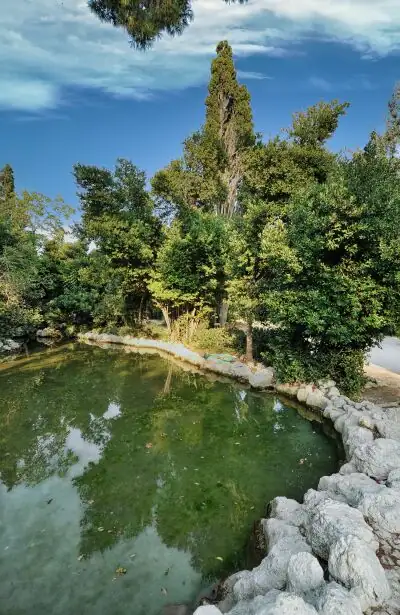
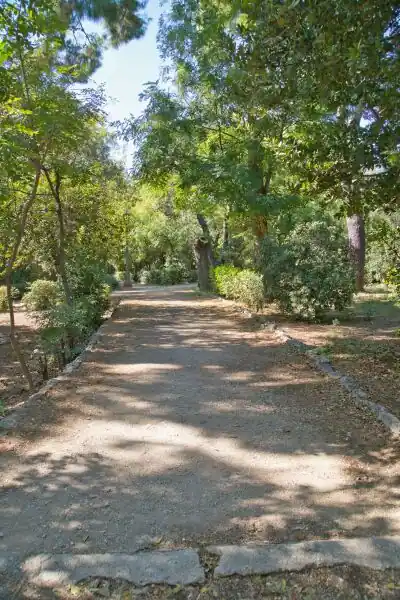
Table of Contents
The oldest garden in modern Greece, hiding in plain sight
Athens’ National Garden is a 15.5-hectare public park in central Athens, located right behind the Greek Parliament building and running south toward the Zappeion and the Panathenaic Stadium. It is the oldest landscaped green space in modern Greece and home to more than 500 plant species, over 7,000 trees, and 40,000 bushes, collected from all over the world.
It is free to enter. It is open every day from sunrise to sunset. And it is, without question, one of the most peaceful places in a city that rarely slows down.
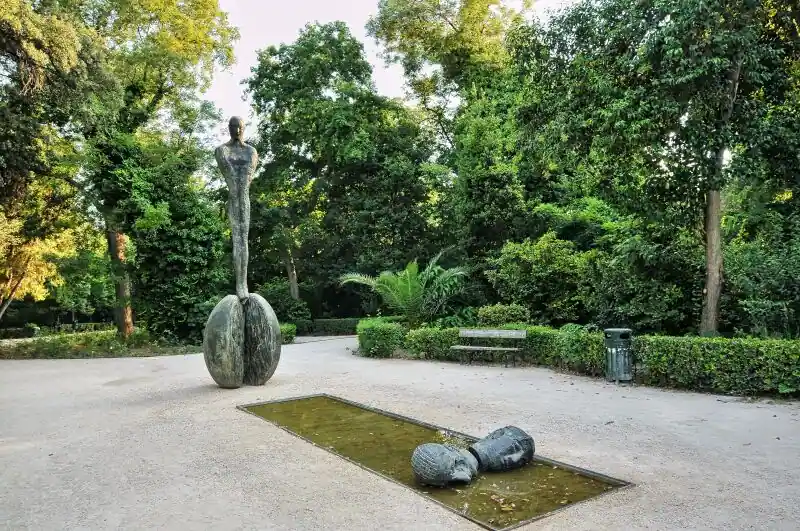
But what makes it different from other European city parks is the layering. This is not just grass and flower beds. Beneath the shade of century-old eucalyptus and towering Washingtonia palms, you will find ancient Roman mosaics, marble columns from long-vanished temples, a duck pond where turtles sun themselves on the rocks, a small zoo, a botanical museum, and the busts of poets who wrote the words that shaped this country.
The National Garden holds more history per square meter than most museums and asks nothing of you in return. No tickets. No queues. Just the sound of water and wind through the trees. For anyone visiting Athens – particularly in the summer months – this place is not a detour. It is a destination.
The story behind the garden: From a queen's dream to the city's breathing space
Every garden has a story. This garden begins with a young queen, homesick for green.
A young queen, a German gardener, and a navy full of seedlings
In 1838, Queen Amalia of Greece, a young woman from Oldenburg in northern Germany, looked out at the dry, dusty landscape behind the Royal Palace and imagined something else. Shade. Water. So much greenery that it would transform the look and feel of Athens. She made it happen.
Commissioning the German agronomist Friedrich Schmidt to design the garden, together they dreamed up an English landscape garden like nothing the city had ever seen before. Schmidt scoured the world in search of exotic and unusual plants, while the young Hellenic Navy was tasked with importing over 15,000 seedlings from Italy, Africa, Asia, and the Americas. Amalia, meanwhile, is said to have spent at least three hours a day working in the garden, planting, watering, and pruning with her own hands.
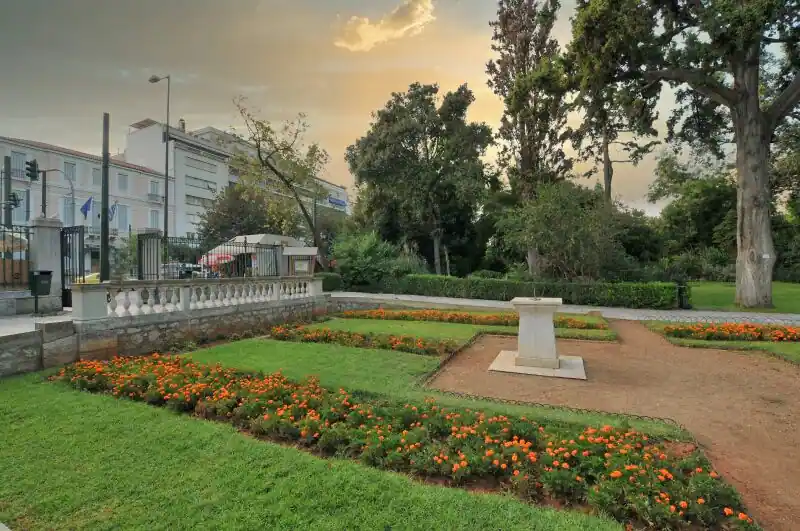
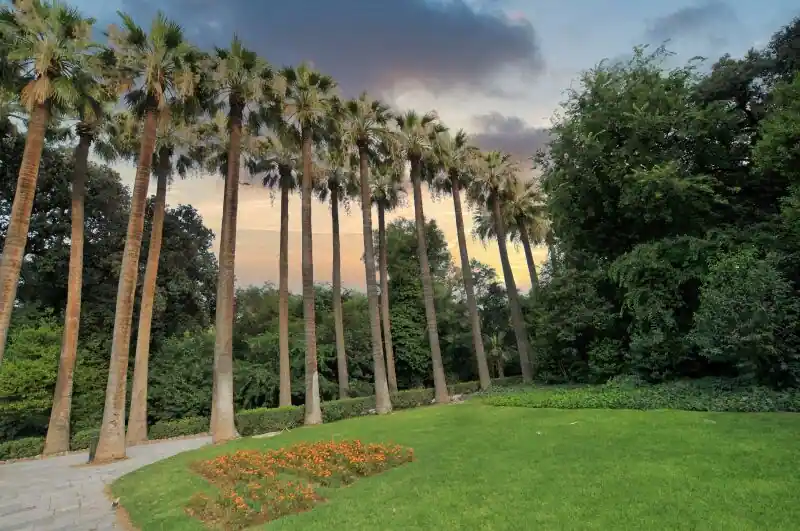
She planted the line of Washingtonia fan palms that still stand at the garden’s main entrance along Amalias Avenue. They are now over 25 meters high. The avenue was named for her. I always think of her when I walk under them: a woman from cold northern Europe who loved a dry Mediterranean city so much that she gave it the gift of green.
By 1840, the garden was complete. It was laid out in the style of an English landscape garden, with sinuous pathways, open vistas, shady alcoves, and water features fed by the ancient Peisistratus aqueduct, an irrigation system that dates back to the 6th century BC and which still carries water through the garden to this day.
From palace grounds to public paths
It’s not every garden with a history dating back hundreds of years that was also the scene of a pivotal moment in modern Greek history. But this one is.
The garden was private for decades. It was the Royal Garden, a sanctuary for the king and queen, where members of the public were only permitted during the hours of the afternoon. It stayed that way throughout the years of many kings and queens, throughout world wars and political turmoil, and through the bizarre and tragic event that, in a sense, altered the trajectory of Greek history.
In October 1920, then King Alexander of Greece was taking a stroll in the Royal Garden, when a pet Barbary macaque monkey living on the palace grounds bit him. The bite became infected and, within a few weeks, the young King Alexander was dead. The death of the king set in motion political events that would see his father, Constantine, return to the throne, shift political alliances during the Greco-Turkish War, and ultimately contribute to the Asia Minor Catastrophe of 1922, one of the most agonizing periods in modern Greek history. Winston Churchill would later write that a quarter of a million people may have died as a result of that monkey’s bite.
In 1923, the park was opened to the public. By 1927, it was officially renamed the National Garden. In 2004, the Greek state transferred the National Garden’s care to the Municipality of Athens for a period of 90 years, and in 2011, it was declared a Historic Garden by the Ministry of Culture, the first and only Historic Garden in Greece.
Ancient roots: How this land was green long before the garden existed
But the history of this place begins much earlier than the 19th century. This area, where the National Garden is now, was called the Lyceum in ancient times. It was a pleasant and green suburb east of the city walls, not far from the sanctuary of Apollo and the banks of the river Ilissos.
And it was there, in 335 BC, that Aristotle founded his school. For twelve years, he would teach his disciples walking in the shaded groves. His school was called the Peripatetic School (the school of walking around), from the Greek words peripatetos, meaning “walking around”.
After Aristotle’s death, his student Theophrastus became head of the school. Theophrastus is considered the father of botany. He was the first to study and describe plants in a systematic way. He wrote his great work, Enquiry into Plants, while teaching at this place.
This is really moving to think about. The father of botany once strolled through this very soil. And now, over 2,300 years later, 500 species of plants are growing here, many of them imported from the very places that Theophrastus described and studied. The garden does not know, of course. But I like to think the soil remembers.
A walk through the garden, one path at a time
The best way to experience the National Garden is the way Athenians do, without a plan and at your own pace, wandering wherever the paths take you. But if you must know what lies ahead, here are my favorite things:
The first steps: Where the palms stand, and the city disappears
For most, it starts at the main entrance on Vassilissis Amalias Avenue, across from Syntagma Square. It’s the most dramatic, framed by giant Washingtonia palms, planted by Queen Amalia and marked by an ancient sundial on which visitors amusingly guess the time before checking their phones.
Beside the gate is almost always a koulouri-vendor, those sesame-covered bread rings Athenians scarf on their way to work. Buy a ring. Walk through the gate. And let the city fall away behind you.
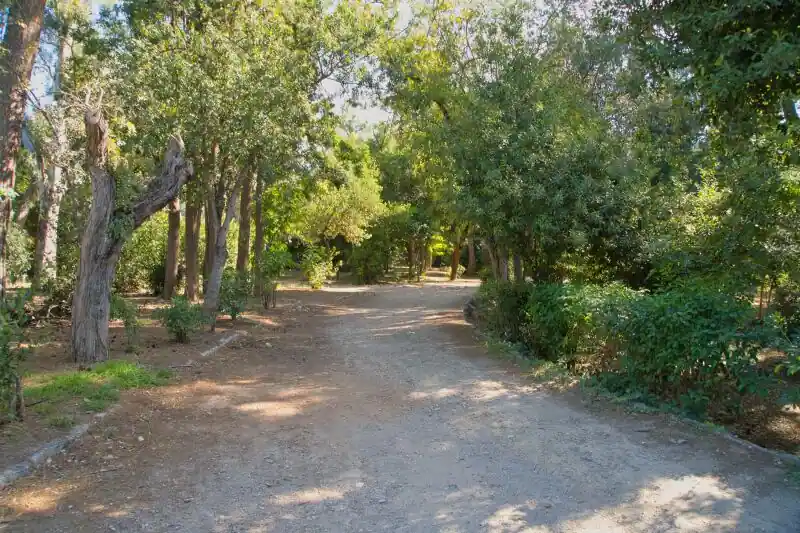
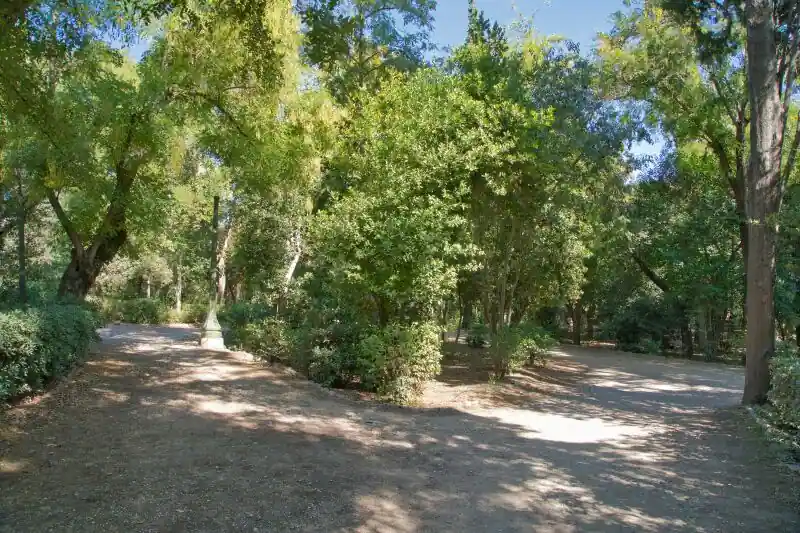
Within seconds, the noise changes. Traffic fades, replaced by birdsong, by the crunch of gravel underfoot, by the distant splash of water. The path in front of you disappears into the shade of old eucalyptus trees, and the air smells different in here, greener, softer, cooler. Even in the height of July, the temperature inside the garden plummets the moment you step through that gate.
The ponds, the turtles, and the ducks
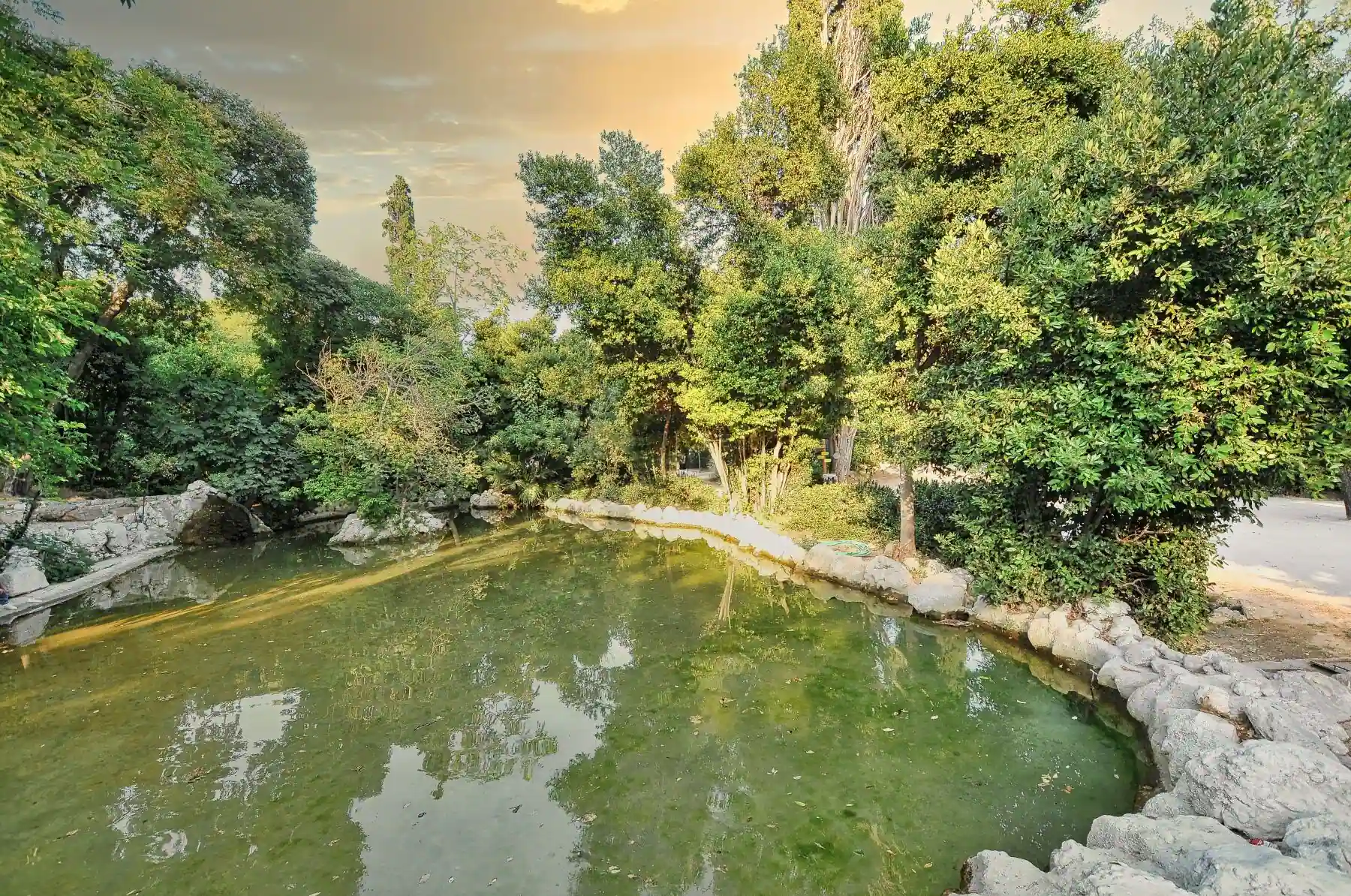
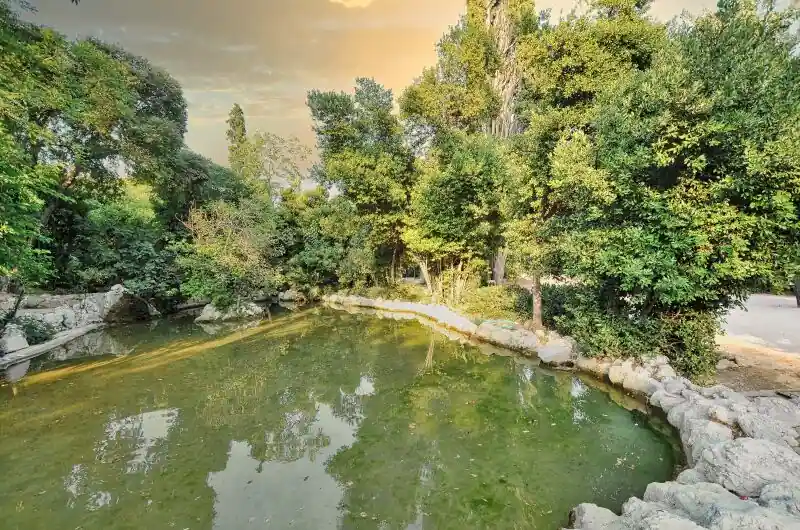
The centerpiece of the garden is the duck pond, and it is one of my favorite quiet places in all of Athens.
It is not grand. It is a small pond, bordered by overhanging trees. Ducks paddle in lazy circles, and turtles sun on the rocks. There are benches nearby, always half-occupied by people reading, or talking quietly, or just sitting. On weekday mornings, it is mostly older Athenians and young parents pushing strollers. On the weekends, families.
In fact, there are six small lakes in the garden, each with its own character. In some, koi fish drift beneath the surface. In others, it is quiet, tucked into a corner where the paths narrow and the light dapples through the canopy. Turtle pond is the one the children love best. The turtles are everywhere, dozens of them, basking on every available surface, oblivious to the small crowd that always gathers to watch them.
I have spent more afternoons than I can count sitting by the ponds. There is something miraculous about water in the middle of a dry city.
The small zoo and the botanical museum
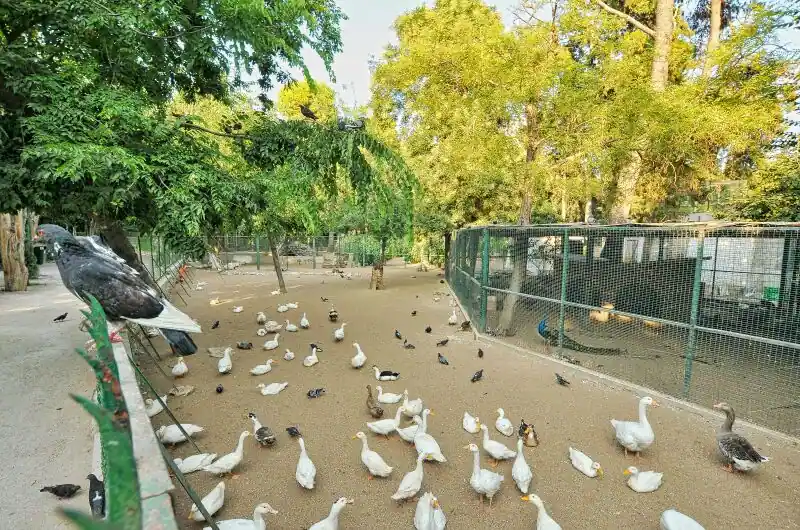
Nestled in the eastern side of the garden is the small zoo, a long-standing feature. Decades old. Modest by any definition of the word, a few enclosures, Cretan goats, peacocks, chickens, rabbits, and birds in aviaries. Not a large zoo, not trying to be a large zoo. For children, however, it is enchantment. Goats approach to be petted, the peacocks sometimes flap their tails for no reason whatsoever, and the aviaries are filled with the sounds of chirping birds.
Beside the zoo is the botanical museum and the garden's own conservatory, which, if the signs are to be believed, was the first working greenhouse in modern Greece. Saplings are grown here before being replanted in the garden proper. Small, easy to overlook. But if you pause and look inside, you'll see the careful, patient work that goes into maintaining this place.
Ancient ruins hidden among the trees
This, though, is the surprise for most visitors. You’re strolling on a shady path, minding your own business, when suddenly you look down and…there’s a Roman mosaic floor beneath your feet.
The National Garden is built on layers and layers of history. As you stroll, you’ll find ancient column drums, Corinthian and Ionic capitals scattered on the grass, the remnants of a Roman villa and its mosaic still partially in situ, traces of the ancient Peisistratus aqueduct that has carried water through this area since the 6th century BC and, towards the Zappeion end of the garden, the remains of Roman baths dating to the 3rd century AD, unearthed during the construction of the Athens Metro.
The ruins are not roped off or given grand signage. They simply are, among the trees, the way history is in Athens: casually, everywhere, as natural as the roots and the stones. There’s also a large marble inscription concerning Caesar Aelius, ordered by a Roman officer from Epirus who had fought the Germanic tribes. It too sits in the garden as if it has always been there, because in a way it has.
If you like unearthing ancient remains where you least expect them, the Ancient Agora and the Roman Agora also offer that feeling of walking through layers and layers of time, though on a far grander scale.
The busts and statues that tell a story
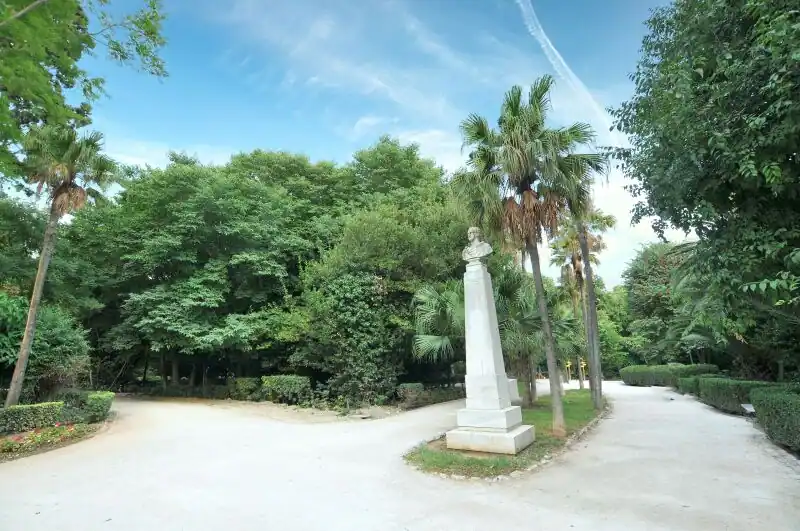
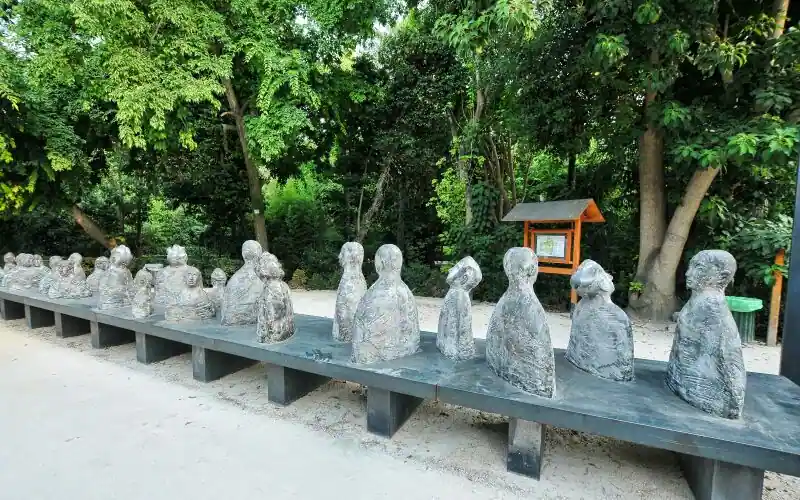
Marble and bronze busts of people who contributed to the shaping of modern Greece are scattered around the garden. They are placed on pedestals on both sides of the paths, sometimes half-hidden by the branches, each one with a story to tell.
Ioannis Kapodistrias, the first governor of the independent Greek state, is on the southeast side. The bust was placed here in 1866 and donated by Swiss admirers of Kapodistrias' diplomatic career. The bust of the Swiss philhellene Jean-Gabriel Eynard is close by.
The poet Dionysios Solomos, author of the Greek national anthem, is on the southern paths, as is the poet Aristotelis Valaoritis. There is also a bust of Spyros Samaras, the Corfiot composer who wrote the Olympic Anthem. The melody has been played at every Olympic Games in the world since the games began. His bust originally stood in front of the old Municipal Theatre. It was moved to its present location when the theatre was demolished.
At the entrance to the Zappeion Garden, there is the statue of Lord Byron, the English poet who died in the fight for Greek independence. Greece, personified as a woman, is seen placing a laurel wreath on Byron's head. It is one of the loveliest monuments in Athens and one that most people walk straight past.
Hidden benches, old books, and coffee under the trees
If you approach from the Irodou Attikou Street entrance, the garden café is your first stop. Simple and unadorned, with small tables under the trees, you order a coffee, and they leave you alone to sit for as long as you like. It is not a fancy place, but there is something magical about sipping a simple Greek coffee in the middle of Athens while you sit surrounded by nothing but green.
A short walk from the café is the garden's children's library, founded in 1984. It has two reading rooms, a fairy tale room, and a music and film room. Free to enter, on a weekend morning, you will hear it fill up with the sound of small voices and pages turning.
But my favorite parts of the garden have no name. The benches are tucked away behind pergolas, hidden by climbing roses. The quiet corners where the path narrows and the light goes soft and golden. The old wooden bench under the huge Holm oak tree, where I have read more books than I care to count. The National Garden is full of these private spaces, of places where you can sit alone and feel forgotten by the city, in the best way possible.
The zappeion: Where the garden meets history
At the southern end of the National Garden is the Zappeion Hall and its gardens, which are technically a different space but otherwise feel like a continuation of the same world.
The Zappeion was constructed between 1874 and 1888, with funding from Greek benefactor Evangelis Zappas and architect Theophil Hansen of Denmark. It was built in the neoclassical style and was originally purposed for the renaissance of the Olympic Games: for the first modern Olympics in Athens in 1896, the Zappeion hosted fencing. Today, the Zappeion is a space for exhibitions, conferences, and cultural events. The building itself can’t be visited just like that, but it is worth strolling up to it to appreciate the stately portico with its Corinthian columns, and to peer through at the charming courtyard behind.

The Zappeion Garden surrounding the hall is also a lovely space on its own. In the spring, the line of jacaranda trees in the garden turns a soft purple, and it is big news in local media. There are plenty of statues of politicians, kings, and historians to discover among the paths, as well as more playful satyrs peeking out of the bushes and small Eros figures with arrows nocked. There are some open grass spaces to have a picnic, and the open-air cinema Aegli, one of Athens’ oldest summer cinemas and a local favorite on balmy evenings.
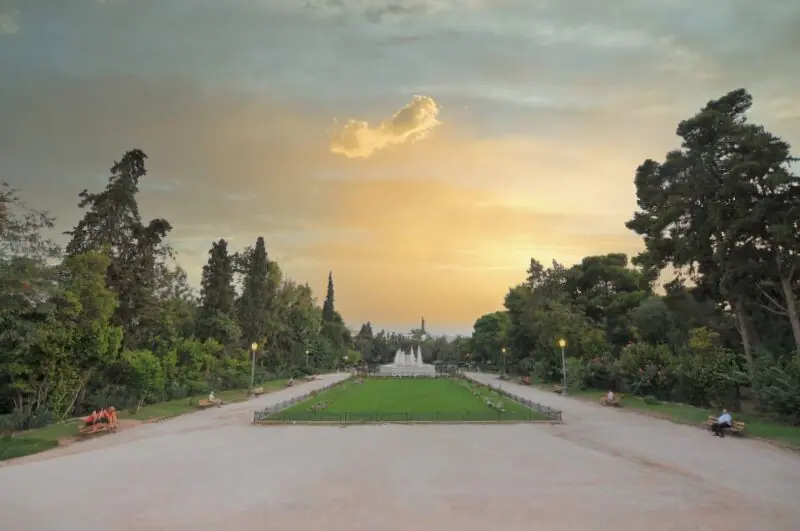
The Panathenaic Stadium, the white marble stadium where the first modern Olympics were held in 1896, is just across the Vassilissis Olgas Avenue from the Zappeion. The three, along with the National Garden, form a green passage through the center of Athens that connects ancient and 19th-century history with the city’s quieter daily life.
Practical information for visiting the National Garden
Opening hours and entrance fee
The National Garden is open 365 days a year, from sunrise to sunset. Admission is free. No tickets. Just walk in through any of the seven entrances and roam wherever you wish.
Closing time is signaled by whistles from garden employees when the entrances will be locked. If you happen to be in the garden at dusk, keep your ears open for the announcement. It’s a strange comfort, like being personally told by the garden itself that it is time to leave.
Finding your way to the green
The easiest way is by metro. Syntagma station (lines 2 and 3) is a two-minute walk from the garden’s main entrance on Amalias Avenue. If you are arriving from the Kolonaki direction, Evangelismos station (line 3) is also very close, near the Vassilissis Sofias entrance.
The garden has seven entrances in total: the main entrance on Vassilissis Amalias Avenue, another on Vassilissis Sofias Avenue, three more on Irodou Attikou Street, and two on the Zappeion side. That means you can always enter and exit from whichever direction is most convenient for your itinerary, and as such, the National Garden is a perfect shortcut between Syntagma Square and the Panathenaic Stadium or the Temple of Olympian Zeus. The hop-on hop-off bus has a stop at Syntagma Square right next to the main entrance.
How long to spend
If you’re just passing through as a shortcut, it will take 20-30 minutes to walk from one end to the other. To do it justice, to see the ponds and ruins and secret nooks, you should allow one to two hours.
If you combine the National Garden with the Zappeion and nearby attractions (the Panathenaic Stadium, the Temple of Olympian Zeus, and Hadrian’s Arch), it’s easy to fill a half-day in this area of the city.
Best time to visit
My favorite time to visit is early in the morning. The light is soft, the paths are almost deserted, and the birds are at their loudest. You’ll see joggers, dog walkers, and a few older Athenians with newspapers on their favorite benches.
Late afternoon is also lovely, especially in autumn when the low sun turns the paths gold, and the air cools just enough to make sitting outside feel like a reward.
In spring (March-May), the garden is at its most colorful. The flowers are in bloom, the jacarandas in the Zappeion Garden turn purple, and the temperature is ideal for long strolls.
In summer, the garden is at its most beautiful. When Athens is baking under 35-degree heat, this is one of the few places in the city center where you can find real shade and a few degrees of relief. Visit before 10 am or after 5 pm to escape the worst of the midday sun.
What surrounds the garden on every side
The National Garden is located in one of the most historically significant areas of Athens, and almost every major attraction is within walking distance.
Syntagma Square and the Hellenic Parliament are in front of the main entrance, where you can watch the hourly changing of the Evzones guard. Behind the National Garden on Irodou Attikou Street, you will pass the Presidential Mansion as well as the Maximos Mansion, the office of the Greek Prime Minister.
To the south, across from the Zappeion, you will find the Panathenaic Stadium. This is the white marble stadium where the first modern Olympic Games were held in 1896. In the same area, you will find Hadrian’s Arch and the Temple of Olympian Zeus, one of the largest temples ever built in the ancient world.
On the Vassilissis Sofias side, the Byzantine and Christian Museum and the War Museum are both a short walk away. The Archaeological Site of the Lyceum of Aristotle, the very ground where the philosopher taught, is also just around the corner. The Museum of Cycladic Art and the Benaki Museum are also nearby, and both are less than 500 meters away.
If you were building a day around this area, I would suggest starting at Syntagma Square and then walking through the National Garden to the Zappeion. From there, continue to the Panathenaic Stadium, then to the Temple of Olympian Zeus. You will cover centuries of history without ever having to get on a bus or a taxi. For a full overview of the area and more ideas on how to plan your days, check out my best attractions in Athens guide or my main Athens travel guide.
The garden where children run free, and parents finally sit down
Athens has several wonderful spaces, but the National Garden is one of the city’s most family-friendly, and one of the places Athenian parents with children frequently visit on weekend mornings.
The main attraction for the littlest Athenians is the tiny zoo. Cretan goats, peacocks, rabbits, and chickens are all tame enough for children to watch at close range, and the bird aviaries are both colorful and musical. The duck pond is also a hit, especially for toddlers who love to stare at turtles sunning themselves on every available rock.
Near the Zappeion end of the garden, there is a fenced playground with swings, slides, and climbing structures. It is shaded and safe and surrounded by all that green, and it somehow feels much more civilized than the typical playground you find in most cities.
Hidden away is the children’s library, an adorable little treasure. Established in 1984, the library has two reading rooms stocked with books in both Greek and other languages, a fairy tale room embellished with illustrations, and a music and film room where small events are sometimes hosted. Entry is free, and the staff is warm and welcoming.
The National Garden is a rare treat for a family in Athens. A place where kids can run, explore, and be loud, and no one will mind. The perfect place to release that pent-up energy after a morning at the Acropolis, where little feet get tired fast, and ‘don’t touch’ seems to be the number one rule. Let them chase the ducks. Let them count the turtles. Let them sit under a tree and munch on a koulouri while you shut your eyes for five minutes. That is what this place is for.
Frequently asked questions
Is the National Garden in Athens free?
The National Garden is free. It’s that simple. You walk in and walk out. It has no tickets, reservations, or time slots, only seven gates through which to enter. You can stay as long as you want.
How big is the garden?
The garden spans approximately 15.5 hectares (38 acres) of land, which, when combined with the Zappeion grounds adjacent to it, makes for an even larger area of green. It takes roughly 20 to 30 minutes to walk from one end to the other. But to properly get lost in its meandering paths and ponds, one to two hours.
Is it safe to walk inside?
Daytime is safe in the National Garden. It’s very popular with Athenians and their families, joggers, and tourists during the day. I’d avoid straying too far from the main areas and get out before the gates close at sunset. They close at sundown, and the whole place is locked at night.
Can you have a picnic inside?
Yes. Athenians do this all the time. The best areas are the grassy fields near the Zappeion on the other side, which get crowded on weekends. It’s not unusual to spot families taking a Sunday picnic break. There are also benches all over the garden if you just want to sit and not bring a sheet.
Are dogs allowed?
Leashed dogs are welcome in the National Garden. I often see Athenians walking their dogs in the garden’s paths in the morning and evening hours.
Is there a playground?
Yes, there is a fenced playground on the Zappeion side of the garden with swings and other equipment for younger kids. It’s nice and shaded and tucked within the greenery.
The garden that teaches you to sit still
I visit this place at least once a week. Not to see. Just to sit. Athens has much to give. The Acropolis, the museums, and the ancient stones that have seen thousands of years. The National Garden offers the opposite. It offers you nothing to see and no place to be. Just shade, birdsong, and the slow sound of water as it runs through the green.
The American writer Henry Miller came here in the late 1930s and wrote, after he left, that of all the parks he had ever known, this one remained, by far, in his memory. He called it the place that you feel sometimes in your dreams: a place you would like to be and never find.
He was right. It is still here, unchanged, behind the gate on Amalias Avenue. If you visit Athens, come in. Sit on a bench. Close your eyes for a while. And let this old, quiet garden teach you something simple. That sometimes the best thing a city can give you is a place to sit still.