Some museums in Athens recount history. Others make you experience how ancient beauty really feels. The Cycladic Art Museum in Athens is the latter. A peaceful spot on a quiet street in Kolonaki, it houses one of the most significant collections of prehistoric Aegean art in the world. But what makes it so special is not the number of its exhibits or the grandeur of its building. It is the way these objects, carved out of white marble over 5,000 years ago on the Cycladic Islands in the middle of the Aegean Sea, still seem as if they were made this morning.
I have been visiting this museum since I was a child. Every time I walk through its rooms, I feel the same: a sort of stillness that only very old and very simple things can provide. If you are in Athens and want to get a sense of something deeper in this part of the world, something older than the Parthenon and quieter than the Acropolis, this is the place to visit.
Table of Contents
The story behind the quiet museum on Neophytou Douka Street
The Museum of Cycladic Art is a privately owned museum in Athens that hosts artifacts and artwork of ancient cultures from the Aegean and Cyprus. It was founded in 1986 by Nikolaos and Dolly Goulandris, two of the most influential figures in Greece’s merchant navy shipping dynasty, who had already been amassing an art collection of ancient Greek and Cycladic pieces since the early 1960s.
Quietly building one of the world’s largest and most authoritative private collections in this field, before the museum opened its doors, the Goulandris collection had been exhibited at the National Gallery of Art in Washington, the British Museum in London, the Grand Palais in Paris, and the Museum of Western Art in Tokyo. “Probably the most important private collection of Cycladic antiquities ever assembled”, it was once described by the New York Times. And when it finally landed in its permanent residence in Athens, it seemed something of a homecoming after all those years of going places.
Situated in central Athens’ Kolonaki neighborhood at 4 Neophytou Douka Street, the museum’s main building, a three-floor space on the corner of Philoxenou and Neophytou Douka, was designed by Greek architect Ioannis Vikelas. In 1991, the museum’s next-door neighbor, the Stathatos Mansion, was added to the complex.
The neoclassical building, designed in 1895 by Bavarian architect Ernst Ziller for shipowner Othon Stathatos, has been incorporated as the museum’s “gallery for temporary exhibitions”. The two buildings are connected by a glass-covered passage. In all, they house over 3,000 pieces across four floors. It is not the largest museum in Athens. But it may be one of the most beautiful.
Cycladic: The oldest art in the Aegean, and the reason it still feels new
First, you need to know what Cycladic art is. And once you do, you will never look at modern sculpture the same way again.
The Cyclades are a cluster of small islands in the central Aegean Sea: Naxos, Paros, Amorgos, Antiparos, Syros, Keros, Milos, Santorini, and some thirty others. They trace a rough circle around the sacred island of Delos, and it is this circle that gives them their name. The Greeks called the islands the kykloi, after the word kyklos, circle.
Between roughly 3200 and 2000 BC, in the Early Bronze Age, a civilization thrived on these islands that produced some of the most beautiful art in all human history.
The most famous products of this Cycladic culture are the white marble figurines. The majority are small, seldom over thirty centimeters high, though a few are much bigger. In the main, they represent nude female figures with folded arms, slightly bent knees, a tilted head, and a flat, featureless face. Only the nose is modeled. Eyes, mouth, hair would once have been painted on, in red and blue pigments now long faded. What remains is pure white Naxian marble, smooth and almost translucent.
We are not sure what the figurines mean. We find them for the most part in graves, but they are not just funerary offerings. Are they representations of a goddess? Fertility symbols? Companions for the afterlife? The truth is, we do not know. The Cycladic people left no written records. All we know about them is what they left behind: their tools, their pottery, their jewelry, and these mute, enigmatic figures.
What we do know is that these objects, which were made five thousand years ago by people eking out a living on windswept islands with limited resources, look astonishingly modern. Their abstraction, their minimalism, their elegant simplicity. Place one of these figures next to a sculpture by Brancusi, a painting by Modigliani, and the family resemblance is unmistakable. That is part of the reason why this art matters so much. It is a bridge between the very beginnings of Aegean culture and some of the most important art of the twentieth century.
What waits inside: A walk through four floors and five thousand years
The permanent collection is spread over four floors of the main building. Each floor is arranged around a theme and period. You ascend through time as you go up the building. The galleries are calm, unhurried, and beautifully presented.
Cycladic art collection: Marble figures older than the pyramids
The first floor is where most people come, and the room that lingers longest in the memory. Some 350 objects from the Early Cycladic period (3200 to 2000 BC) make this one of the most important collections of Cycladic art in the world.
As you walk through the gallery, you can see how the art developed over a thousand years. The earliest violin-shaped figurines are small, flat, and abstract, barely suggesting a human shape. Then come the Plastiras-type figures, more naturalistic, with features carved and long necks. And then the canonical folded-arm figures: arms crossed over the abdomen, head tilted back, knees faintly bent. There are varieties named after the islands where they were first discovered (Spedos, Dokathismata, Chalandriani), and the largest stands 1.4 meters tall, the second tallest of its kind in the world, carved from a single block of marble with stone tools and obsidian blades.
The room is filled with other treasures. The Dove Vase, carved from a single block of marble with birds perched on its rim. The Keros Hoard, figurines found deliberately broken as part of ancient rituals, we can only guess at. Objects made of obsidian that glow darkly under the gallery lights.
And then the detail that changes everything. These figures were not always white. They were painted with red and blue pigments that have faded over the centuries. What we see as minimalist abstraction was, in its time, vivid and alive. The silence we admire is partly an accident of time, and that makes it even more beautiful.
Ancient Greek art: The centuries that followed
There are approximately 350 works on display on the second floor that date from 2000 BC to the 4th century AD. This is the permanent collection, "A History in Images," and it charts the development of Greek art from the Mycenaean period through the Geometric, Archaic, Classical, and Hellenistic periods and into Roman times.
Painted vases, bronze vessels, terracotta figurines, gold jewelry, coins, stone sculptures, and glass objects are just some of the media that you will find in the gallery. The gallery is set out thematically rather than strictly chronologically, which helps it to feel less like a textbook and more like a conversation. You see how Greek artists gradually became more confident and graceful in the way that they depicted the human body, how the stiff, almost stilted figures of the Archaic period give way to the natural beauty of the Classical age, and how the drama and emotion of the Hellenistic period push art into new territory.
It is a different experience from the first floor. Where the Cycladic collection is all about mystery and stillness, this floor is about storytelling and movement. But together, they give you an arc that is quite remarkable: from the abstract silence of the Bronze Age to the expressive richness of Classical Greece and all within one building.
Cypriot antiquities: The island that looked in every direction
The third floor is home to the Thanos N. Zintilis Collection of Cypriot Antiquities, some 400 objects that trace the history of Cyprus from the Chalcolithic period to the early Christian era. It’s the floor through which most people hurry on their way to and from the elevators, and that is a crying shame, because it has a really cool story to tell.
Cyprus is right in the middle of the eastern Mediterranean, so it was influenced by everyone around it: Greeks, Egyptians, Phoenicians, and Near Easterners. And you can see all of that mixing of cultures in the art on this floor, in ways that are subtle and in ways that are just jaw-dropping. You see vases with decorative motifs that come straight out of the Levant; figurines with a mishmash of Greek and Egyptian features; and objects that seem to be part of no one culture, and yet part of every culture at once.
It’s a reminder that the ancient Mediterranean world was never really a place of isolated, walled-off cultures. It was a network of trade routes and shared ideas, and Cyprus was one of its busiest intersections.
Scenes from daily life in antiquity: When the ancient world feels close
The fourth floor is the museum's most human floor. 142 objects from the museum's ancient Greek art collections are organized by theme (Gods and Heroes, Eros, the World of Women, the World of Men, and the Underworld) and explored in audiovisual presentations about everyday life and burial customs that bring the ancient world into startlingly personal focus.
This is where you learn about weddings and funerals, education and war, love and loss. With their help, the objects begin to feel less like museum pieces and more like windows onto real lives: A painted vase showing a woman at her loom. A figurine of a child playing. A funeral scene in which the bereft survivors' grief is palpable even after two thousand years. For families, the fourth floor is especially rewarding. Children connect with it intuitively because it shows them that ancient people were not so different from us. They played, they loved, they mourned. They lived.
The mansion that hosts Picasso, Ai Weiwei, and the ghosts of Cycladic sculptors
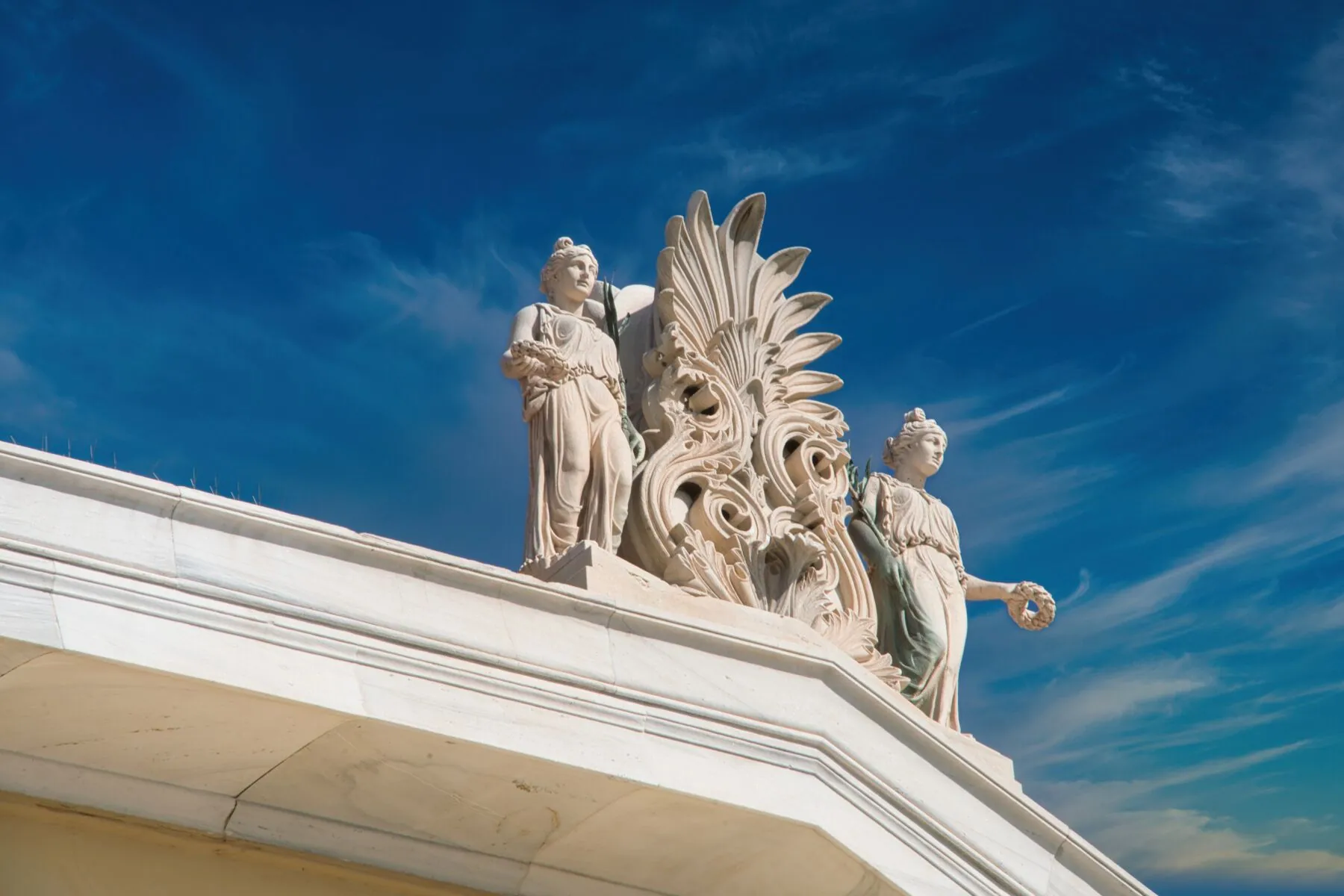
Adjacent to the main building and linked to it by the glass-covered passage, the Stathatos Mansion itself is also worth a visit just for the building. Designed in 1895 by Ernst Ziller, it is one of the grandest examples of neoclassical architecture that is still intact in Athens. Its porticoed entrance, statuary on the roof, and elegant interior spaces are a delight.
The mansion is more than a lovely architectural shell, though. It houses the museum’s temporary exhibitions. These often provide an intriguing juxtaposition with the permanent collection, sparking unexpected dialogues between ancient and contemporary art. Over the years, the museum has staged temporary exhibitions by Ai Weiwei, Pablo Picasso, Salvador Dali, Cindy Sherman, Louise Bourgeois, Thomas Struth, and many more. Ai Weiwei’s 2016 exhibition at the museum included a life-sized marble sculpture entitled “Standing Figure” which was inspired directly by the Cycladic figurines. It is a powerful reminder that the dialogue between the ancient and the modern is not just a historical curiosity but an active and ongoing conversation.
Temporary exhibitions at the museum change regularly. It is worth checking their website before your visit. Some of the most memorable exhibitions in Athens over the last decade have taken place in this building.
Cycladic art and Modern art: A conversation across five thousand years
Most guides allude to it in a sentence and then move on. But the relationship between Cycladic art and modern sculpture is one of the great stories in the history of art. In the early decades of the last century, European artists searching for a new visual language to depict the human figure found it in the stylized forms emerging from the Aegean islands.
Constantin Brancusi’s Sleeping Muse is so reminiscent of Cycladic heads that it is hard not to think it intentional. The attenuated visages of Amedeo Modigliani have the same hushed intensity. The abstractions of Henry Moore, Barbara Hepworth’s curves, Alberto Giacometti’s pared-down bodies. They are all cousins of the little white figurines from the Cyclades.
Pablo Picasso owned Cycladic figurines and made studies of them. On the Beach, which he painted in 1937, is a frontal contemplation of the Cycladic figure. Jean Arp, Ben Nicholson, Isamu Noguchi. The list could go on and on. And the dialogue between Cycladic art and modern sculpture has continued right up to the present day.
When Ai Weiwei selected the Cycladic Museum for his first Athens show in 2016, he was situating his work in a tradition that goes back five thousand years. I find the humility of it moving. The people who carved these figurines on Naxos and Paros five thousand years ago could not have imagined that their work would one day be held up as a source of inspiration for some of the most revered artists in history.
They were making little objects for reasons we will never fully know. And yet the beauty they made was so close to something elemental that it has survived the millennia and still speaks to us as directly as ever.
Is the Museum of Cycladic Art worth visiting?
Yes, and I say this not just as a resident of Athens but as someone who’s visited most museums in this city on numerous occasions. The Cycladic Art Museum is one of the very best museums in Athens because it provides something the bigger, flashier, and more famous ones can’t: intimacy.
The Acropolis Museum is spectacular, but it is also always packed. The National Archaeological Museum is massive and a tad overwhelming in the best way possible. The Cycladic Museum is neither of those things. It’s small enough to see in a couple of hours, quiet enough to hear yourself think, and beautiful enough to make you see art differently.
Everything is displayed to perfection, with explanatory texts in both Greek and English, so that everything is understood clearly. The lighting is carefully designed, the space between objects ample, the overall atmosphere serene. It has less of a museum vibe and more of a very well-curated private collection feel, which is, in a way, exactly what it began as.
If you care about art, history, design, or just the idea of seeing something that’s lasted 5000 years and still feels so relevant, this museum should have a spot on your Athens itinerary. It’s one of the best attractions in Athens that many people never find.
Practical information
How much is the ticket?
General admission is €12. Reduced price tickets are €9 for seniors over 65, students 19 to 25, and for groups of twelve or more. Children under 18 have free admission. Disabled visitors and one accompanying person have free admission.
Free admission is also available to ICOM members, archaeology students, and people who have a free-entry pass issued by the Greek Ministry of Culture. A family kit costs €20 and includes the price of a self-guided experience for two adults and up to three children. Some dates during the year are free.
Opening Hours
- Monday - Wednesday - Friday - Saturday: 10 am – 5:00 pm
- Thursday: 10:00 am – 8:00 pm
- Sunday: 11:00 am – 5:00 pm
- Tuesday: closed
Closing Dates
- January 1st
- March 25th
- May 1st
- Orthodox Easter Sunday
- Clean Monday
- Holy spirit Monday
- August 15th
- December 25th & 26th
How long to spend
Visitors spend between one and two hours at the museum on average. I could have seen the main highlights of the first floor in about forty-five minutes, but I’d budget ninety minutes to go through all four floors at a leisurely pace. If you’re the type to read every description and sit with each object for a while, you’ll need two to three hours.
How to reach
The museum is located in Kolonaki, one of the most central neighborhoods of Athens. It is a ten-minute walk from Syntagma Square and from the Evangelismos metro station on Line 3. The Syntagma station (Lines 2 and 3) is also close by for visitors arriving from farther away.
Several bus lines pass by the Rigillis stop in front of the museum, including the airport X95 bus, so the museum is easily accessible for those who have just arrived in Athens. There is no parking available on site, but four private parking lots can be found within walking distance. If you are staying in central Athens, you will probably find it easiest to walk. The walk from Syntagma takes you down Vassilissis Sofias Avenue, past the National Garden and the Parliament building, through one of the most pleasant areas of central Athens.
Is it good for families and kids?
I found the fourth-floor scenes of daily life in antiquity particularly engaging for children because they show how life was lived in ancient times through things they can most easily relate to: toys, games, household objects, and stories about children.
There are some interactive tables and audiovisual displays to keep kids engaged without overstimulating them. Staff are friendly with families, and the small size of the museum means that even small children won’t get exhausted from walking.
The cycladic cafe and gift shop
The Cycladic Cafe is one of Kolonaki's best secrets. With its natural light-filled space and floating ceiling sculpture designed by Stelios Kois, it feels like a little oasis in the center of the city. And the menu, of course, follows a Cycladic theme with brunch offerings, light bites, homemade pastries, and good coffee. A museum ticket is not required to visit the cafe, so you can stop in for a quiet coffee even if you are not visiting the exhibitions themselves.
The Cycladic Shop is also worth a visit. They have designer jewelry, books on Greek art and archaeology, and unique gifts made in collaboration with Greek and international designers, many of them inspired by the museum's collection. If you are looking for a meaningful souvenir from Athens, one that feels more personal than a cheap replica of the Parthenon, this is one of the best places to start.
Contact info
- Address: Neofitou Douka 4, Kolonaki
- Phone: + 30 213 722 8321
- Fax: + 30 213 723 9382
- Email: museum@cycladic.gr
- Official Web site
The nearby places that make this part of Athens impossible to leave
The Cycladic Art Museum is in one of the city’s most culturally rich neighborhoods. Some of Athens’ most important museums and institutions are within a five-minute walk.
To the north, the Byzantine and Christian Museum is only 168 meters away. This museum covers a completely different era of Greek history, from the early Christian era to the fall of Constantinople. In combination with the Byzantine Museum, you will have seen nearly six thousand years of Greek art in one morning. The War Museum is 226 meters away, and the Benaki Museum, one of Athens’ oldest and most highly regarded institutions, is only 222 meters in the opposite direction.
The National Gallery is a short walk to the south. In total, these institutions make up what some Athenians refer to as the museum mile of Athens, a section of Vassilissis Sofias Avenue where you could spend a whole week and still not see everything.
If that were not enough, the Kolonaki neighborhood itself is filled with excellent cafes, small bookshops, and some of the best people-watching in the city. And if you’d like to stretch your legs after a morning indoors, Lycabettus Hill is a short walk uphill from the museum. The view from the top, out over the Acropolis and the Saronic Gulf, is one of the best in Athens.
If you are planning on a full day of sightseeing, you could easily do the Cycladic Museum, the Byzantine Museum, and a walk through the National Garden, finishing with coffee in Kolonaki Square as the afternoon light turns golden. That, for me, is one of the best ways to spend a day in this city.
Quick answers to the things you are probably wondering
Can I take photos inside the museum?
Yes. Photography for private use is allowed (no tripods, no flash) in the permanent collection galleries. Video recording is prohibited. Feel free to share your photos on social media – the museum encourages it!
Is there an audio guide or a museum app?
The museum has a free self-guided tour available through QR codes in the galleries. Simply connect to the free Wi-Fi and open the link on your phone. Don't forget your own headphones!
Is the museum wheelchair accessible?
Yes. Wheelchairs can be brought into the museum through the ramp at the Stathatos Mansion entrance on Vassilissis Sofias Avenue. There is an elevator to all floors of both buildings.
What is the difference between this museum and the Cycladic collection at the National Archaeological Museum?
They're both great, and I recommend visiting both if you have the time. The National Archaeological Museum has a much bigger Cycladic collection, and it includes the world-famous Harp Player. But the Cycladic Art Museum presents its collection more beautifully, with better context, better lighting, and more detailed explanations of the objects. So if you have time for both museums, definitely see both. But if you must choose, this one will give you a more intimate, focused experience.
Does the museum have temporary exhibitions?
Yes, quite regularly. The Stathatos Mansion building is dedicated to temporary, rotating exhibitions. Often these exhibitions compare ancient and modern art, or give modern artists the opportunity to reinterpret the Cycladic works.
White marble, Aegean light, and the proof that beauty has no century
I never leave this museum in a hurry. It’s not because there is so much to see. It’s because the feeling that it leaves me with is difficult to leave behind.
There is something special about standing in front of a marble figure that is five thousand years old and realizing it looks more modern than most of the things made yesterday. There is something about the way that these objects, carved by people whose names we will never know on islands where the wind never stops blowing, still have a kind of grace that time will never erase.
The Cycladic islands have always been a part of my life. I grew up hearing about them and reading about them, and eventually going to visit them. Islands like Folegandros and Anafi still have a bit of that ancient stillness to them, that same quietness that you can feel in the landscape and in the light. When I walk through this museum, I feel like I am walking through the same light, only stopped in marble.
Athens is a city of layers. Every street you walk on has a story underneath it, and every story has a story older than itself hidden below that. The Cycladic Art Museum is one of those older stories. It does not shout. It does not compete with the Parthenon or the Acropolis. It simply waits quietly on a side street in Kolonaki for the people who are ready to see what came before everything else.
If you come to Athens, make time for this place. It will show you something you do not expect to find: the proof that beauty, real beauty, does not belong to one century. It belongs to all of them.