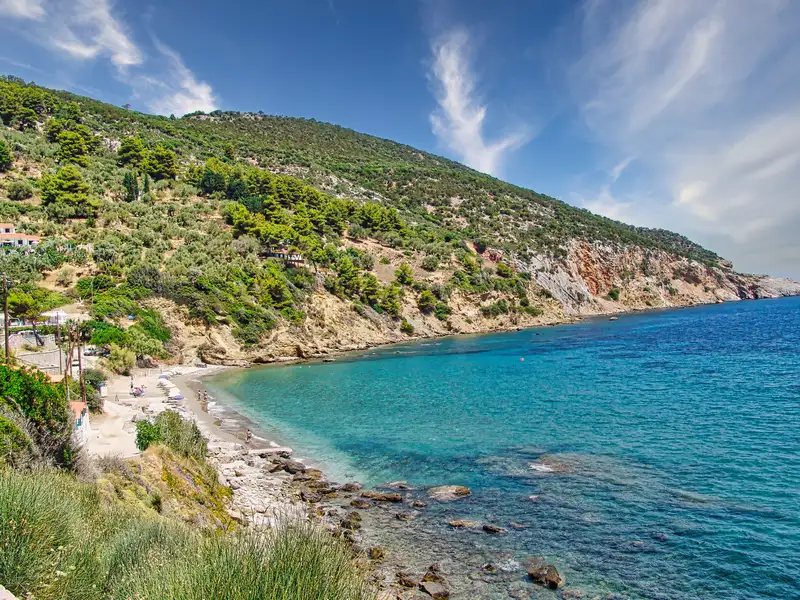
The first thing that strikes you about Skopelos is the smell. The air here does not smell like the Greek islands you have read about in books and magazines. It does not smell like dry stone, oregano, and salt. It smells like pine. Warm pine, in long resin-heavy drifts that follow you up from the harbor into the alleys of Chora and stay on your clothes when you go to bed.
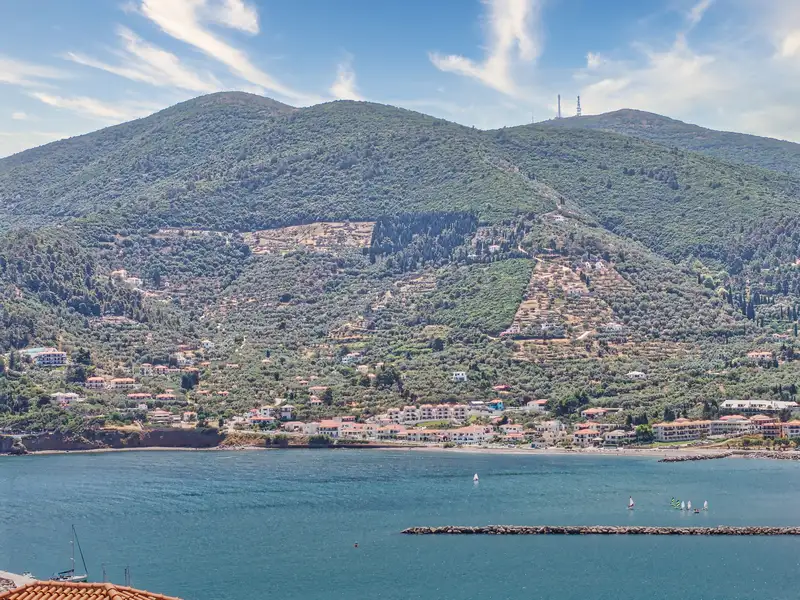
Skopelos belongs to a different country entirely. It is part of the Sporades, a small archipelago in the northern Aegean, and its geography breaks all the rules you might bring with you. More than two-thirds of the island of Skopelos, Greece, is covered in pine forest. That single fact rearranges everything you think you know about a Greek island.
The water is still impossibly blue. The harbor still has its white houses with their terracotta roofs. The tavernas still spill out onto the cobblestones at dinner time. But the green is the first language the island speaks, and once you hear it, everything else fits inside it.
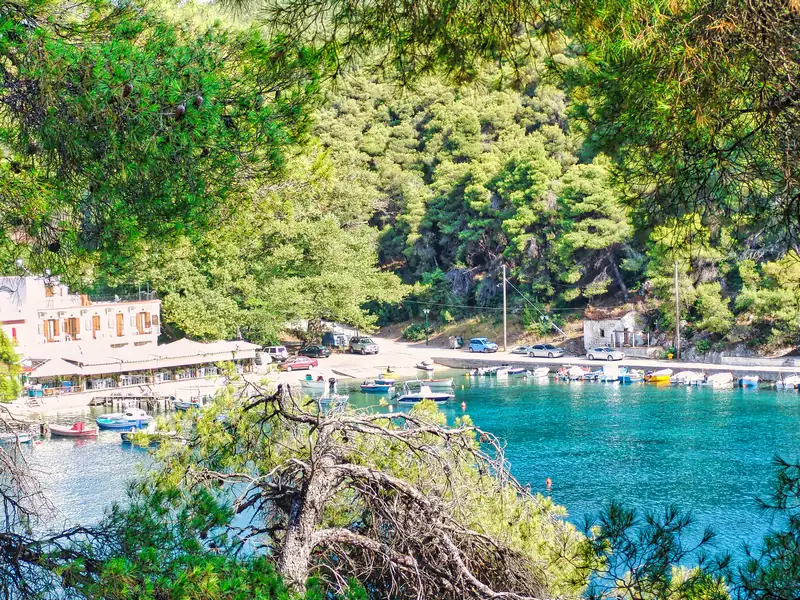
Table of Contents
Getting to know Skopelos Island
On some islands, you meet gradually. Skopelos is one of those. It makes you learn a few things about it first before it really gives in, and those things are simple. It's perched on the Greek seas. Why doesn't it feel like the Greek summer you may have dreamed? The first answer is a matter of geography. The second is a matter of feeling. Both come first because everything that follows rests on them.
Skopelos on the map
Skopelos lies in the center of the Northern Sporades, a string of islands in the northern Aegean Sea between the east coast of mainland Greece and the island of Skyros. It is the central island of the group, with Skiathos to the west and Alonissos to the east, all three so close to one another that on a clear day you can see each from the other.
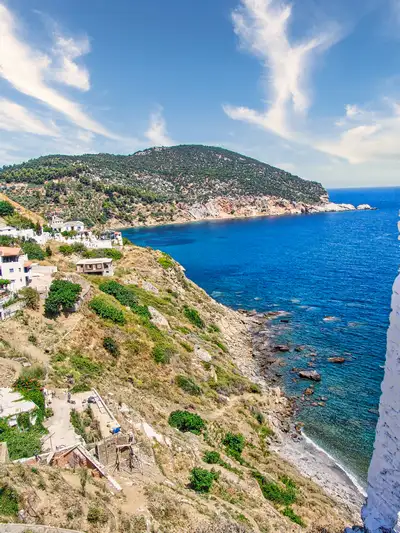
The island is roughly 28 kilometers long from end to end, and remains narrow throughout: it is never more than 8 kilometers wide at its widest point. It is the second largest island of the Sporades after Skyros, but it feels larger than that because much of its surface area is high and covered with forest. The capital, Skopelos town, is built on the slope of a horseshoe-shaped bay on the eastern coast. The second port, Glossa, rises on a steep hillside on the northern coast. In between, a single coastal road connects almost every beach and every village that is worth knowing.
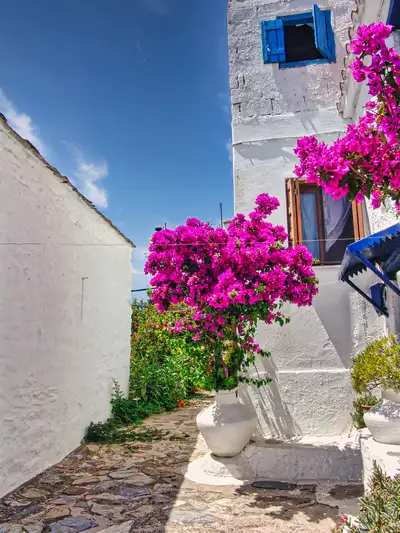
What makes Skopelos unlike any other Greek island
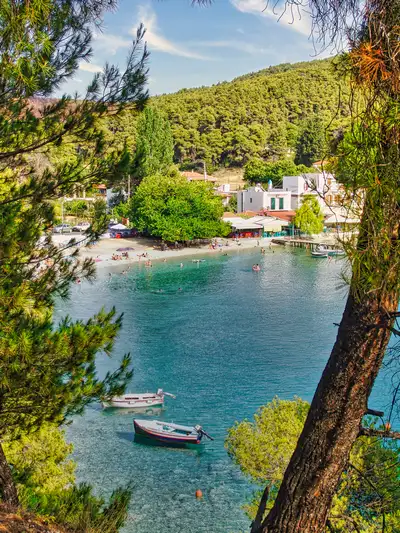
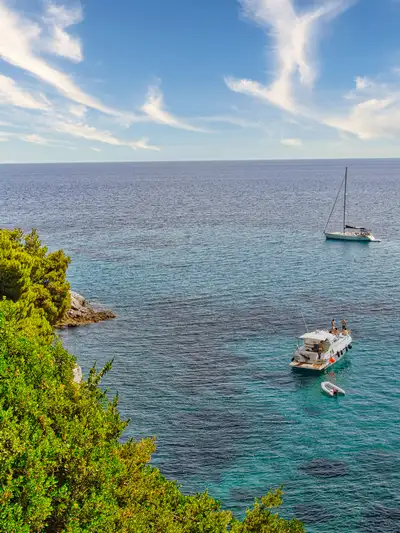
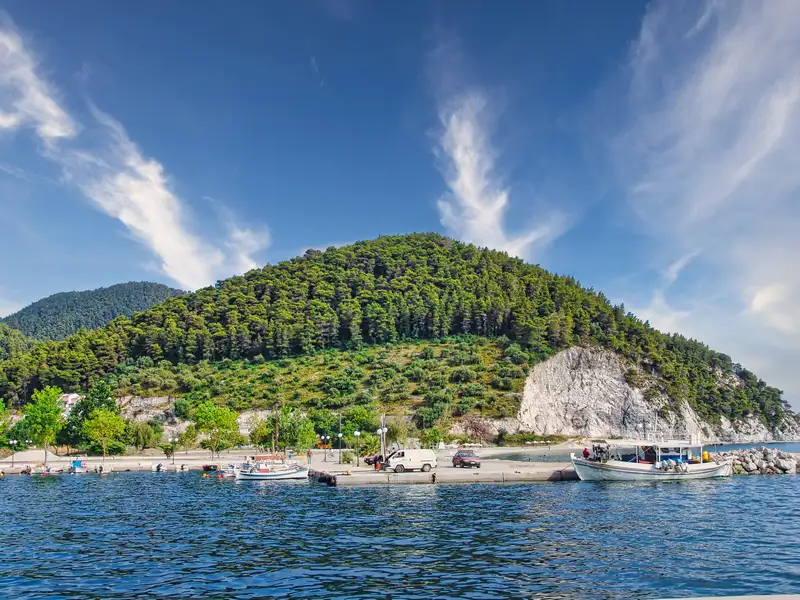
Skopelos is different in one straightforward geographical way: it is green. The visual palette of most Greek islands is worn lightly, sun-bleached, and all but featureless. Still, Skopelos is deeply forested, with pine trees growing right down to the water's edge and shading beaches that on other islands would lie open to the full Aegean sun.
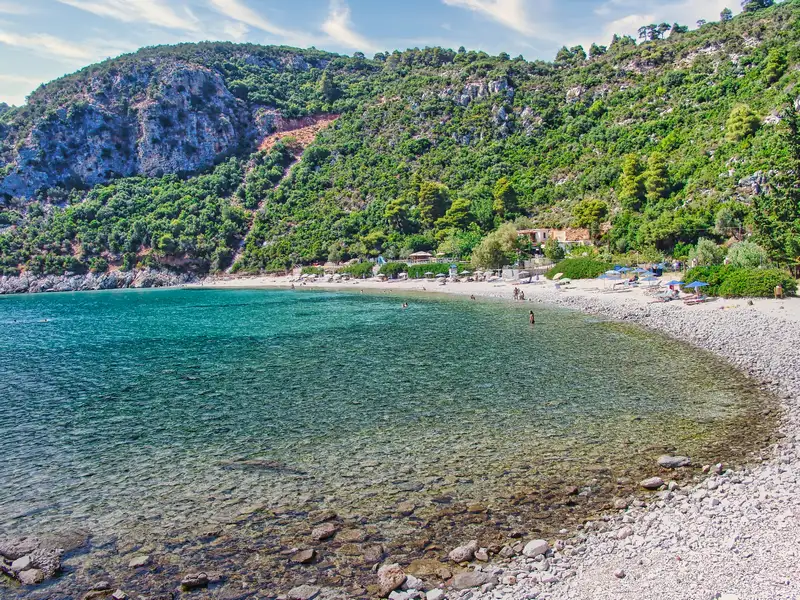
This single fact reorganizes everything. The temperature in the shade is softer. The air smells heavier, sweeter, and more layered. The palette of colors runs cooler. The blue of the sea looks even more electric when set against the green hills behind it. When you sit on a beach in Skopelos, you do not sit on hot sand staring into glare. You sit on white pebbles under pine branches, and the smell of resin in the air mixes with the salt of the sea.
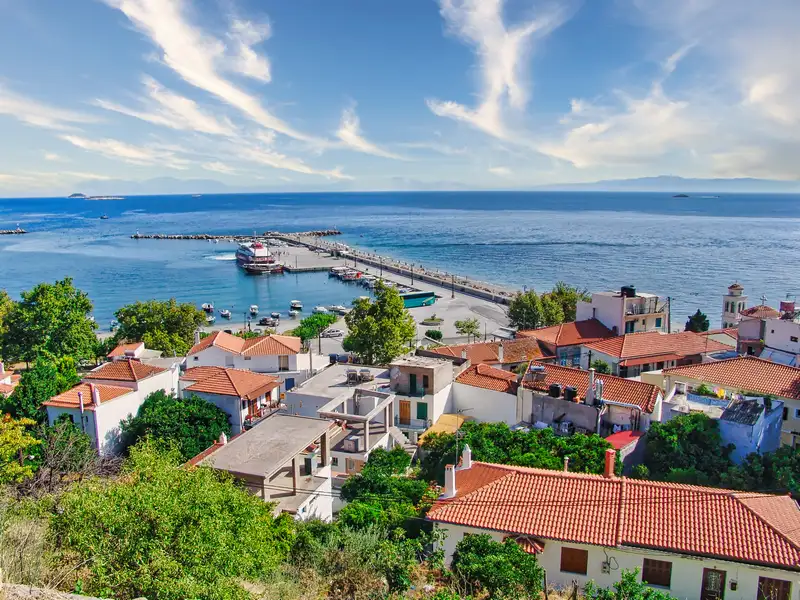
The history and myth of Skopelos Island
Peparithos: the mythical first inhabitant
Skopelos was called Peparithos, after its first mythical inhabitant, the son of Dionysus and Ariadne. The story goes back to the oldest layer of Greek mythology, the one that populates the world with gods and heroes long before the walls of cities were built.
Ariadne, the Cretan princess who helped Theseus out of the Labyrinth and was then betrayed by him on Naxos, was found and married by Dionysus. Peparithos was one of their sons. According to the myth, he inhabited this little wooded island in the Aegean and gave it its first name.
That ancient name lasted for centuries. The present name, Skopelos, appears much later in the texts of the second century AD by Ptolemy and is probably derived from the word skopia, meaning "lookout," a reference to the island's cliffs and high points used to keep watch over the surrounding sea.
The Asclepieion that healed an ancient island
Peparithos was a working city long before Skopelos town was a Hellenistic and Roman port. In a series of excavations southeast of Skopelos town, in an area called Livadi-Ambeliki, one of the Aegean's oldest sanctuaries has been discovered: an Asclepieion, or healing shrine, to the Greek god of medicine.
Archaeological finds on the site, amphoras, architectural elements, statuary fragments, clay figurines, Attic red-figure pottery, and coins from the 4th century BC and into the Hellenistic period, indicate this was no backwater: ancient Peparithos was strategically positioned on the maritime roads between mainland Greece and the Aegean islands, and the scale of the finds is a testament to that wealth.
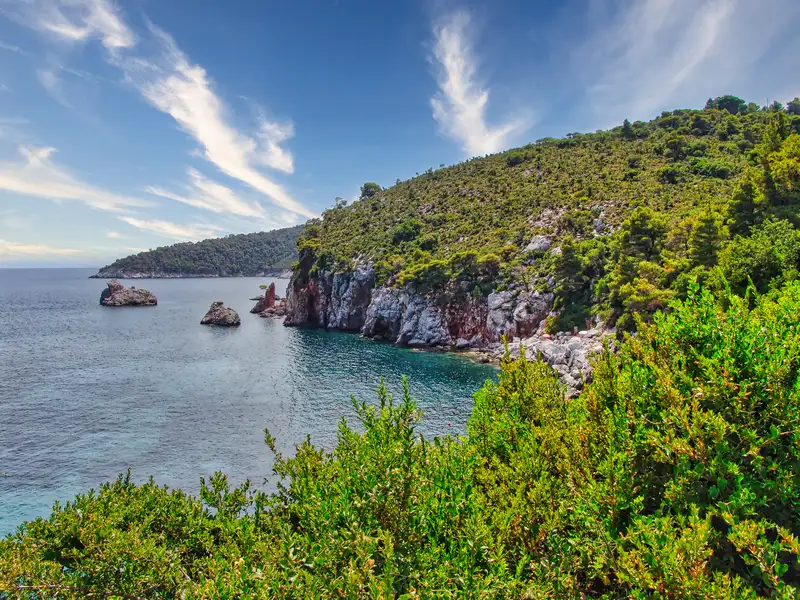
Byzantium, Venice, and the walls of Skopelos
Skopelos' Byzantine and Venetian centuries contributed most of the architecture you pass as you walk today. The monasteries at the summit of Mount Palouki, the ruined fortress castle above Chora, the uncompleted bishop's house known as the Episkopi: these were all built during centuries in which the island was fought over by empires and preyed upon by pirates.
The Venetians rebuilt the castle on the hill above Skopelos town on the site of the ancient acropolis. The monasteries date from the 16th to 18th centuries and were mostly built as fortified refuges where villages could close their gates when raiders were spotted on the horizon. Many of the houses in Chora's village core are in Venetian style, with stacked terracotta roofs and external staircases.
The Ottoman era left relatively few traces on Skopelos compared with other Greek islands. This was because the island was repeatedly raided rather than settled, and because the local population would rebuild their houses in their own style, either as the threat receded or when they were destroyed. The result is a town that seems older than it is, with layers visible if you know where to look.
The villages of the island
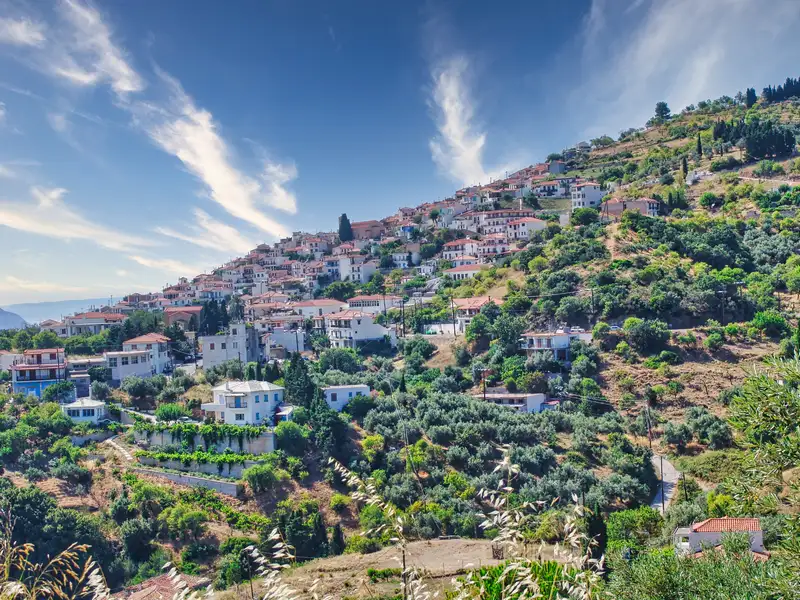
The two main settlements of Skopelos sit at opposite ends of the island and have opposite personalities. Chora, on the southeast coast, is the bustling harbor town where most visitors arrive and stay. Glossa, in the north, is the quieter, hillside village that overlooks the island's second port, Loutraki. Nestled in between sit smaller hamlets, but if you know these two, you know the soul of the island.
Chora, the white town above the harbor
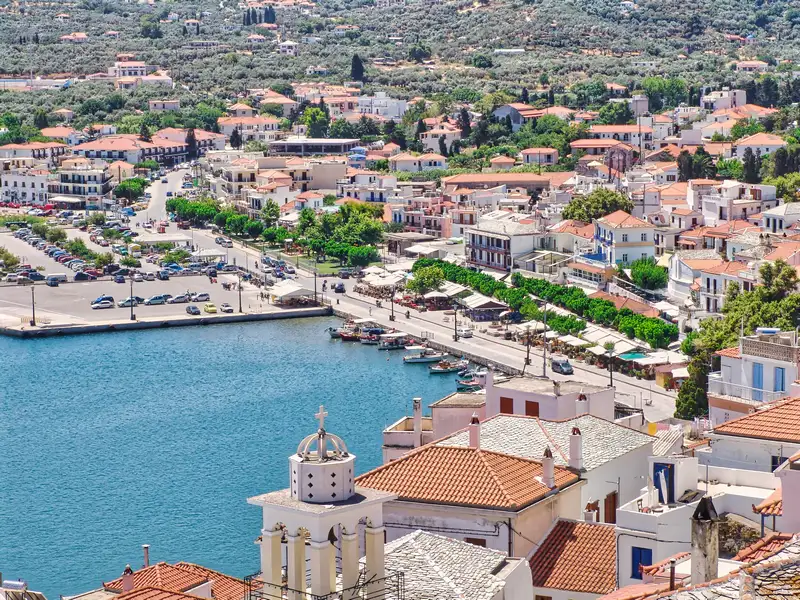
Skopelos town, or Chora as the locals call it, is the kind of place you recall in fragments. The first is the approach from the ferry. When the harbor finally opens in front of you, and the houses climb the hillside in white tiers, and at the very top, the ruins of the Venetian castle crown it all. The second fragment is the moment when you walk into the Labyrinth of cobbled alleyways, and every corner seems to unveil another chapel, another flower festooned doorway, another taverna with chairs waiting out under a vine.
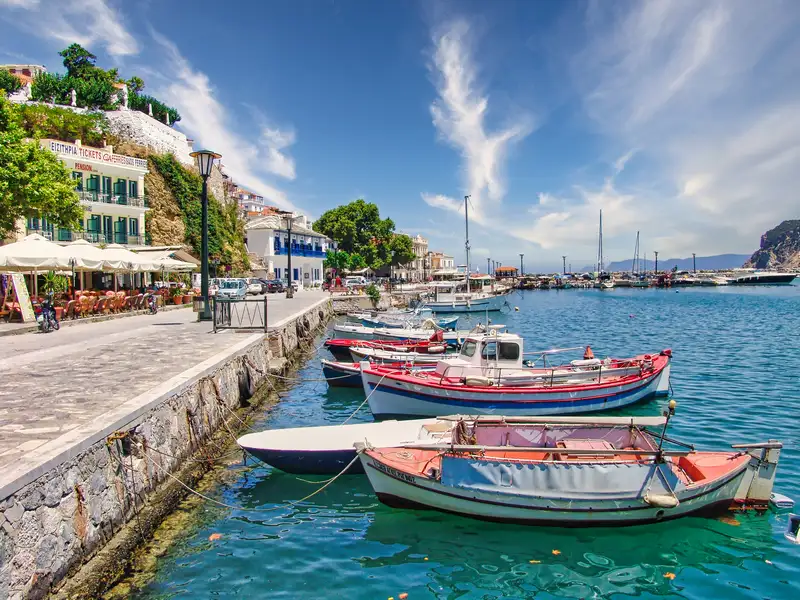
There are over 360 churches and chapels on the whole island, and a large proportion of them are squeezed into Chora itself, wedged in between houses or hidden behind whitewashed walls. The town gradually ascends the slope of the bay, the Kastro ruins at the top, the cafes at the harbor at the bottom, and in the middle a small grid of shops, restaurants, bakeries, and museums that punches far above its weight.
The Folklore Museum, a quiet history of the island
Situated in a restored 18th-century mansion in the center of Chora, the Folklore Museum traces how Skopelians have lived over the centuries. Room after room is given over to traditional costumes, embroidery, household objects, agricultural tools, and wedding dresses, displayed in the musty, overcrowded way good local museums have in common.
For me, it's not about the individual objects but the cumulative effect. By the time you leave, you have an understanding of island life that the beaches and the harbor cannot on their own impart. It's also, on a hot afternoon, one of the coolest and quietest places in town.
The Vakratsa house: how a Skopelian family lived
The Vakratsa Mansion is a typical three-story Skopelian house, restored to show a wealthy local family's way of life in the 19th century. It's in the center of Chora, and you can walk through its rooms looking at the family's personal objects, furniture, and household items, all kept as they were.
The back courtyard is green and shaded, and in the summer, it is used for small cultural events. If you are in Chora on an evening when something is happening here, discover what it is and go. The setting is more memorable than most concert halls.
Pavlos Nirvanas: the home of a Skopelian writer
The Pavlos Nirvanas House is of an entirely different nature. Pavlos Nirvanas was a 19th-century Greek scholar and writer born on Skopelos, and his house in Chora has been made into an exhibition on the island's history. The exhibits follow Skopelos from antiquity through the modern era, weaving together the literary, historical, and quotidian.
It's small and can be done in under an hour, but it will alter the way you see the rest of the town. The Greece I write about on this site is a country of layers, and there is no clearer expression of that than walking through a Skopelian house and finding a thousand years of the island waiting inside.
Glossa and Loutraki, the soft side of Skopelos
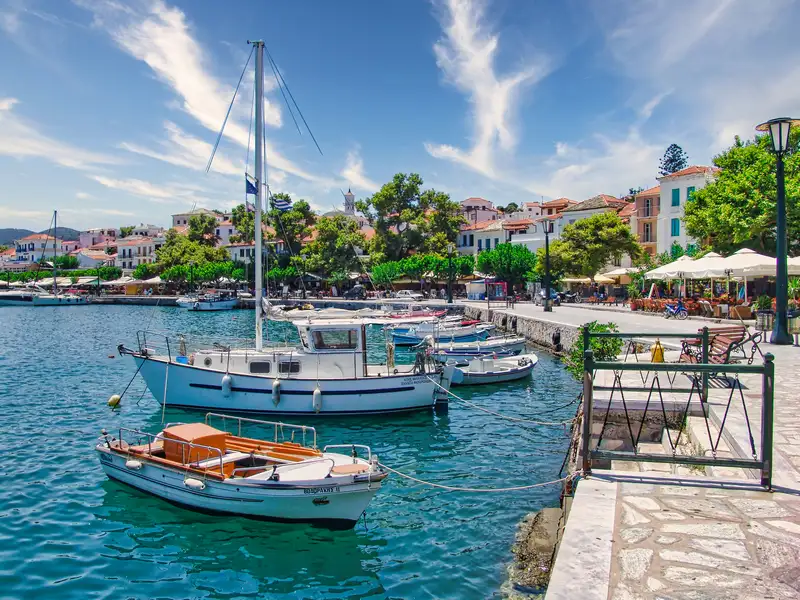
Situated on a hillside in the northwest of the island with views across the sea to Skiathos, Glossa is the second largest settlement on Skopelos, and by far the quieter of the two. It's the kind of place that forces you to slow down your stroll to keep pace with the meandering streets.
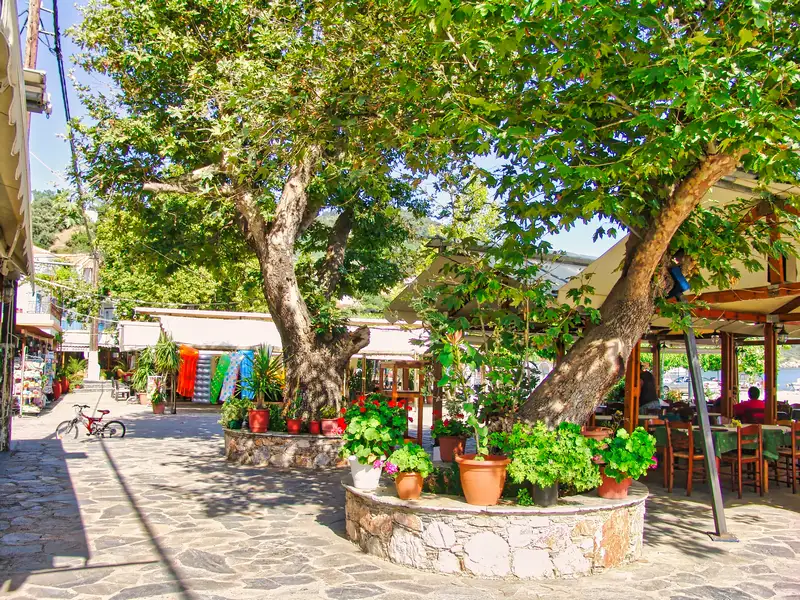
The houses feature a slightly different architectural style from Chora, with their painted shutters in deep blues, reds, and greens, and balconies that jut over the narrow streets. At the center of the village stands the church of Panagia Eleftherotria, the Liberator. Legend has it that a sailor from a shipwreck came to pray at this site and was saved by the discovery of an icon of the Virgin Mary.
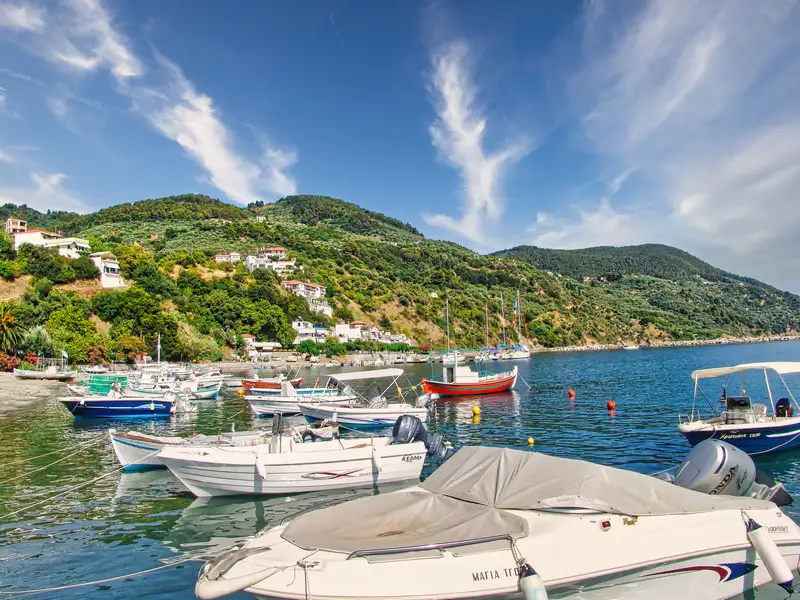
The village has a pottery workshop that still produces pottery in the traditional manner, and you can watch a potter at work on the wheel if you visit in the morning. Down the hill from Glossa is the small port of Loutraki, which is the island's second ferry harbor, as well as a peaceful place to swim in its own right. A few tavernas line the water's edge. If you arrive on one of the slower ferries from Skiathos, then Loutraki is your first glimpse of Skopelos, and the softer tone is set against Chora.
Where to swim on Skopelos
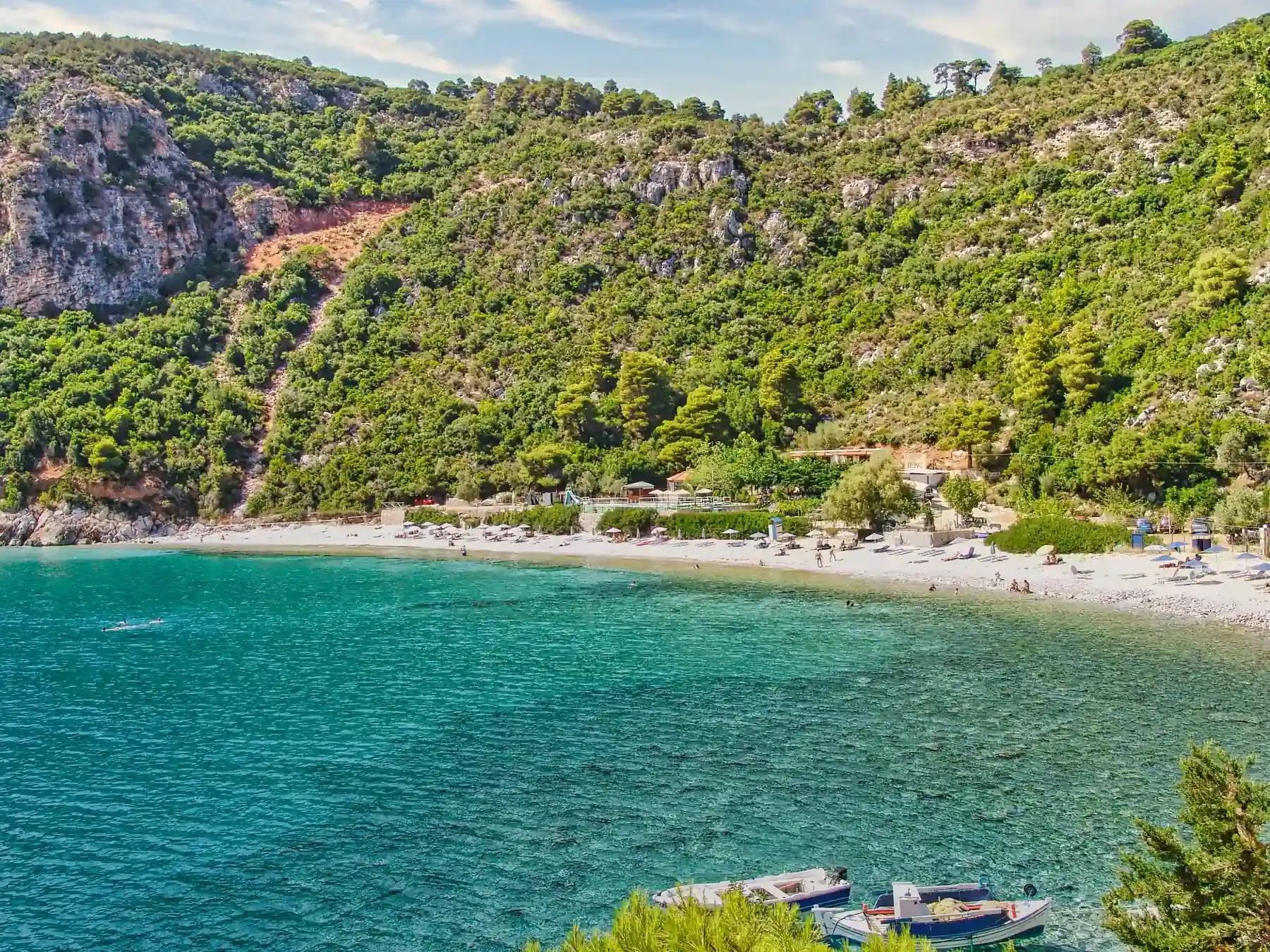
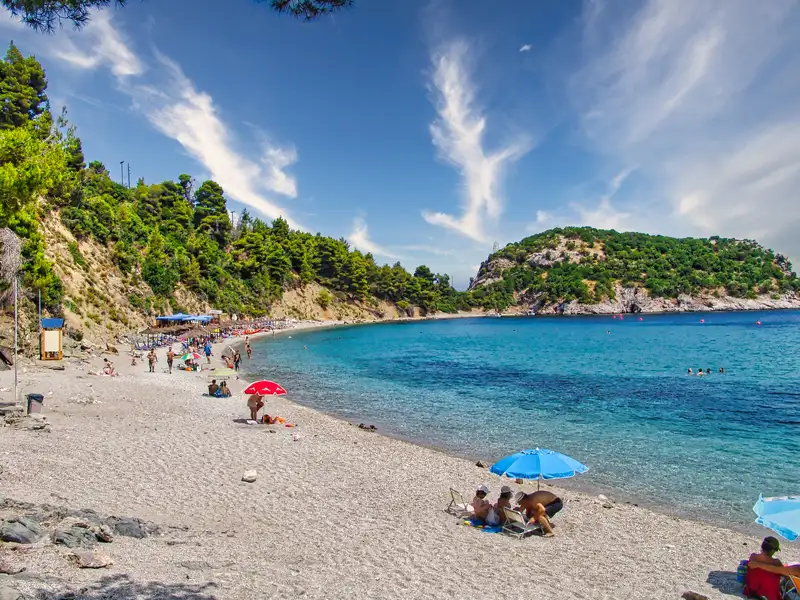
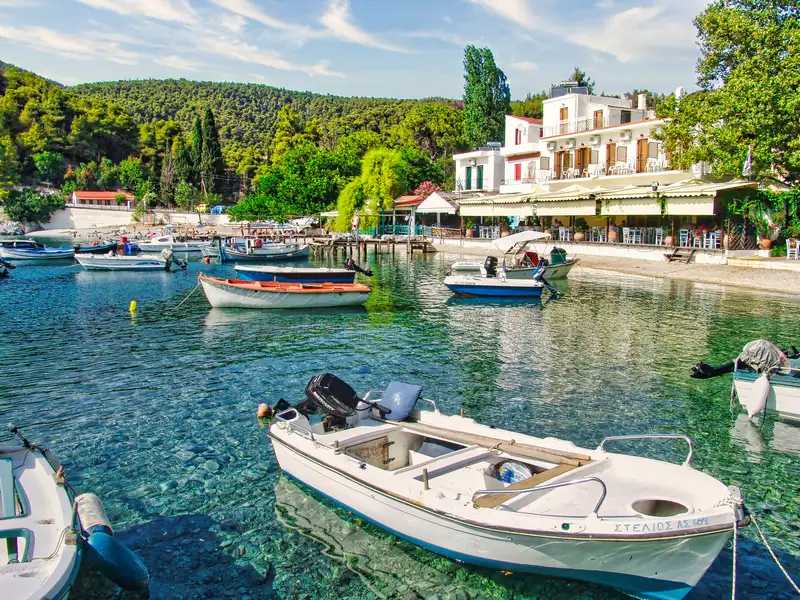
Skopelos' best beaches are pebble beaches with pine trees on either side, and turquoise-to-cobalt water washing over the pebbles. This is about as far away from real sand as you can get, but the white pebbles are surprisingly easy to get used to, and they keep the water above them crystal clear.
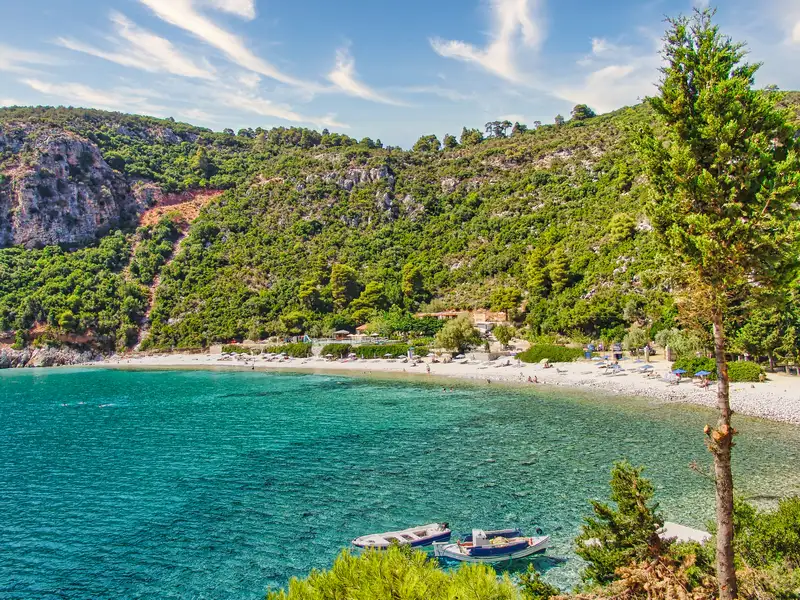
Kastani is the most famous, as most of the Mamma Mia beach scenes were filmed here, while Milia is the most beautiful, a long curve of white pebbles and pine shade.

Panormos is on the west coast, in a large, protected bay, and is the best family beach, while the closest swimming beach to Chora is Stafylos, with the wilder Velanio just behind it. Hovolo is a white-cliffed string of coves below Elios, and Limnonari is a gentle, golden curve south of Agnontas that's calm enough for children. Glysteri is the closest northern beach to Chora and one of the few with real sand.
The archaeological sites of Skopelos Island
Skopelos' archaeological sites aren't the kind to be found on the daily tour bus itinerary, but they're real, atmospheric, and the story they tell, from the 4th century BC through the Venetian period, is one that will add a couple of centuries to the age of the island and several layers to the postcard pretty version of Skopelos.
The Asclepieion of ancient Peparithos
The Asclepieion of ancient Peparithos is located southeast of Skopelos town, in Livadi-Ambeliki, on a quiet, cove-lined coast. The sanctuary of Asclepius, the Greek god of healing, was one of the oldest in the Aegean, with excavations uncovering amphoras, clay figurines, Attic red-figure pottery, and coins from the 4th century BC through Hellenistic and Roman times.
What you see today is the footprint of the sanctuary and a scattering of stones, with the sea close enough to hear from the site. The setting is more impressive than the remains, but if you know what they've found here before you go, the place quietly comes alive. It also provides a useful idea of what Peparithos was before it became Skopelos: a working maritime town with its own major religious site.
The Roman tombs at Sentoukia
The Roman tombs at Sentoukia are rock-cut burial chambers in the forest of Mount Delphi, some nine kilometers west of Chora. The name means "small chests", which is what they look like. They are rectangular stone graves cut directly into the bedrock, lined up under the trees.
The site is not prominently signposted at all, and the road that leads there becomes a narrow forest track for the final stretch. But once you are there and walk among the tombs and listen to the wind in the pines, you feel like you have stumbled into a place the modern map has not noticed.
The Venetian castle that crowns Skopelos town
Atop Chora, perched on the acropolis of the ancient city of Peparithos, is the Venetian castle of Skopelos, or Kastro, as the locals call it. The walls of the castle are partially in ruins, but that's only half the reward for climbing the cobbled stone alleys up the hill.
The view from above is the other half. The white town pours down into the harbor below, the bay curls away, and on a clear day, you can make out the shapes of Skiathos and Alonissos in the distance. There is a small chapel among the ruins. Cats live here in the summer months, surveying all calmly. Go at the end of the day when the sun tugs the white walls into gold, and the lights on the harbor begin to come on.
Episkopi, the unfinished Venetian seat
Episkopi is an incomplete Venetian building that was never completed because the pirate Barbarossa invaded the island in the 16th century. It was to have been the seat of the Bishop of Skopelos. It is a building suspended in time – half-finished and half-ruined, slowly being reclaimed by the earth that surrounds it.
It is reached by a short walk from Chora and has very few visitors. If you are interested in the island's complex history and have already visited the Kastro, this is the next place to visit. It is a poignant place, as it speaks to the ambitions of history and to how things can be forgotten and abandoned. It also speaks of how exposed even the most protected islands once were.
The monasteries of Skopelos
Monasteries in Skopelos are found mostly on Mount Palouki, the green ridge that rises east of Chora, and most date from the 16th to 18th centuries. Skopelos has over 360 churches and chapels, perched on hillsides and in villages, but it is the fortified monasteries on Palouki that give Skopelos its spiritual heart.
Most of them were built defensively, with thick walls and small windows, since many had to double as refuges during centuries of pirate raids in the Aegean. Some are still in use and open to visitors during set hours.

The monastery of Evangelistria, the jewel of Palouki
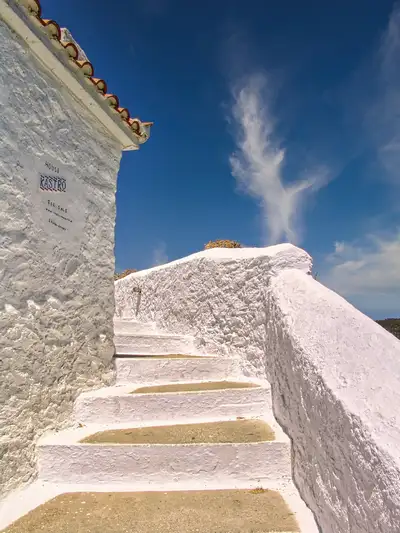
The most popular and the most attractive monastery of the Palouki group is the monastery of Evangelistria. It is built on a hill, east of Chora, offering a nice view over the town and the harbor, below. It was rebuilt in 1712, and its fortified walls, the bell tower, and the carved wooden iconostasis make it the most photographed religious building in the Sporades.
The church has 18th-century frescoes and one of the finest iconostases in the area. It is gilded and carved with great detail. The monastery is operational and has a small community of nuns. They sell honey, herbs, and embroidery in a tiny shop near the entrance. It is necessary to dress modestly, and there are wraps at the door if you come in shorts.
The monastery of Timios Prodromos, hidden in the pines
The monastery of Timios Prodromos (dedicated to St John the Baptist) perches at a higher elevation, in a clearing surrounded by pine trees on Mount Palouki. This is an active women's monastery, much smaller and more intimate than Evangelistria, and it's one of my favorite places on the island.
The nuns who reside there weave, make icons, and garden in a small plot of land. The chapel itself is unadorned on the outside and quietly beautiful inside, with frescoes that have softened with age. If you happen to get there early in the morning, you may hear the bells ringing through the forest below, and understand why this kind of life has been chosen here for centuries.
Metamorfosi Sotira, the silent place on Palouki
The monastery of Metamorfosi Sotira, the Transfiguration of the Savior, is the oldest of the Palouki monasteries. It's small and mostly inactive, and atmospheric in the way only old, quiet buildings can be.
The walk to reach it passes through a pine forest, and the monastery itself sits in a clearing with views down towards the sea. There is rarely anyone else there. If you sit on the low wall outside for a while, you start to hear the sounds the silence is made of: the wind, a distant bell, a single goat somewhere down the slope.
Agia Varvara, the monastery built into the rock
The monastery of Agia Varvara is the most dramatic of the monasteries of Palouki. It is dedicated to Saint Barbara, built into the side of a sheer rock face, partly ruined. There's a story that it was used as a place of refuge when pirate raids threatened, and you can see how that might be so, with the fortified outer wall, the near-hidden entrance.
The walk to reach it is a little longer than the others, but the setting is worth it. You are on the edge of a green ridge, with the rock and the old stones underfoot, and you see why people wanted to be here when the wider sea was full of menace. It's the sort of ruin that doesn't need restoring. It's enough on its own.
Panagia Eleftherotria, the story of an icon and a sailor
The monastery of Panagia Eleftherotria, the Liberator, is perched above the village of Glossa in the northwest of the island and is the most significant spiritual center for that area of Skopelos. The monastery's name comes from the tale of a shipwrecked sailor who stopped here to pray for deliverance and, by chance, discovered an icon of the Virgin Mary, which he claimed saved him.
The church itself is small and white, and is perched on the side of a hill with views down to Loutraki and across to Skiathos. The summer feast day draws visitors and locals alike, and the celebration that ensues is one of the friendliest community events I have come across anywhere in Greece.
The soft trails of a forested island
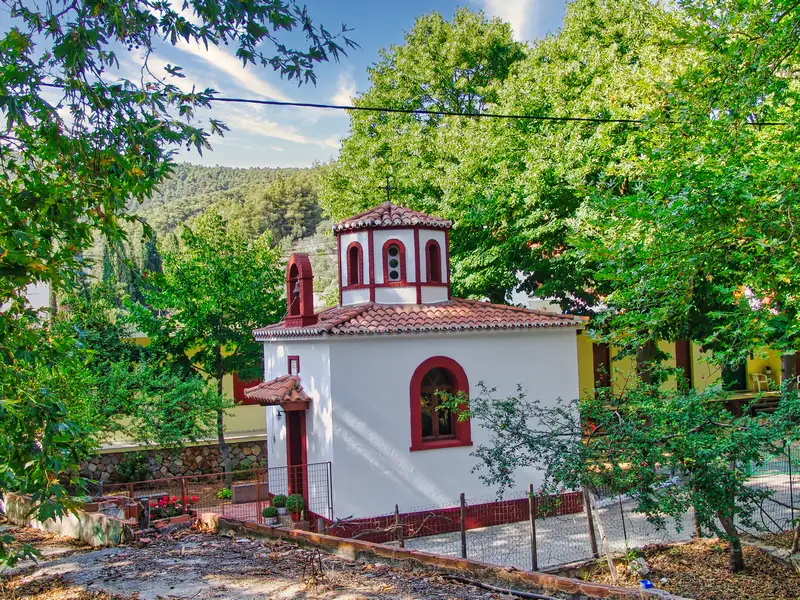
Hiking on Skopelos is different from hiking on most Greek islands; the trails are through the forest, not over bare hills. The canopy of pine needles casts shade, the smell of resin hangs in the air, and the temperature is never excessive even in the hottest summer weather. For a country as sun-bleached as Greece, this is a gift.
Mount Delphi, in the center of the island, is the highest point of the Sporades at 681 meters. The slopes are densely forested, the trails can be overgrown, and climbing to the summit is best with a guide, unless you are an expert at route-finding. The reward is a view that includes the entire archipelago.
Mount Palouki, east of Chora, is the easier and more rewarding option for most visitors. The monastery trail is well marked, the elevation gain is not excessive, and you walk in good shade for most of the way. The island also has a network of older paths between villages and along herding routes and chapel approaches that you can link together for longer walks if you have a good map or local guide.
Compared with the rocky walks of Sikinos or the volcanic shores of Milos, the trails of Skopelos offer something completely different: the rare experience of walking through a Greek forest with the sea always just behind the trees.
The local food of the island
The cuisine of Skopelos is based on the island's own produce and is among the most distinctive of any Greek island. The dish that is the calling card of the place is the Skopelitiki tyropita, the twisted cheese pie, or strifti as it is locally known, made from very thin phyllo dough, rolled into a long coil, and fried until golden. Rich and salty, it is a cheese pie like none you have eaten on the mainland, and every taverna does its own version, which serious eaters will compare over several days.
The other great Skopelian product is the local plum, the avgato. It is small and sweet, and it becomes an excellent prune, which is exported to kitchens all over Greece every winter. You will find avgato plums fresh in the markets in July and August, and in jams, sauces and meat dishes year-round. There are two other varieties grown on the island: a sour plum for jams and a French Agen plum used in cooking as well as dried as prunes.
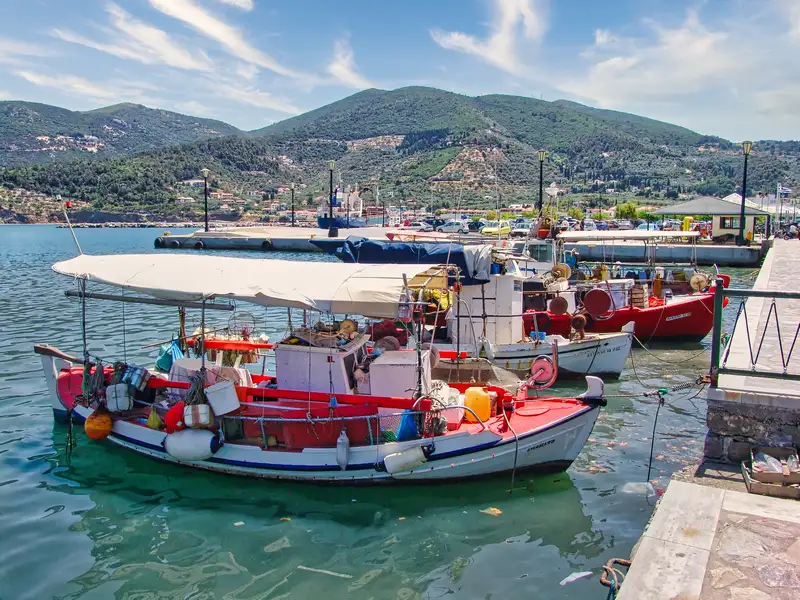
The fish in Skopelos is excellent, especially in the little port of Agnontas, where a few tavernas serve grilled octopus, fresh anchovies, sea bream, and the daily catch within walking distance of the boats that brought it in: honey, olive oil, and almonds round out the picture. The island is small, but it produces an astonishing amount of what it eats.
Day trips and island hopping from Skopelos
Day trips from Skopelos have something of a homefield advantage thanks to the island's position at the center of the Northern Sporades. To the west lies Skiathos, and to the east, Alonissos, both less than an hour by ferry from the port in Skopelos town.
Skiathos is the more crowded and developed of the two, with a recently expanded airport (the only one in the Sporades) and some of the best sandy beaches in Greece, including the iconic Koukounaries. It's a different rhythm from Skopelos, a bit more cosmopolitan and noisy, but a nice juxtaposition for a day trip.
Alonissos is the opposite: quieter and smaller, it's home to the National Marine Park of Alonissos and the Northern Sporades, one of Europe's most important marine protected areas. The park is home to the Mediterranean monk seal and dolphins, as well as wild, uninhabited islets, and a boat tour from Skopelos or Alonissos itself takes you through it, with stops for swimming in spots that feel truly wild.
Planning your trip to Skopelos Island
How to get to the island
Skopelos does not have an airport. The ferry is the only means of transport to the island. The most popular routes are from mainland ports of Volos, Mantoudi (Evia), Agios Konstantinos, Thessaloniki, and from the neighboring island of Skiathos.
If you are flying to Greece from overseas, the quickest way is to fly to Skiathos International Airport, which during the summer months has direct seasonal flights to many European cities, and then take the short ferry to Skopelos. The crossing from Skiathos to Skopelos takes from 30 minutes to 1.5 hours, depending on the vessel.
For travelers from Athens, there is no direct ferry connection from Piraeus or any other port in Athens. The most common way is to drive or take a KTEL bus from Athens to Volos (approx. 3.5 hours by car, longer by bus), then take a ferry from Volos to Skopelos, which takes 2 to 4 hours, depending on the vessel type and the port of arrival.
The best time to visit
The best times to travel to Skopelos are late May and early June or mid-September and early October. The weather is good, ferry services are high-frequency, and tavernas are open, while fewer tourists visit the island during these months.
July is also a good time to visit, but the island gets busy, especially in August, the most crowded month of the year, particularly during the first two weeks, when Greek families come to the island for their holidays.
How many days do you need?
A minimum of four full days is needed on Skopelos to really do the island justice, and a week or so to really begin to feel it. Four days will allow you to visit Chora, take in the Mamma Mia sites, explore a few great beaches, and make a monastery trek.
Five or six days will see you visit Glossa, the Alonissos Marine Park, and eat at your leisure. One week or more will allow you to hike up Mount Palouki and find the beat within your own beat. I'd be honest with you and say that it's better to err on the long side. The island plays fair, and there are rewards for staying.
How to get around
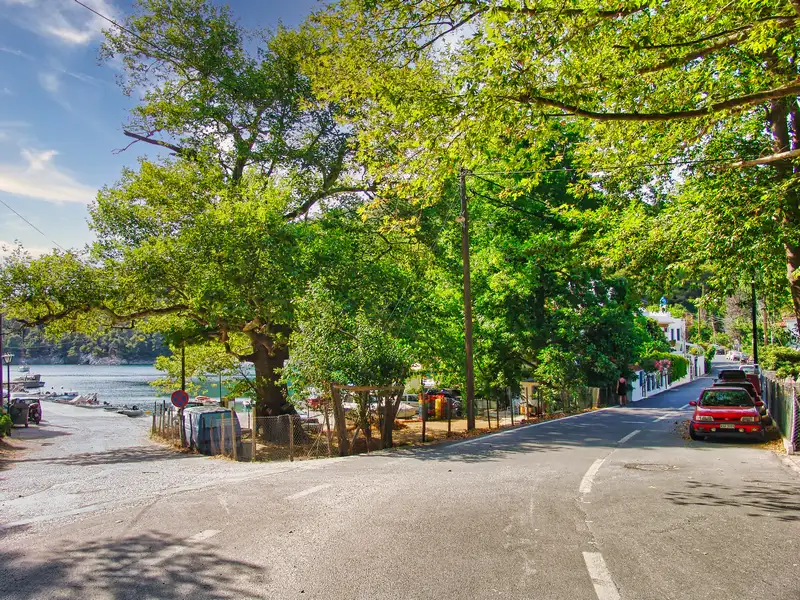
The best way to get around Skopelos is by rental car, especially if you are looking to visit the more remote beaches and monasteries. The coast road is paved for most of its length, distances are short, and parking is no issue outside of Chora.
If you are traveling in July or August, be sure to book in advance. Scooters and quad bikes are ideal if you want to do short hops between beaches. The island bus service is reliable on the Chora-Loutraki route, calls at most major beaches, and has a limited but very basic schedule.
Taxis are available but expensive over long distances. Water taxis ply the route between Chora and Glysteri in summer, and small boats can be hired from the harbor.
Where to stay
For first-time visitors, I think the best base is Skopelos town (Chora), which has the widest range of restaurants and shops and is closest to the ferry and buses. Stafylos and Panormos offer a small clutch of accommodation overlooking their respective beaches, which may be best if you'd like to swim every day and drive into Chora in the evening.
Glossa and Loutraki are by far the quietest bases, with the disadvantage of distance from the southern beaches. There are very few large resorts on the island, which I regard as an excellent thing.
Quick answers about Skopelos
What is Skopelos known for?
Skopelos is known for three things: it is the filming location of the 2008 musical Mamma Mia, it is the greenest Greek island (more than two-thirds of its area is pine forest), and it is the third largest of the Northern Sporades island group.
Is Skopelos worth visiting?
If you are looking for an authentic Greek island with genuine natural beauty, a less hectic atmosphere and fewer crowds than the crowded Cyclades, and a strong local identity, Skopelos ticks all the boxes. It is more effort to get to than Santorini or Mykonos, but the effort is worth it.
Is there an airport in Skopelos?
There is no airport on Skopelos. The closest airport is on the neighboring island of Skiathos, a 30-minute ferry ride away. Skiathos has direct flights from many European cities in the summer, and year-round domestic flights from Athens and Thessaloniki.
Is Skopelos better than Skiathos?
Skopelos is quieter, greener, more authentic, and better suited to the traveler who prefers hiking and monasteries to partying and beaches. Skiathos, on the other hand, is the obvious choice for families because it has an airport and better-developed beaches. Many travelers choose both on the same trip.
Can you visit Skopelos as a day trip?
It is possible to visit Skopelos as a day trip from Skiathos or from the mainland port of Volos. Boat tours and ferries run regularly in the summer, and a day trip will allow you to see the town, a couple of beaches, and Agios Ioannis, the chapel seen in Mamma Mia. But if you do have time, you should consider staying longer, as Skopelos deserves it.
Is Skopelos expensive?
Skopelos is a moderately priced Greek island. It is cheaper than Mykonos and Santorini. Accommodation, food, and transport are at fair Greek-island prices, with the usual peak in August. Tavernas in particular are good value, and the excellent local produce keeps food costs down even in the busiest months.
Is Skopelos good for families?
Skopelos is a great destination for families. The beaches are calmer and shallower in many bays, the rhythm of the island is slower, and there are no party scenes or nightclubs to get in the way of planning days around children. The most family-friendly beaches are Panormos, Limnonari, and Stafylos.
A quiet island and the memory of it
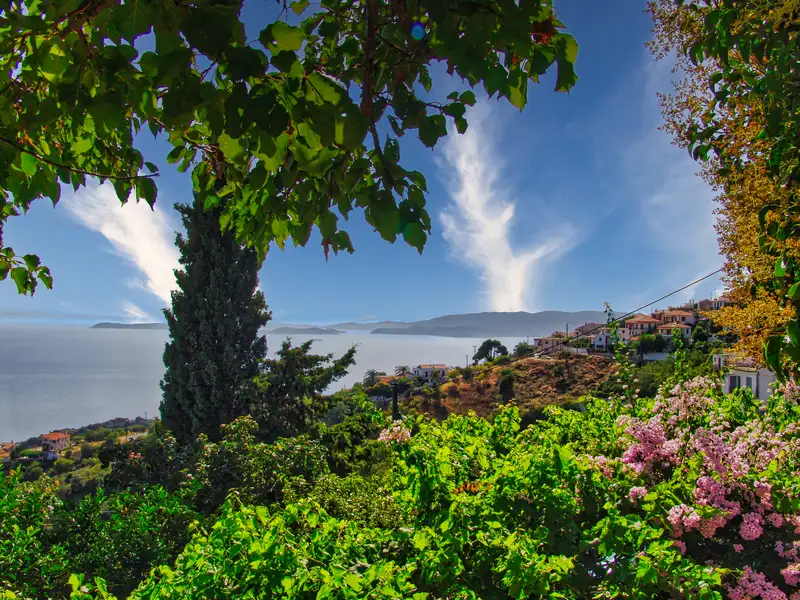
I first arrived on Skopelos as a young man who had spent every summer of his life in the Cyclades, and Skopelos stayed with me in a way I did not expect. The green stayed with me. The smell of pine on my clothes stayed with me. The feeling that I had been somewhere a little softer and a little older than the islands I knew.
I have returned many times since. I have walked Mount Palouki in May, when the wildflowers cover the trail. I have eaten far too much tyropita in Chora. I have sat on a quiet beach in September, listening to the pines move in the wind. The island has never once let me down.
Go if you can. Stay longer than you meant to. Walk up to the Kastro at sunset. Find a small chapel in the hills and sit with it for a while. Eat the cheese pie. Take the ferry to Alonissos and look back at Skopelos from the water. The island will give you what it gave me, which is a quiet, particular kind of memory that does not fade. And the next time someone asks you where to go in Greece, you will pause, because the honest answer might be a small green island in the Sporades that most people have never thought to ask about.