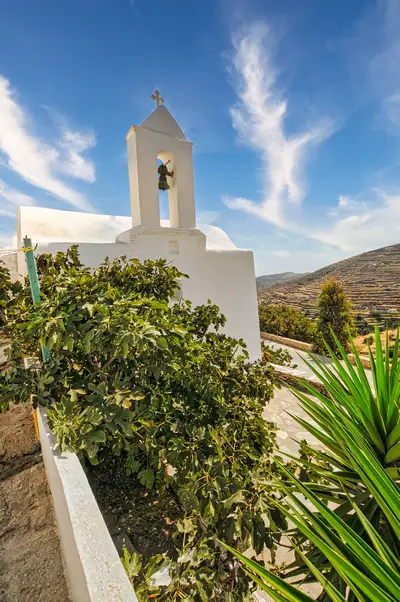
There is a jar of thyme honey from Sikinos in my kitchen in Athens. I have had it since September. I bought it on my last morning on the island from a small shop in Chora from a woman whose grandfather kept the bees. Every time I open the lid, I take a piece of that place back. The dry heat of the slope. The smell of wild herbs in the wind. The silence that, somehow, smelled of itself.
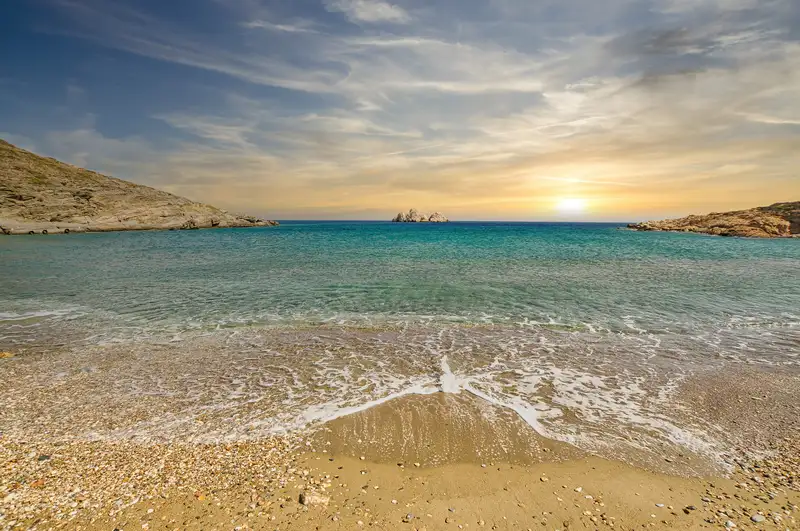
I have been writing about the Greek islands for a long time now, and most of them, I love. A few I keep returning to in my head, long after the summer ends. Sikinos is one of those few. Small, almost forgotten, sitting in the southern Cyclades between Ios and Folegandros, it offers almost nothing in the way of obvious attractions. That is exactly what makes it worth the journey.
What follows is the guide I wish I had read before I went. The practical things, yes, but also the small, honest things. Where to walk in the early morning. Where the light goes in the late afternoon. Why, the people who find Sikinos tend to keep finding it, year after year.
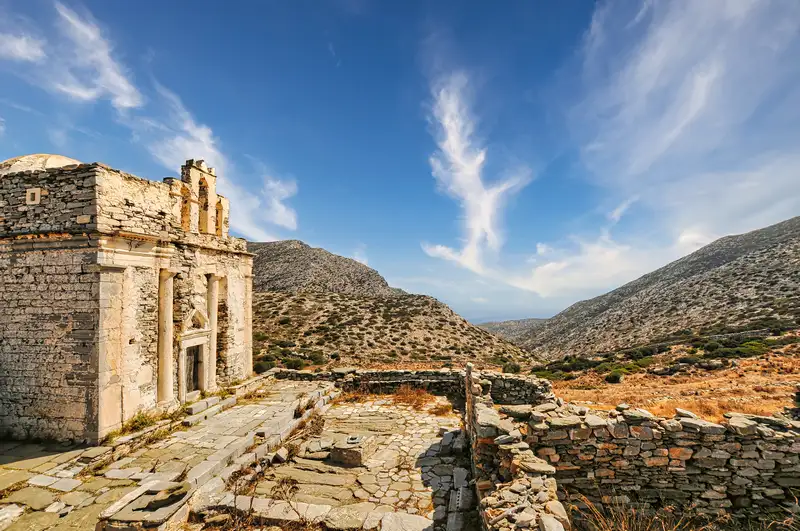
Table of Contents
Finding Sikinos between Ios and Folegandros
Sikinos is one of the southern Cyclades, located between Ios and Folegandros, almost midway between Piraeus and Santorini. It is one of the smallest of the inhabited Cyclades and one of the least known.
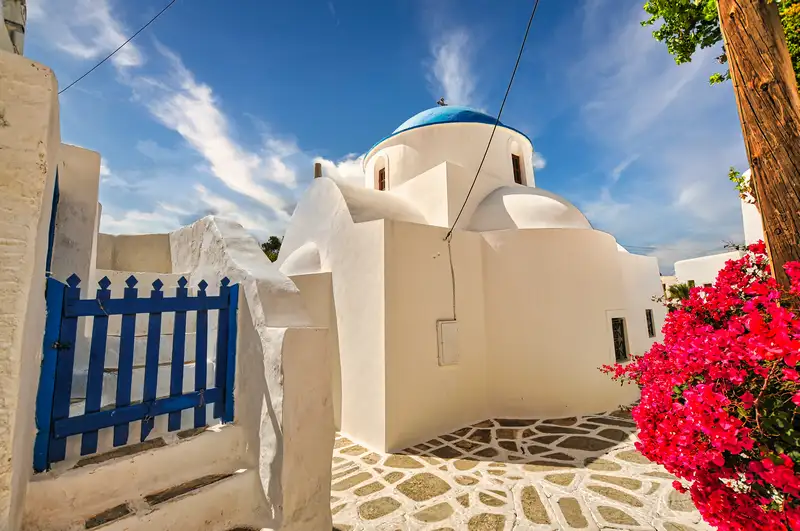
If you trace a line on a map from Ios to Folegandros, Sikinos is almost exactly at the midpoint. From the cliffs of Folegandros, you can see it from the beaches of Ios, in the west, even more clearly. Most people sail past without ever getting off the ferry. That is part of what makes it what it is.
The island is approximately 42 square kilometers. The year-round population is about 260. 18 There are 18 kilometers of paved road, give or take. One petrol station. A few hours open a day. Two real settlements. A handful of beaches. The numbers are small enough to fit in your hand, and that is exactly what you feel when you arrive.
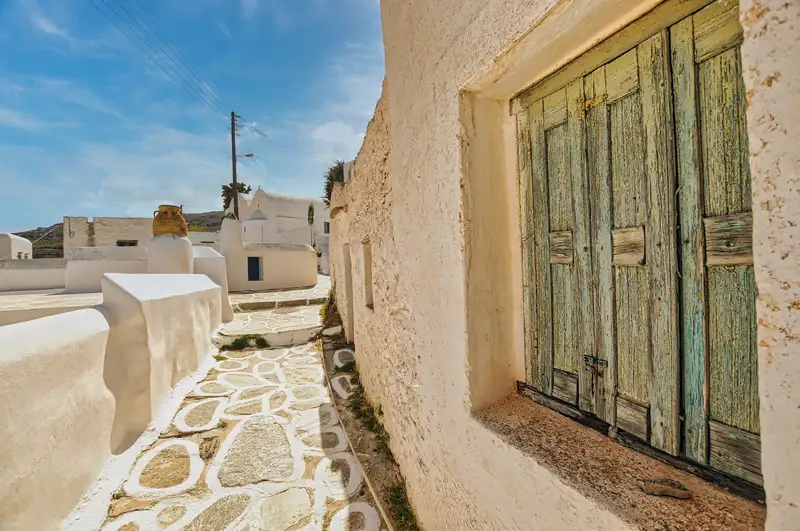
The long, quiet story of Sikinos
The story of Sikinos begins in the Bronze Age, with its settlement by the Mycenaeans, its first name from its love of wine, and a long, peaceful life influenced by conquest, religion, and piracy.
The Name Oenoe and the Wine
Before Sikinos, the island was called Oenoe. Oenoe comes from the Greek oinos, which means wine. When the island was first documented, it was noted to be rich in vineyards, and ancient texts mention the island for the quality of the wine produced there.
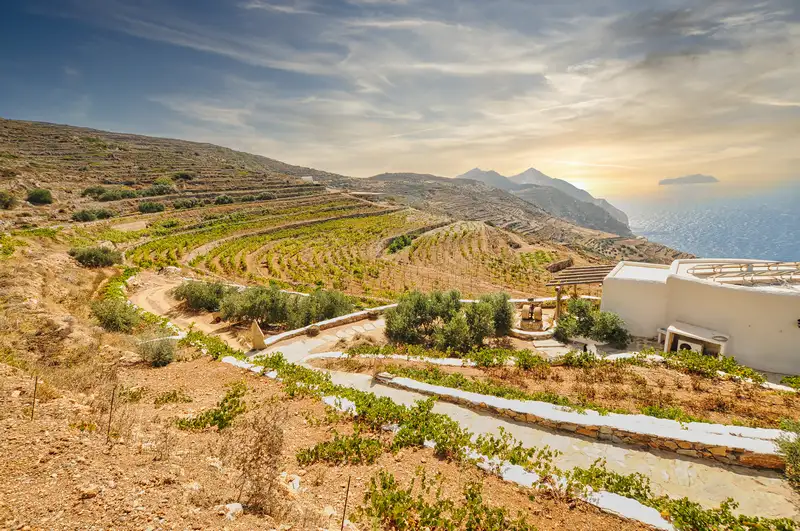
If you are on the western side of the island around sunset, with the slope falling away towards the sea, it is easy to see how this place became a place for wine. The light here is gold, and the terraces are very old, like everywhere. In some of them, there are still vines.
The Myth of Sikinos and King Thoas
Sikinos, as the island is now called, is named after a myth that is older than the historical record. Thoas was the king of Lemnos. According to myth, Thoas' daughter, Hypsipyle, saved his life by putting him in a wooden chest and setting him adrift. He landed on the island of Oenoe, where he met a nymph living on the island. They made love and had a child. The child's name was Sikinos. The island was renamed and has since carried that name for almost 3,000 years.
I like this myth because it is like the shape of the place. A man comes by sea, he is alone, and he finds a quietness here. A child is born. The island is given a name. Nothing more.

From Mycenaean footprints to Byzantine domes
Sikinos was first inhabited by Mycenaean Greeks, then by Ionian Greeks, then by Romans, and finally by Byzantines. You can see the remnants of each at Episkopi, where a Roman mausoleum from the third century was converted to a Christian church in the Byzantine era, and remains today.
The Byzantine centuries gave rise to the small chapels tucked into the hills, the post-Byzantine icons that hang in the folklore collection in Chora, and the rhythm of religious feasts that the islanders still keep.
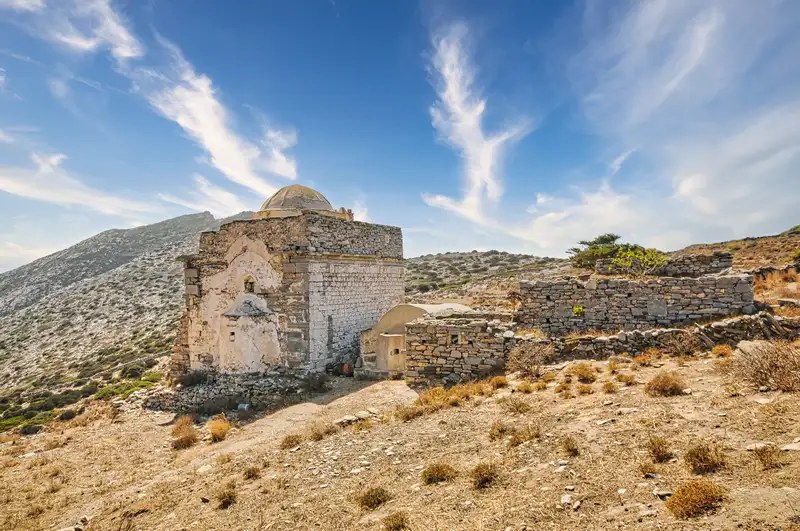
Kastro and the long memory of pirates
In the fifteenth century, the islanders built Kastro. It's on the edge of a cliff. The houses face inward, forming a single defensive ring. The pirates of the South Aegean were the reason. For centuries, the people of Sikinos lived between the sea that fed them and the sea that frightened them.
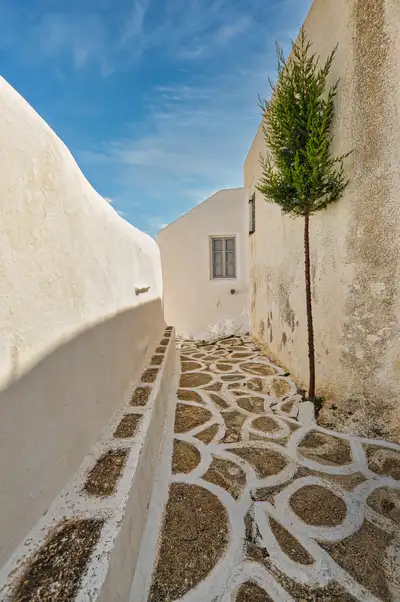
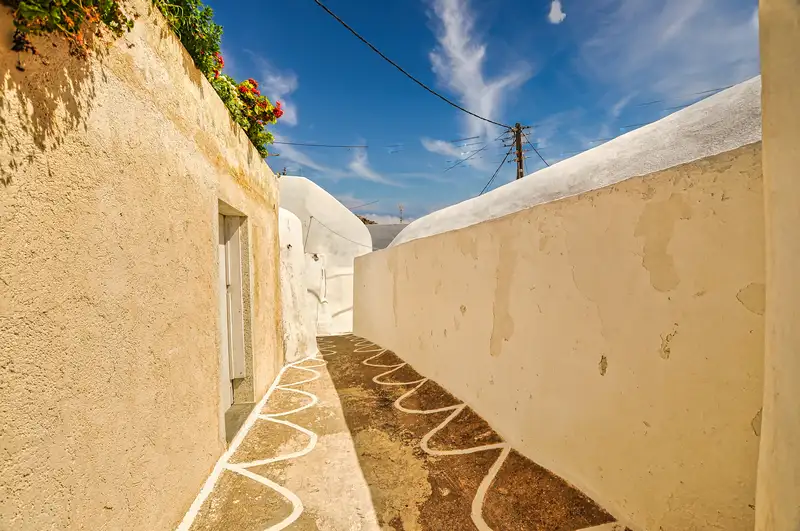
You can still walk through the side gate of Kastro and feel it. The streets are narrow on purpose. The houses lean into each other on purpose. The whole settlement is one slow, careful answer to a long fear.
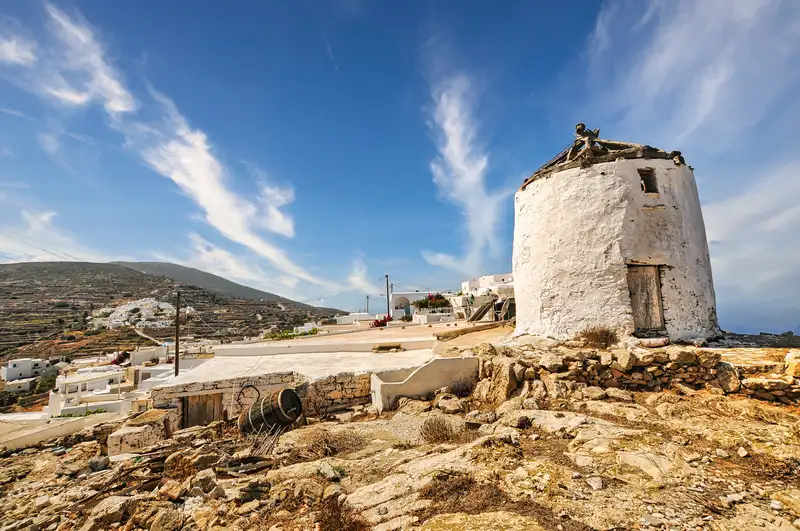
Alopronia, the port that welcomes you
Alopronia is Sikinos' small harbor village on the island's southeast coast. It is the first town you will meet upon arrival, when the ferry docks. Pretty much all hotels, tavernas, cafes, and beach umbrellas are gathered there.
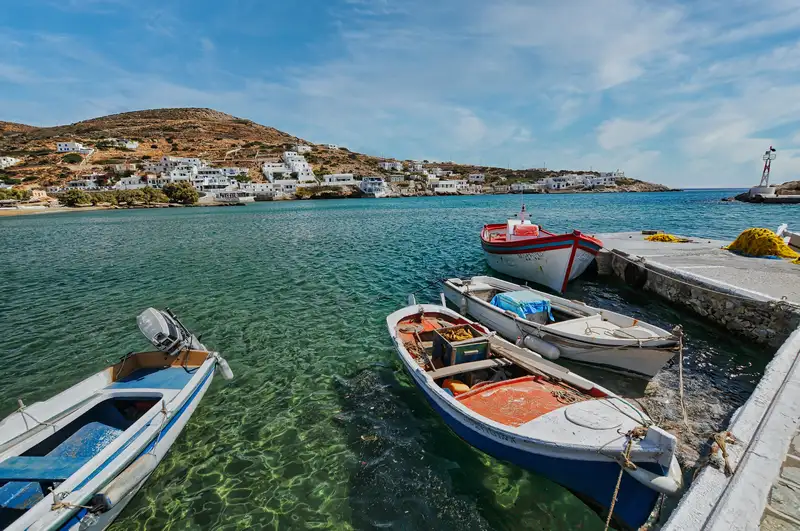
The first walk along the bay
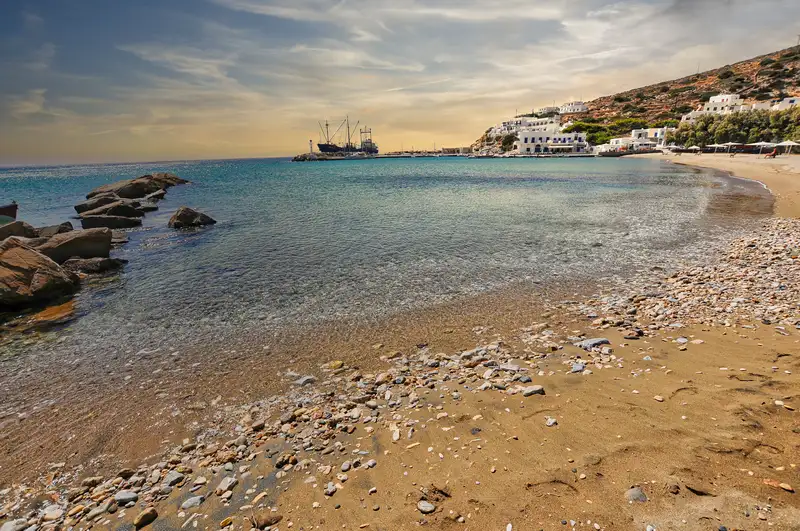
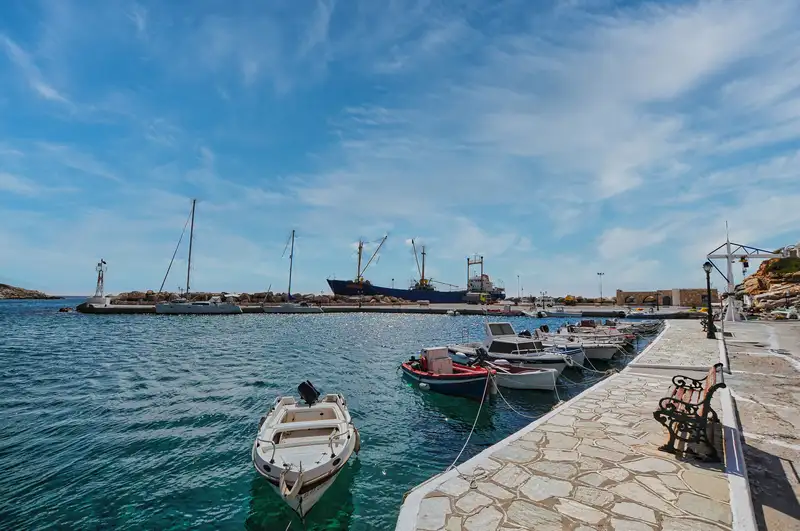
The bay bends in a half-moon like a smile. There is a long sandy beach, a small marina, a few tamarisk trees, a couple of cafes overlooking the sea, and a single mini market. That is pretty much it. You could walk the whole settlement in ten minutes. But you will not, because the air smells of salt and pine and grilled fish, and the bay itself is the kind of place that makes you want to stay still.
Locals come down to swim in the late afternoon. Children jump from the small jetty. Elderly men chat at the kafeneio. The sun goes pink over the cliffs in the north. It is one of the very few places in Greece where I have never felt the need to hurry up.
The ritual of the departing ferry
I will tell you about a beautiful custom on Sikinos, which almost nobody writes about. When a ferryboat leaves the bay, people swim out into its wake to honor someone who is leaving. Children, mostly, but also adults. They surf the jetstream, they wave at the rails of the boat, they hold up the moment of farewell.
Kastro and Chorio, the two faces of Chora
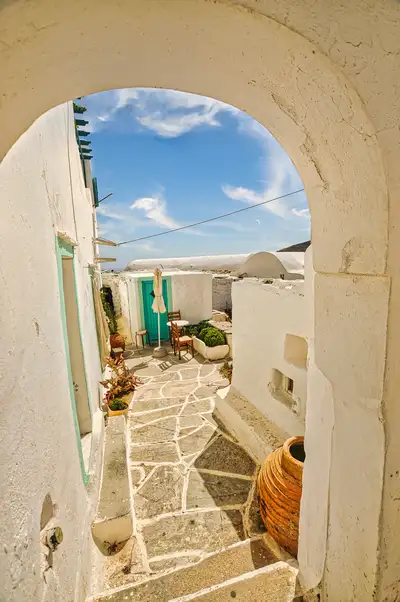
The village of Sikinos, Chora, lies high on the edge of a ridge overhanging the sea. It is built of two old settlements divided by a saddle, Kastro on one side and Chorio on the other. Both are among the most beautiful and least visited choras in the Cyclades.
Kastro, the fortified heart
Kastro was constructed in the fifteenth century as a stronghold against pirate attacks. The houses' outer walls are also the village's walls. The narrow streets within are so constricted that two people walking side by side are sometimes forced to turn away from each other. At the very highest point, three old windmills complete the fortification.
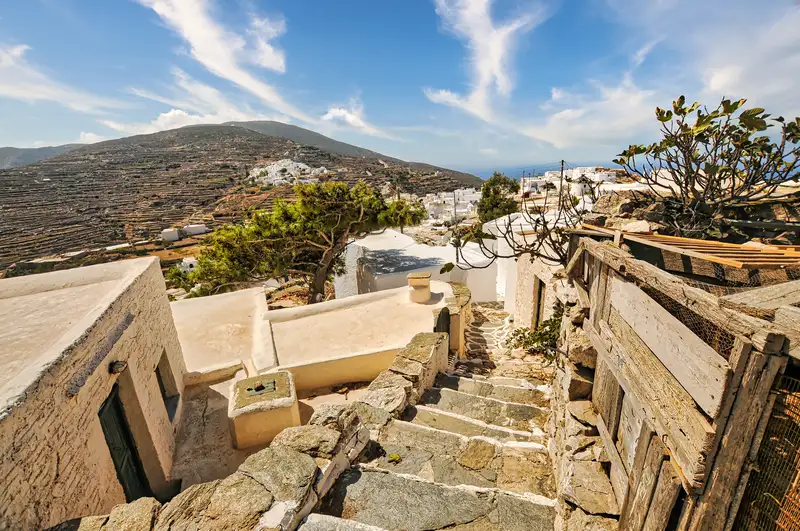
At the heart of the village is a square with the church, Pantanassa, which dates from 1787. The gilded wooden iconostasis is a reward for lingering. The first time I climbed up to Kastro, I arrived through the side gate. The silence on the other side of the gate stopped me in my tracks. It is a silence that only occurs in stone-built villages designed to keep sound out.

Chorio, the gentler twin
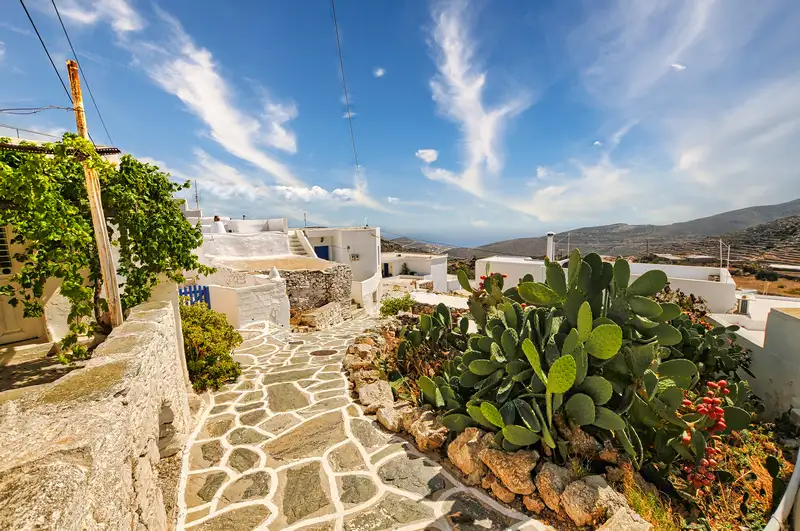
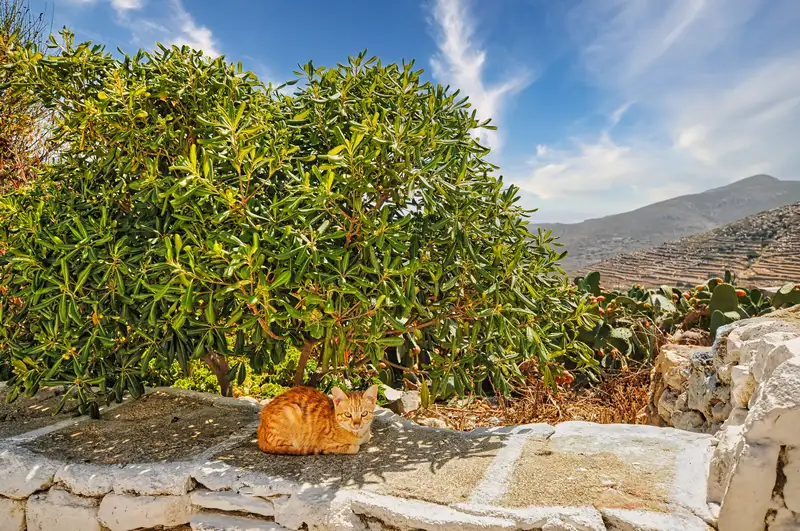
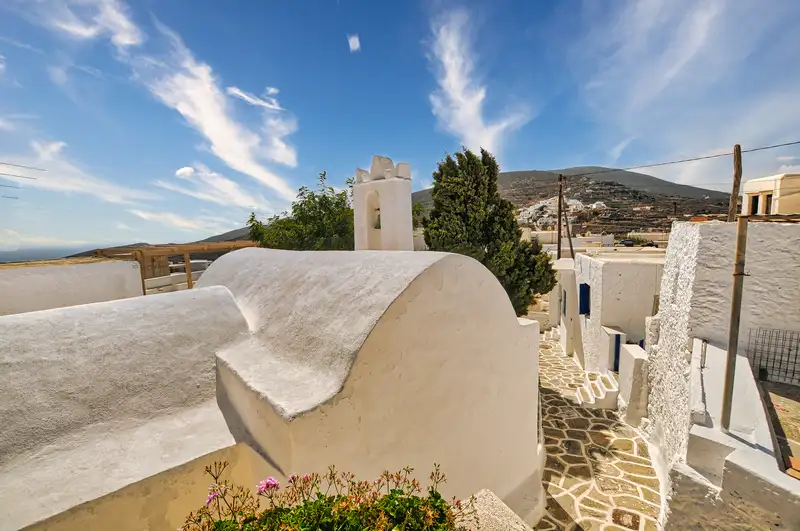
Chorio is the older of the two villages, and also the softer. It sprawls more gently down the southern slope, with whitewashed houses, prickly pears, flowerbeds, and little alleys which open out at low walls overhanging the sea. It is the kind of place where you round a corner and an old woman is watering geraniums and a cat is asleep on a step.

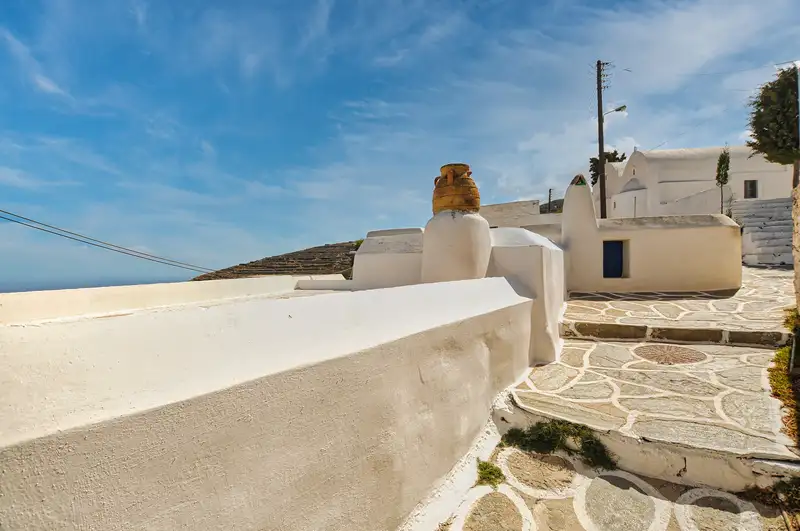
Between Kastro and Chorio is a square with cafes, a folklore museum, and an old neoclassical school which was built by the benefactor Andreas Syngros. The square is the social center of the island. In summer, it slowly fills after the sun has gone down and empties toward midnight.
The monastery of Zoodochos Pigis at the top
The monastery of Zoodochos Pigi or Chrysopigi, built in 1690, crowns the highest point of Kastro, on a crag, gazing eastwards over the Aegean Sea. Pirates would land here on moonlit nights to capture villagers and take them away as slaves. The monastery was built as a place of prayer and protection, to which people could come to pray and escape pirates' eyes.
The slow path up the stones
The trail from the main square of Kastro to the monastery is short but steep. It is paved with stone steps and smaller curves, with old doors painted in whitewash. It takes about ten minutes if one does not stop, or more if one does. Most people stop.
The chapel of Panagia Pantochara
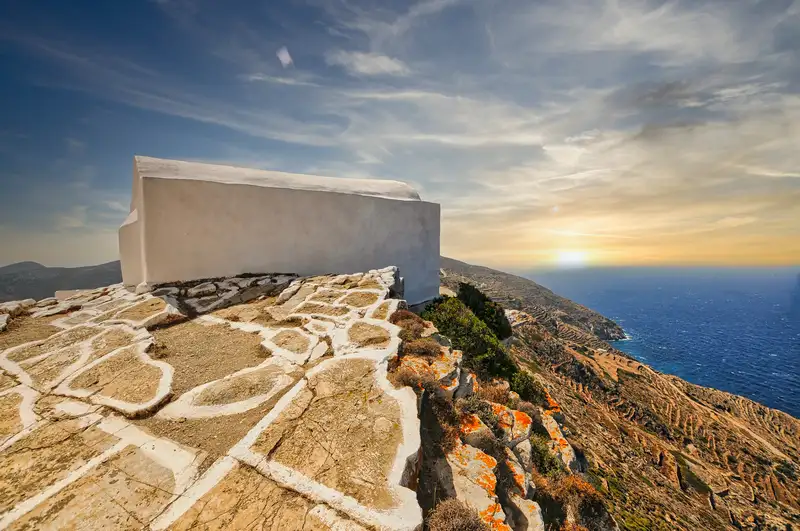
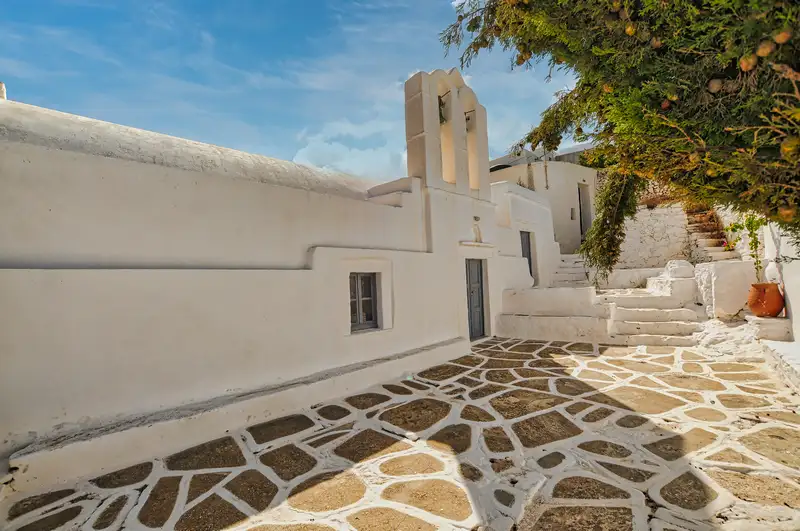
Halfway between Kastro and the monastery, suspended almost motionless over the Aegean Sea, is a small white chapel. It is dedicated to Panagia Pantochara, the Holy Mother of Joy. Odysseas Elytis, the Greek poet and Nobel Prize winner, who fell in love with Sikinos for the clarity of its air, pledged the chapel to the island before he died.
Elytis did not live to see the chapel built, but his wife, Ioulita Iliopoulou, finally did, in 2011, as he had wanted. The poet had the clarity of air to say it, and she had the clarity of heart to do it. There is something quiet and tender about the place when you sit on the low wall next to it. A promise by a poet, fulfilled after he was dead, on an island he believed to be the clearest air in Greece.
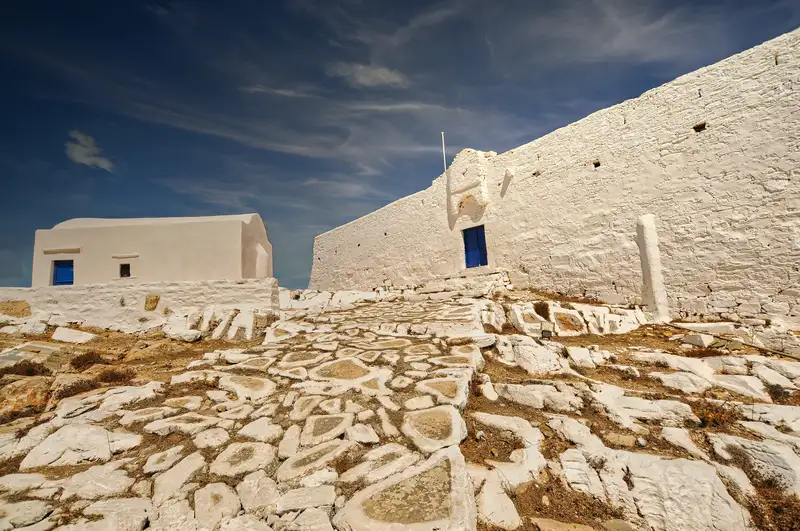
The quiet sunset from the monastery
If one arrives at the monastery in the late afternoon, one will understand why people make the climb to sit on this windswept ridge, above the world, as the sun goes down. The whole of the Aegean Sea opens in front of you, with Folegandros to the west, and Ios to the east, and the sea between them slowly changing its color from blue to gold, to pink. There is almost no sound. Sometimes a bell. Sometimes a single bird. Mostly the wind, and the breath of the sea.
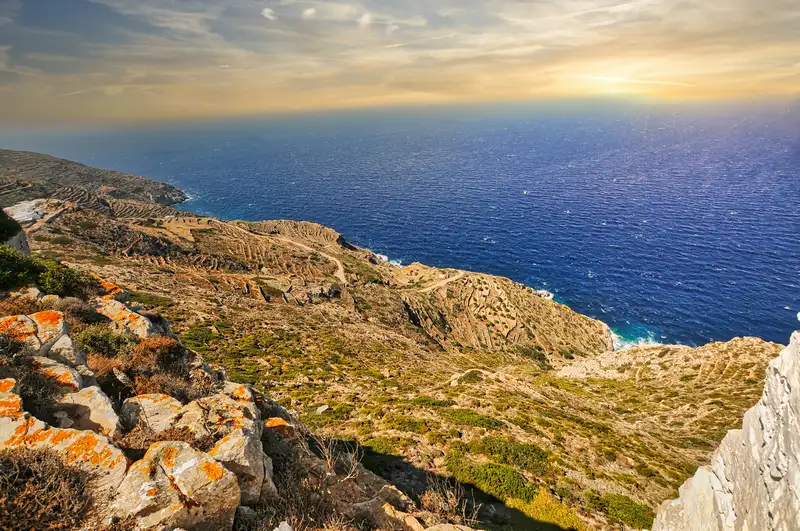
Episkopi, the Roman mausoleum turned church
Episkopi is the most significant ancient site on Sikinos. Located in the center of the island, it is one of the oldest standing buildings in the Cyclades. A Roman mausoleum from the third century, it was converted into a Christian church in the Byzantine period and is still used as a church today.
Walking the old road to Episkopi
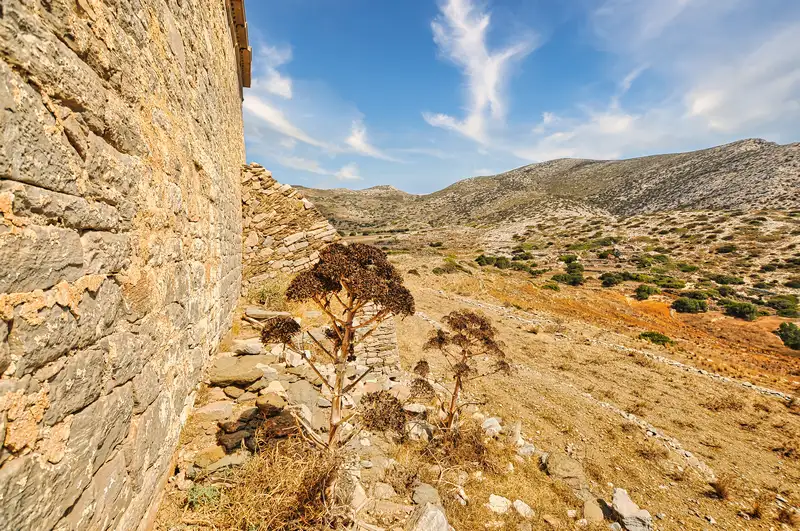
It's usual to drive part of the way and then walk the last bit along the stone track. The walk takes about fifteen minutes from where the road ends. You walk past low stone fences, dry grass, abandoned terraces, and small chapels that suddenly appear. The wind blows through the dry plants, making a sound like paper rustling.
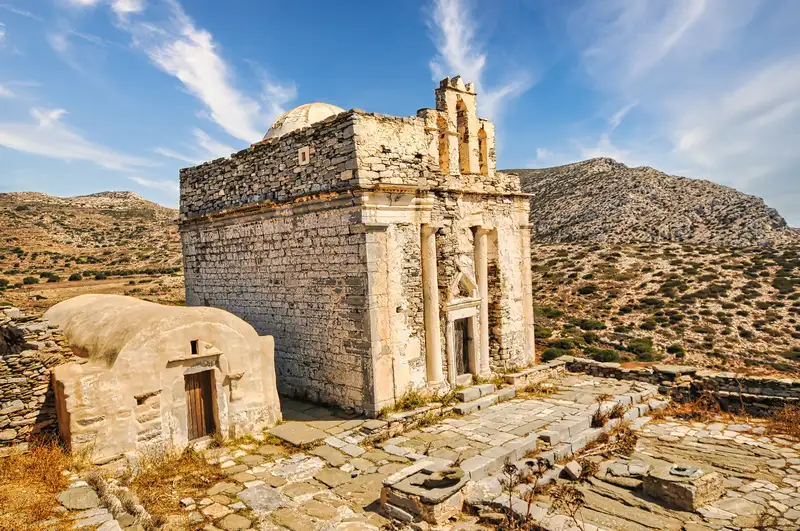
Stepping into the old monument
The building itself is small, square, and made of big pale stones. The dome on top was added in the Byzantine period. The air inside is cool and still, and the light is thin through the narrow openings. You can see the joins between stones, where Roman work ends, and Byzantine work begins.
Outside, the chapel of Agia Anna is huddled against the side. Down below the monument, the foundations of an ancient settlement tumble down the slope. You can walk among them if you tread carefully.


The layers of history
Episkopi is one of those rare places in Greece where you can stand in a single room and feel three thousand years pass through you. A Roman tomb. A Christian church. A Byzantine dome. A modern village half a kilometer away. Around all of it, the same wind and the same sea that the Romans heard.
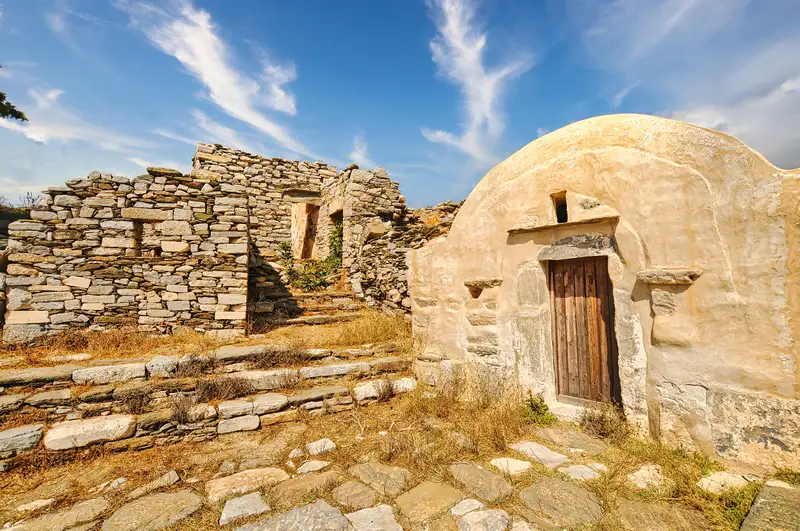
Manalis Winery and the memory of Oenoe
The winery Manalis is the island's only operating winery; it is also a restaurant, a tasting room, and one of the loveliest places on the island to watch the sun set over Folegandros. Manalis is built on the steep northwestern slope of the island and is far from civilization. There, there is quiet.
The slow return of an old name
In ancient times, Sikinos was known as Oenoe, meaning 'wine'. Centuries passed, and the name was dormant. George Manalis planted an organic vineyard in the rocky northern part of the island and began making wine again. The vines are planted in old Greek varietals, and the bottles are labeled with ancient Greek names: En Lefko, En Thermo, Manalis Rose, Liosato.
The small wines of a small island
The wines are artisanal and easy to drink. The whites are crisp and clean. The rose is dry and hushed. The reds are full, without being heavy. Most pair well with the winery's straightforward Greek home cooking, prepared with ingredients grown on or near the island.
The slow violet hour at Manalis
The terrace is west-facing. Folegandros sits across the water like a reclining beast. The light shifts from orange to pink and finally ends in deep violet. Most guests sit for the entire arc. I have done this twice. Both times, I was the last to leave.
The small beaches the island keeps
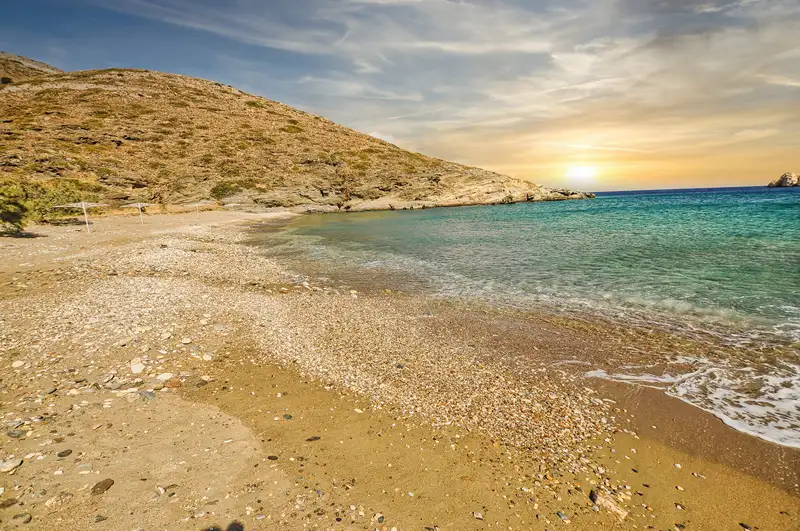
The beaches of Sikinos are few in number but rich in feeling, ranging from the long, organized sand at Alopronia to small, almost-forgotten pebble coves you can only reach by boat or on foot. The most visited are Alopronia, Agios Georgios, and Dialiskari. The most beautiful, depending on who you ask, are Malta and Santorineika.
The water is among the cleanest in the Cyclades, the beaches are quiet even in August, and you should always carry your own water because shade and shops are not guaranteed.
The slow trails that cross the island
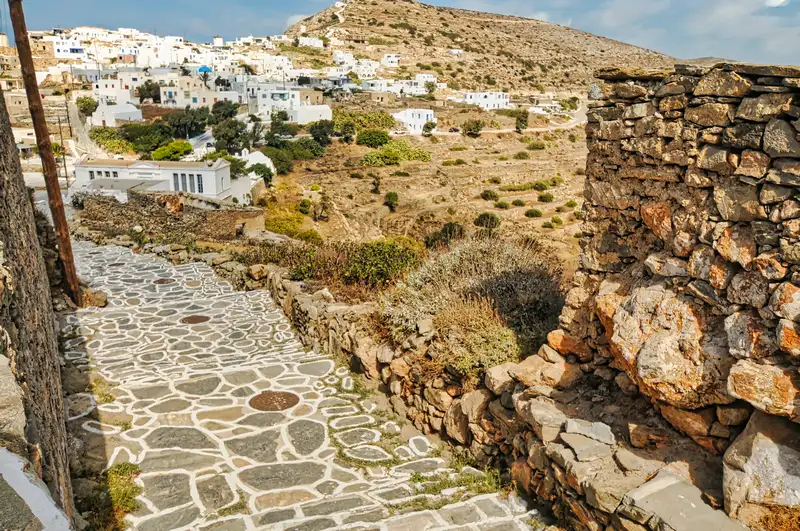
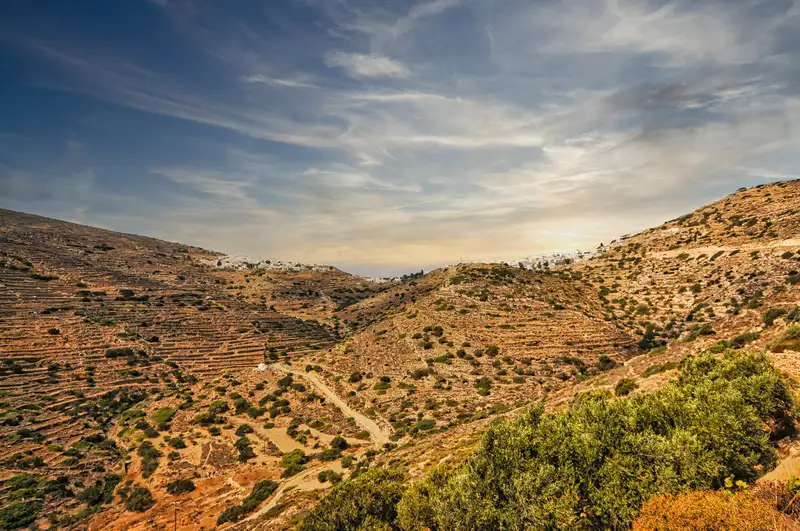
One of the finest small islands in Greece for walking is Sikinos. It has a network of stone paths that connect almost every village to every beach, chapel, and ancient ruin. These are not hiking trails. They are old roads, used for hundreds of years by donkeys and farmers, and you can still feel that in the way the stones lie.
The path from Chora to Episkopi
The classic walk on Sikinos is the one from Chora to Episkopi, which is roughly four kilometers each way. It follows the old donkey road across the center of the island. The path is well marked, mostly flat, and takes about an hour at an easy pace. You can do it in the early morning before the heat, and take a bus back if you do not want to walk both ways.
The trail down to Malta
A longer, more demanding walk leads from the chapel of Profitis Ilias, the highest point of the island, down to the bay of Malta. It takes around an hour and a half, and rewards you with one of the loneliest swims in the Cyclades. If you do it in late spring, the slopes are still green, and the air smells of thyme.
The chapels along the way
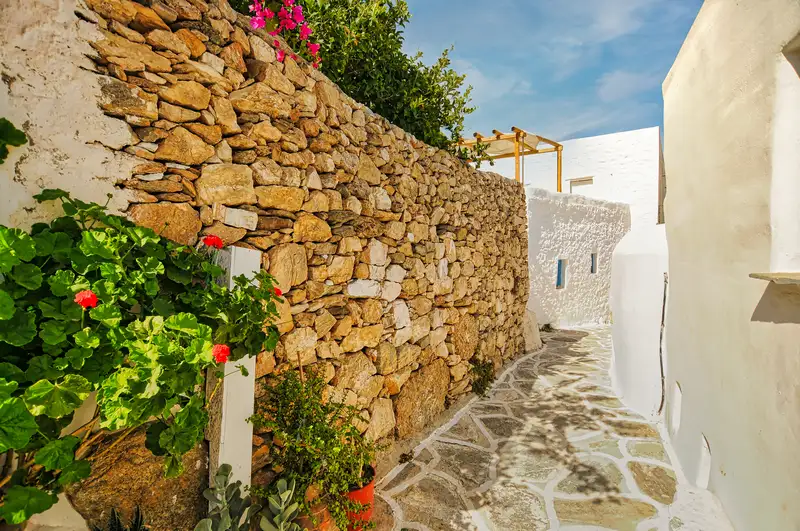
What I love most about walking on Sikinos is the chapels. They appear without warning. A small white shape against the dry hill. A door that is sometimes open, sometimes not. A name carved into a lintel. They were built one by one, over centuries, by families who made vows. There are dozens of them across the island. Most you will never know the names of. You pass, and feel, and keep walking.
The black cave and the boat trip around the island
Mavri Spilia, or the black cave, is one of the largest sea caves in the Cyclades. Nestled below the northern cliffs of Sikinos, it can only be accessed by boat. One small excursion boat leaves Alopronia in summer and circles the island, stopping at the cave and at the secluded beaches of the north and west coasts.
The trip takes about three to four hours. You pass hidden coves, sheer rock walls plunging into the sea, wind-carved caves, and see the cliffs below Chrysopigi from the water side. The boat anchors for a swim at one of the beaches you can't get to by land. If the sea is calm, the captain will take you into the mouth of Mavri Spilia, where the light bounces and turns the water a luminous blue, and the cave itself darkens around you.
One of the best half-days you can spend in the Cyclades, and a part of Sikinos that few visitors will ever see.
The folklore museum and the soul of Chora
The folklore museum of Sikinos is a small but poignant collection of old tools, embroidery, photographs, religious objects, and a surviving set of post-Byzantine icons from the school of Crete tradition in the main square of Chora. It's the kind of place that begs for fifteen quiet minutes and not a full afternoon.
What you will see inside
Expect to see the everyday life of the island laid out in a few small rooms. A loom. A bread oven. Wedding clothes—a child's first shoes. The faces of people who lived here a hundred years ago look back at you from black-and-white photographs. The post-Byzantine icons, painted in the Cretan school style after the fall of Constantinople, are kept in a small adjoining room.
The panigirades tradition
The panigirades are religious feasts that the island still celebrates today. On certain saints' days, an icon is taken from the church in procession, then handed to a family who will keep it in their home for the next year. There is food, wine, dancing, and singing. If your visit overlaps with a panigiri, do not miss it. You will see the soul of the island in a single evening.
The kitchen of Sikinos
Food on Sikinos is local and straightforward. It reflects what the island has to offer: honey, capers, goat cheese, wild greens, fresh fish, and the wines of Manalis. There are only a few tavernas on the island, but what they lack in quantity they make up for in quality, serving some of the most honest Greek food you will taste in the Cyclades.
Thyme, honey, and capers
Sikinos thyme honey is among the best in Greece. The bees feed on wild herbs, producing dark, fragrant, slightly smoky honey. You can buy it at the small shops in Chora and at the port. Capers are also wild and picked from the rocky slopes. They are pickled in brine and used in salads, as spreads, and on bread with olive oil and a little salt.
Kouneli stifado and local cheese
The traditional dish to seek out is kouneli stifado, rabbit slow-cooked with onions, red wine, cinnamon, bay, and tomato. A winter dish, it is served in summer at family tavernas. The local cheese is made from goat and sheep milk, is fresh and mild, and pairs well with bread.
For something sweet, try almond pasteli, a slab of honey-bound almonds, and kserotigana, thin, folded pastries fried and drizzled with honey and sesame.

The practical notes for a trip to Sikinos
How to get to the island
You get to Sikinos by ferry. Almost always, this will be from Athens or one of the neighboring Cycladic islands, since there is no airport on the island. The journey is part of the adventure.
By ferry from Athens
The most common connection is from Piraeus, Athens' main port. There are roughly three to five sailings a week in summer, fewer in the shoulder season, and sometimes only one or two a week in winter.
The journey takes five to nine hours, depending on the ferry. Blue Star Ferries, Zante Ferries, and Fast Ferries all cover the route at different times of the year, as does the less frequent service from Lavrio, the smaller port on Athens' east coast.
From Santorini, Ios, and Folegandros
If you fly to Santorini, you can get to Sikinos by ferry in one or two hours. From Ios it is about half an hour to fifty minutes. From Folegandros, it is much the same. There are usually daily connections in high summer, sometimes more than one a day, which means you can slot Sikinos easily into an island-hopping itinerary around the southern Cyclades.

How many days do you need?
You need a minimum of two full days on Sikinos to experience it, three or four if you want it to make a difference to you. A day is never enough, even if you could theoretically see most of it in that time.
The honest truth is that Sikinos asks you to slow down. If you arrive with a list of attractions to tick off, you will be disappointed. If you arrive with two empty days and a willingness to walk, swim, eat, sleep, and walk again, you will leave changed. Most people who fall in love with this island do so on the third morning, when they realize the rhythm has already changed them.
The best time to visit
The ideal season for Sikinos is late May to early October, when the ferries run, the tavernas open, and the sea is warm enough for swimming. There are two moments within that season that rise above the rest. Mid June, when the wildflowers are still in their prime, and the paths are still mostly empty.
Early September, when the sea is at its warmest, and the light is beginning to mellow, the days are long, and the people who came in August have gone home.
July and August are bright and dry, with a meltemi wind most afternoons. Sikinos doesn't get as crowded as Santorini does, but those weeks are busier. By mid-October, the island begins to close, by November, it belongs to itself again, and you should know that before you go.

Getting around the island
You can get around Sikinos in three ways, and most visitors do all three. The local bus goes between Alopronia and Chora every hour or so in summer, plus a couple of daily trips out to Agios Georgios beach, the winery at Manalis, and Episkopi. The timetable is posted at the port and at bus stops in Chora. In the off-season, it dwindles to sparse or, sometimes, nothing at all.
The second way is by walking. It's the honest way, too, since the old stone footpaths cross the whole island. Most of Sikinos can be reached on foot in an afternoon. Bring water. Wear real shoes.
For the rest, hire a scooter or ATV in Alopronia, and keep in mind the island's one petrol station opens just a few hours a day.
Frequently Asked Questions about Sikinos Island, Greece
Is Sikinos worth visiting?
Yes, if you want a quiet, traditional Cycladic experience and don't mind slowing down. It's not for you if you are looking for nightlife, large resorts, or a list of things to do. But for travelers who value silence, walking, swimming, simple food, and old stones, it is one of the most rewarding of the small Greek islands.
What is Sikinos known for?
Sikinos is known for its peaceful, traditional Chora, its off-the-map feel, its old monasteries and chapels, its ancient Roman mausoleum at Episkopi, the Manalis winery, and its web of old stone paths that crisscross the island. It is also known as one of the last unspoiled islands in the Cyclades.
Is Sikinos better than Folegandros?
Sikinos and Folegandros feel very similar but are slightly different in scale. Folegandros is slightly bigger, slightly more developed, and easier to reach. Sikinos is smaller, quieter, less polished, and feels more remote. If you want beauty with a few comforts, then Folegandros is for you. If you want beauty and almost no one else, then Sikinos.
Can you do Sikinos as a day trip?
Technically, yes, you could do Sikinos as a day trip from Ios, Santorini, or Folegandros in high season, by taking a morning ferry and an evening return. You could see Chora, the port, and perhaps the winery. You would not see much else. To know Sikinos even a little, you need to spend at least one night.

The slow traveler and the slow island
I have a theory that people fall in love with Sikinos in their midlife. They are people who have already traveled, people who have been to Santorini and Mykonos and Naxos and Paros, and have begun to wonder if there might be something quieter. They are people who walk more than they drive. They like long meals. They like silence. They like the moment when the ferry leaves and the bay goes still.
If you are one of those people, Sikinos is waiting for you. Come on the slow ferry from Piraeus. Bring a book you have been meaning to read. Stay at least two nights. Walk to Chrysopigi at sunset. Swim at Agios Georgios in the late morning. Buy a jar of honey at the shop in Chora. Eat fish at the port on your last night. Watch the next ferry leave. When you return home, you will find you are quieter for a while. That is what Sikinos does.