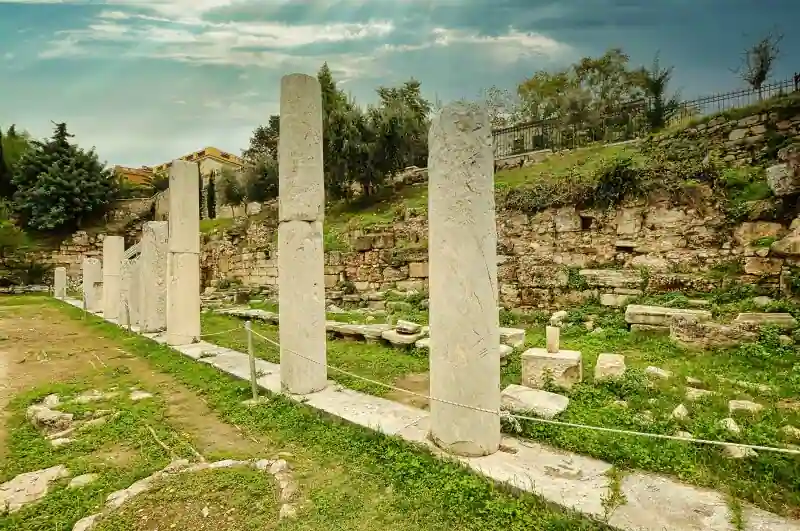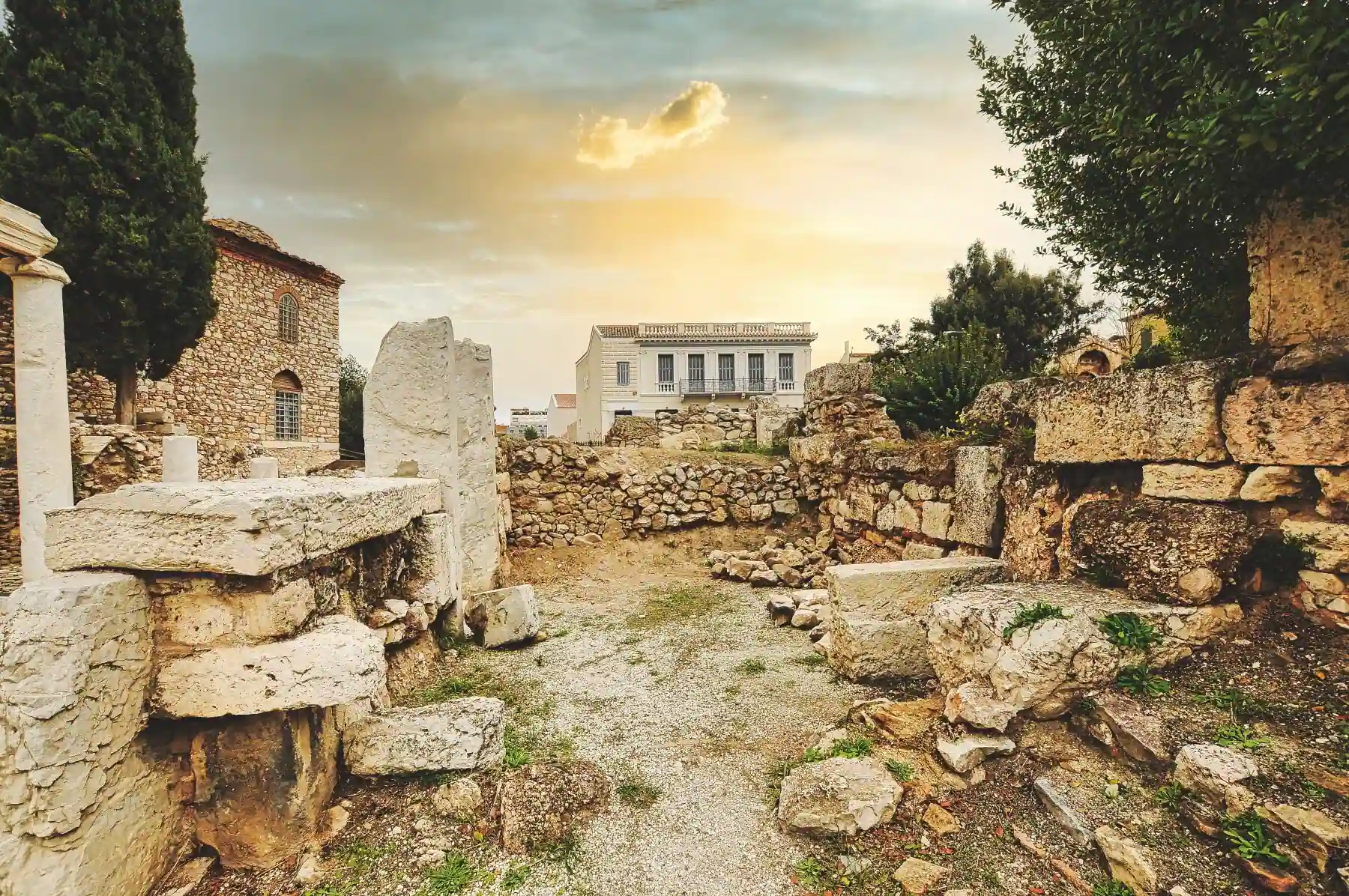
Hidden between narrow streets of Plaka and the shadow of sacred rock lies the Roman Agora of Athens. I have walked past this place hundreds, if not thousands of times in my life. And yet every time I visit there’s always something new to discover.
The Roman Agora archaeological site used to be the heart of Athens’ marketplace centuries ago, when Rome ruled over the ancient world. Today it stands as a reminder to even the greatest empires that you can’t keep marble from making its mark.
So, is the Roman Agora in Athens worth visiting? Well, as someone who has literally grown up with this place in their backyard the answer is obvious. The ancient Roman marketplace is a place that doesn’t try to woo you with flashy sights. It’s humble like that. But if you take a moment to relax and look around, it will whisper secrets of over two thousand years.
Table of Contents
How old is the Roman Agora in Athens?
The story of the archeological site begins with none other than Julius Caesar. In 51 BC, he promised to fund the construction of a new market in Athens.
Wars were fought. Politics changed. And Julius Caesar himself eventually met his end. So, it fell to his successor, the Emperor Augustus, to pick up where Caesar left off. And between the years 19 and 11 BC, the Roman Forum in Athens rose from the ground, taking form some 100 meters east of the existing Ancient Agora. The new Roman Agora was much bigger and surely more Roman in style.
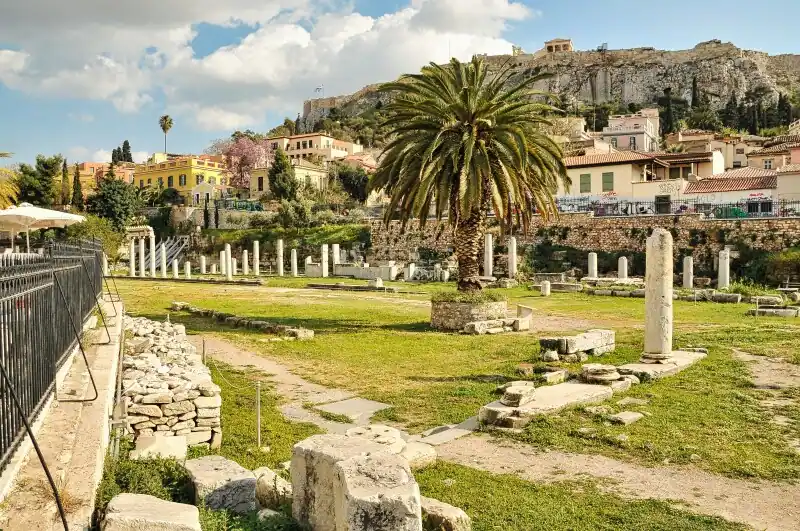
The Agora was later expanded under Emperor Hadrian in the 2nd century AD, and marble paving was added to the courtyard. Hadrian also built the famous Library of Hadrian just to the south of the Agora, and the Roman Market in Athens eventually became the city's true commercial heart. Olive oil, grain, wine, and merchandise from across the Mediterranean would find their way here, traded by Athenians, Romans, Greeks, and many others.
As often is the case in history, nothing lasts forever. In 267 AD, Athens was invaded by the Heruli, and the resulting damage to the city and its monuments was severe. The Roman Agora was the least affected of the ancient sites and later served as the administrative center of Athens. In the years that followed, many houses and mosques were built on top of its remains.
By the time of the Venetian occupation and later the Ottoman rule, the ancient stone had long been forgotten by the people of Athens.
What to see in the Roman Agora archaeological site?
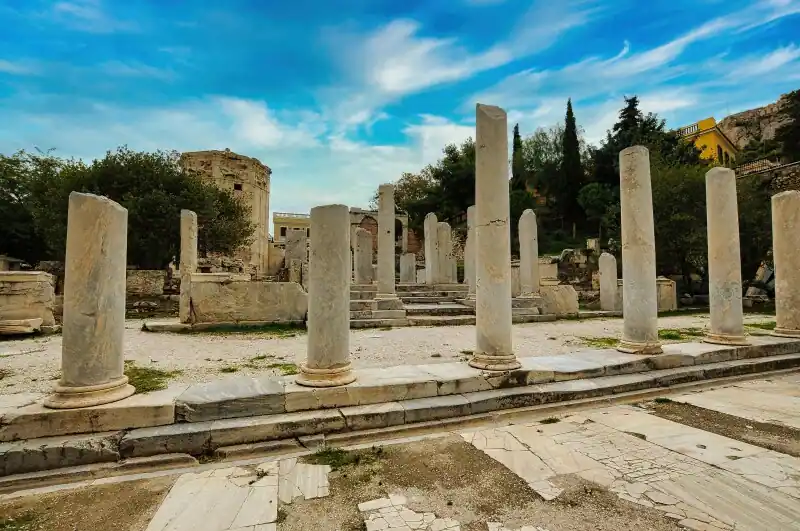
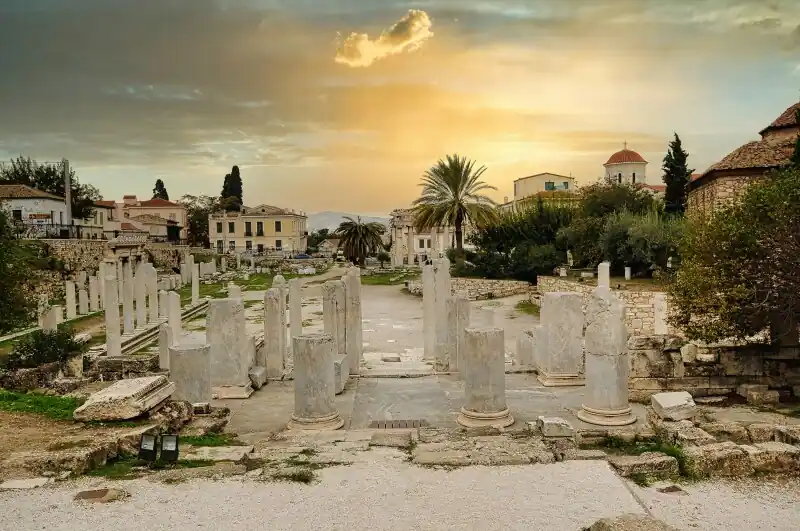
The site is not as big as its ancient neighbor, the Ancient Agora, but what you do find here has a certain gravitas. Each building has a story to tell, and together they convey a sense of daily life in Athens during its time as a city within a large empire. So if you are wondering whether the Roman agora in Athens is worth visiting, read below to see what you can see here.
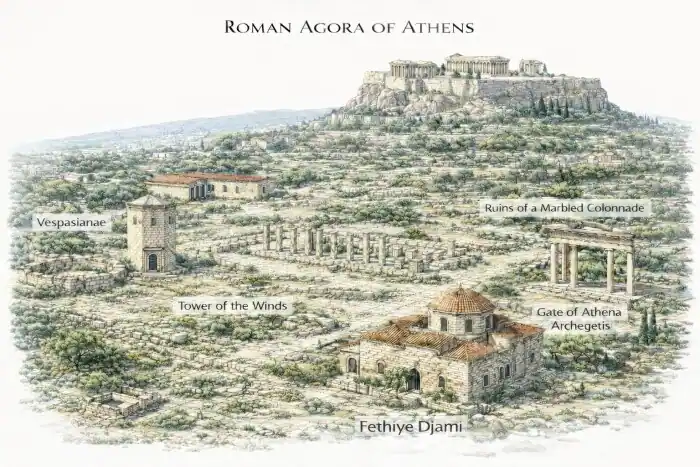
The Tower of the Winds: Where science met art
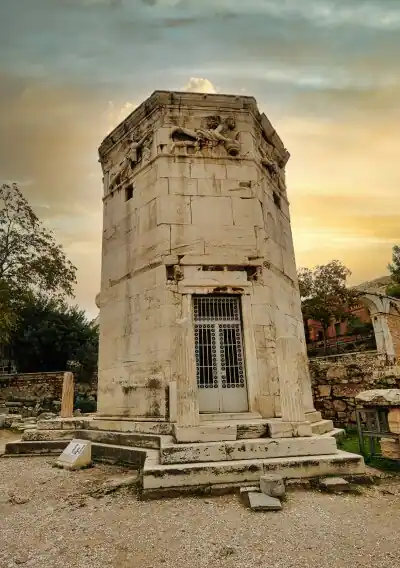
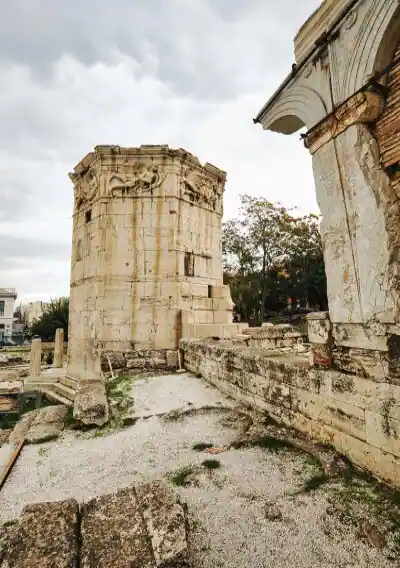
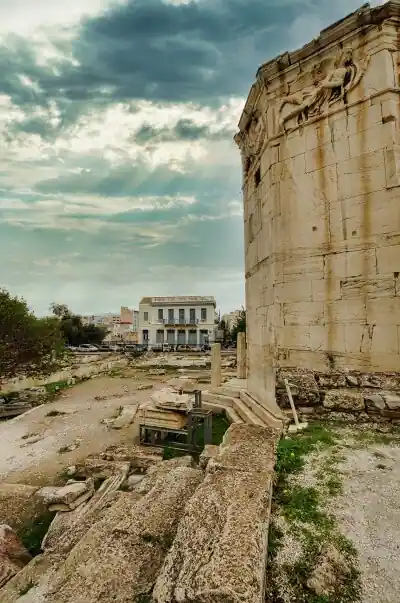
An octagonal tower, 13 meters high and made of white marble, was being transported from Penteli. It was constructed in about 50 BC by the astronomer Andronicus of Cyrrhus; it was the first of its kind: a public clock and weather station combined.
Sundials decorated the outer walls. Inside was a water clock to tell the time on cloudy days and at night. On the roof, there was a bronze weathervane in the form of Triton.
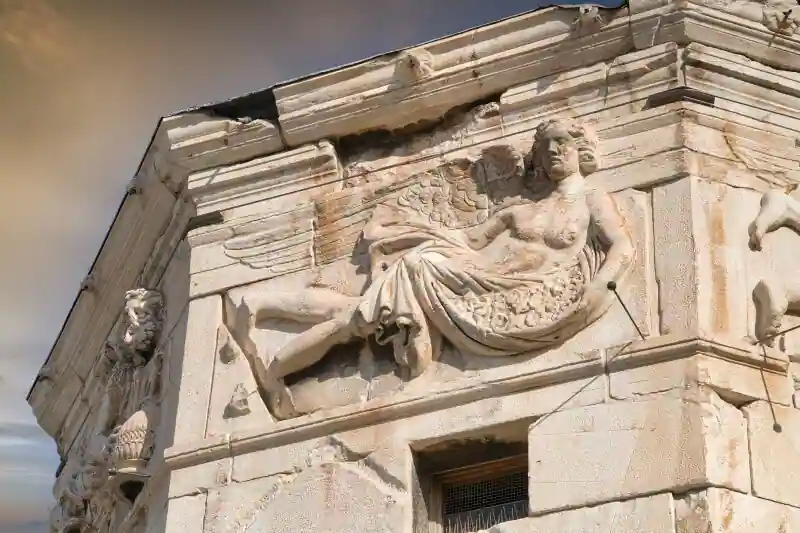
But it’s the eight wind gods carved in relief near the top that make this a special monument. Each side of the tower faces a different direction, each with a wind god of its own: Boreas, the bringer of cold winds from the north; Zephyrus, the gentlest of breezes from the west. The Athenians called it the Horologion of Kyrrhestos, but we call it simply Aerides, the Winds.
Survival must be credited to the tower’s continued utility. It became a church in Byzantine times, then, under Ottoman occupation, the Mevlevi Dervishes turned it into a prayer house, which is why Lord Elgin couldn’t bring it back to England. The Dervishes refused to part with it.
I’ve stood inside it after its recent restoration, looked up at the conical roof, and thought of merchants, checking the time before their ships sailed from Piraeus.
The Gate of Athena Archegetis: A threshold between worlds
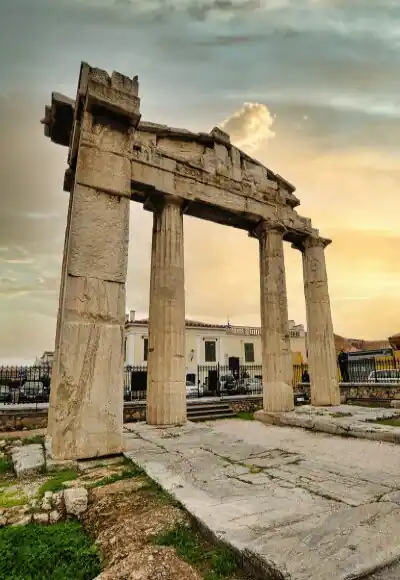
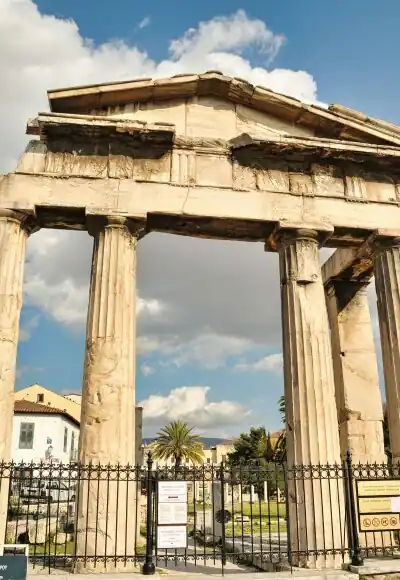
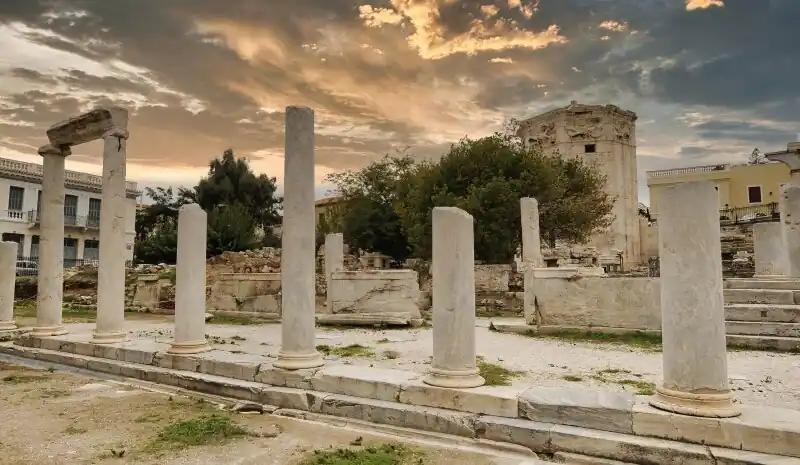
The west entrance gate remains intact, and four Doric columns of Pentelic marble still soar. Constructed in 11 BC, it was built with donations from Julius Caesar and Augustus and dedicated to Athena Archegetis.
On the architrave is an inscription in ancient Greek: "The people of Athens built this as a gift to Rome, with donations from the Roman state." It was both an expression of gratitude and of a greater identity.
In Ottoman times, the gate was known as Pazaroporta, the Market Gate, due to the grain market which operated outside. It still remains the main entrance to the archaeological site today.
The East Propylon: A quieter welcome
Less famous but no less beautiful is the eastern gate. Four Ionic columns of gray Hymettian marble would have welcomed visitors arriving from the city's administrative sections. Built at the same time as the rest of the forum between 19 and 11 BC, it gave access to the Tower of the Winds and to the public latrines.
The contrast between the two gates reveals something of Roman taste. For a gate meant to impress, the Romans chose the heavier Doric style for the west gate and the elegant curves of Ionic for the more functional eastern entrance.
Fethiye Djami: When history changes direction
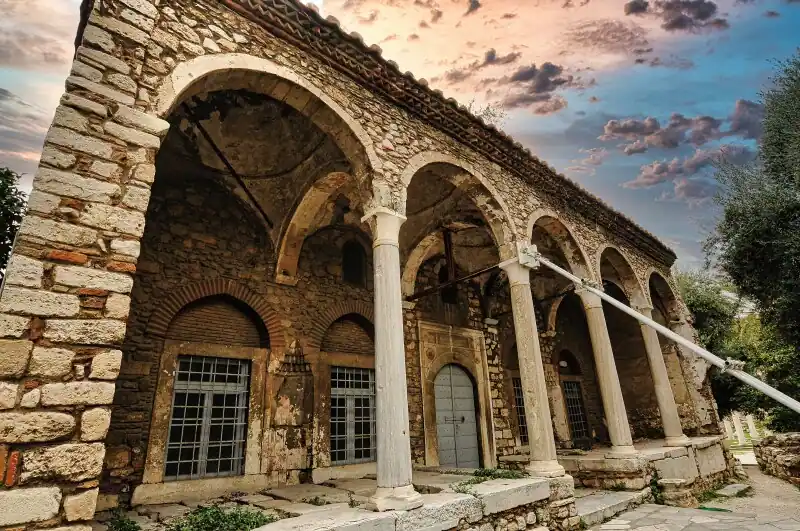
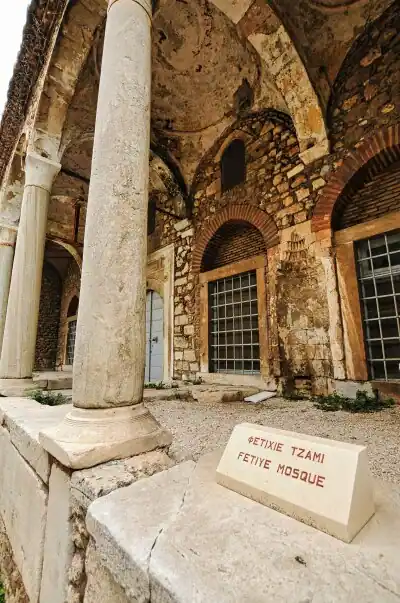
On the north side of the site, one comes across an architectural anachronism: a mosque. Built between 1668 and 1670 over the remnants of a Byzantine church, the Fethiye Djami, the Mosque of the Conquest, is a rare reminder of Ottoman rule.
The simplicity of its central dome and its arched portico is a reminder that Athens changed hands many times over the centuries. Locals named it the Wheatmarket Mosque. The grain bazaar was next door.
After Greek independence, when Greece was free, the minaret was removed. The building was used as a barracks, a prison, a bakery, and, finally, a storage space for archaeological finds.
I stand inside and wonder about the various layers of different empires: Roman columns buried beneath, Byzantine walls in the foundations, Ottoman craftsmanship in the domes. This is how Athens works. Nothing disappears. Everything transforms.
The Agoranomion: Where Fair Trade Had Its Guardians
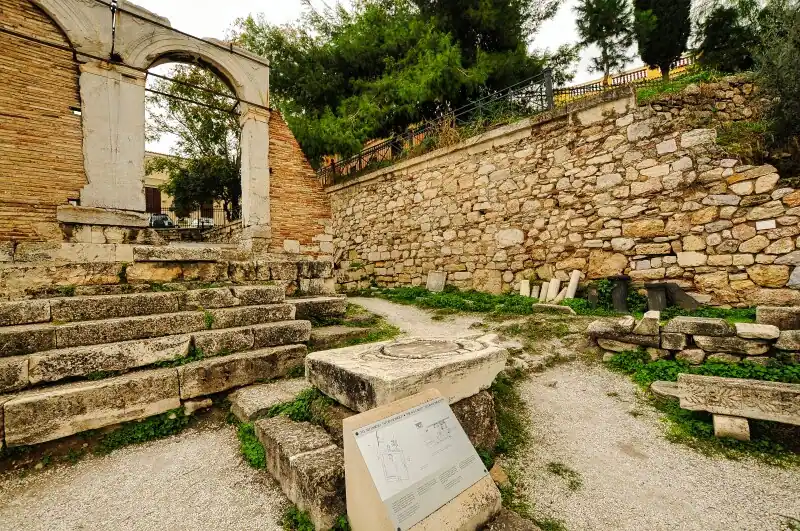
East of the forum is a rectangular building with three arched doorways and a wide stairway. This was the Agoranomion, built in the 1st century AD. It was probably the office of the agoranomoi, officials who monitored commerce and kept trade honest in the agora. Their duties included checking weights and measures, collecting taxes, suppressing fraud, and arbitrating disputes between merchants.
An inscription in the building states that it was dedicated to the divine Augustus and Athena Archegetis.
Some believe it was a Sebasteion, a structure dedicated to the worship of the Roman emperor. In any case, it shows the close connection between administration and religion in the Roman world.
The Vespasianae: A lesson in Roman practicality
North of the Tower of the Winds are the remains of something that rarely survives the centuries: public toilets. The Romans called them vespasianae, after Emperor Vespasian, who famously levied a tax on the collection of urine for the tanning industry.
Public toilets in Roman times were places to socialize. Politics, business, and the latest gossip were discussed while the various necessities were attended to. It’s strange to hear, but normal for them. For me, what is more astonishing is the engineering: continuous running water, proper drainage, and attention to sanitation. After the fall of Rome, Europe would not see its like for more than a thousand years.
Where is the Roman Market?
The empire's marketplace is located in the center of Plaka, the old neighborhood that cascades down from the Acropolis.
To reach the site, take the metro to Monastiraki station, and it is a 5-minute walk on pedestrian streets. Just follow the signs to Plaka, and you will see the columns above the modern cafes.
The site is about 350 meters from the Ancient Agora, so you can visit both sites in the morning.
The journey continues: Places connected to this one
The Roman Agora is just one of many. The city is laced with a network of ancient places, each with a chapter of its story to tell. Head west, and the Kerameikos cemetery is where Athenians buried their dead along the road to the Sacred Gate. The tombs date back over a thousand years and range from simple graves to massive monuments. It is the quietest of the archaeological sites and the most poignant.
Heading south towards the Acropolis, you pass the Theater of Dionysus, carved into the side of the hill where Greek tragedy was first performed. Nearby, the Herodes Atticus theatre also hosts performances in the summer, music filling its marble seats instead of ancient drama.
Outside the old city walls, the Temple of Zeus, with its giant columns, was built by an emperor who loved Athens as much as Rome. The temple took almost 700 years to complete.
And beyond, the Panathenaic stadium waits in its marble valley, the only stadium in the world made completely from white stone.
And if you have the time, drive south along the coast to Cape Sounion, where the Temple of Poseidon is perched on a cliff overlooking the Aegean.
Walking the ancient path: Connecting the sites
The Roman Agora in Athens is part of a remarkable walking tour of the city. Sites like the Roman Agora, the Ancient Agora, Hadrian’s Library, and the Acropolis can all be visited within a short walk of one another.
Start your day at the Ancient Agora, where democracy was first invented, and Socrates used to stroll. Walk east to the Roman Forum, and feel the transition from Greek to Roman. Continue on to Hadrian’s Library, built by the same emperor who created the expanded market.
Finish at the Acropolis as the afternoon sun mellows. As you’re up there gazing down, you can look out over the ground you’ve already covered, seeing how everything fits together in this ancient city, like the pieces of a giant puzzle.
A few more helpful details
Is the Roman Agora of Athens free?
No, you have to pay a ticket, but there are some days of the year when the entrance is free.
How much is the ticket?
The standard ticket costs 8 euros for adults, but there are various types available; you can see them in my ultimate guide to tickets for archaeological sites.
How long does it take to visit the ancient place?
Visiting the ancient marketplace usually takes 25 to 35 minutes.
What was the agora of Athens?
It was the main marketplace and commercial spot for Athenians during the Roman times.
What I remember: The feeling of this place
There are facts about the Roman Agora in Athens, and then there is the feeling of this place. Facts are things I can give you. Dates, measurements, and the stories of historical events. The feeling of being here is something else.
It’s the way the wind sounds rushing through the Tower of the Winds, just as it did when Andronicus built those eight faces. It’s the smoothness of the stone threshold at the Gate of Athena, ground down by all those millions of footsteps over so many centuries.
It’s the sense that commerce, for all its seeming mundanity, has a poetry of its own. People did not just come here to buy and sell. They came to meet, to talk, to feel connected to something greater than their individual daily concerns.
All these facts tell one story. But as you stand there, watching the light change, listening to the city around you hum around those ancient stones, you feel the presence of another story. One with no ending, because each visitor is writing their own chapter.
When you are in Athens, do not miss this place. It may not have the fame of the Acropolis or the grandeur of the Ancient Agora. But it has something both of them lack: the intimacy of a neighborhood that has been breathing for two thousand years.