Every time I passed those columns, I never asked myself this question: What is Hadrian’s Library in Athens? I was always in a hurry to catch a metro or to get a coffee somewhere near Monastiraki.
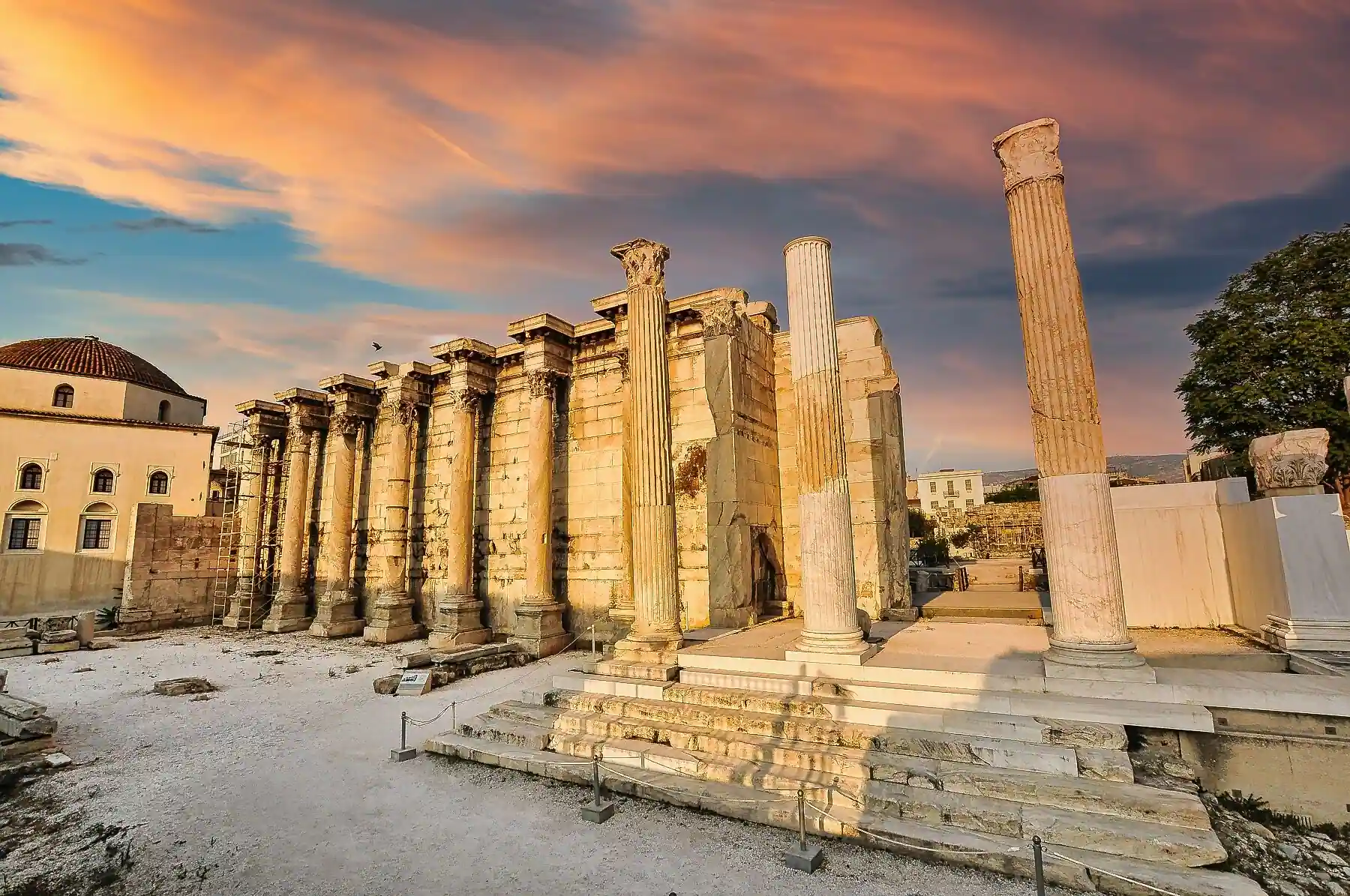
Until one day, one fall evening. The sun was setting behind the Acropolis, casting an orange and pink glow over the sky. I stopped and actually looked at the stones I had passed for years. The columns towered over me in the evening light as if they had been waiting for someone to pay them some attention, finally. A flock of pigeons circled above their heads like birds must have circled those columns two millennia ago.
It was at that moment that I fell in love with the place. Not with the information I would later come to know, not with the stories I would find in history books, but with the sense of feeling like I was where thousands of other people have been before me. Students, philosophers, travellers, and dreamers. They had all passed through this marble entrance in search of something. Knowledge, maybe. Or perhaps just a quiet place in a noisy world.
Table of Contents
The Emperor behind the library: Who was Hadrian?
We can better understand this ancient Roman library if we first meet the man who built it. Hadrian was different from other Roman emperors. He didn’t spend his reign waging wars of conquest or commissioning monuments to himself. He travelled. He studied. He fell in love with a culture that was very different from his own.
Hadrian was born in 76 AD in what is now Spain. He worked his way through Roman military and political ranks before being named emperor in 117 AD. He would rule until he died in 138 AD, and during those twenty-one years, he would spend more than half of his time travelling through the provinces of his empire.
Greece was his favourite destination. He visited Athens on at least three occasions, and each time he left permanent marks on the city. He completed the Temple of Olympian Zeus, an enormous temple left unfinished for more than 600 years. He built an arch still known by his name, which marked the boundary between the old Greek city and his new Roman expansion. And he gave Athens this library, the largest and most beautiful he could conceive.
What made Hadrian so different was his respect for Greek culture. For many Roman emperors, Greece was a conquered province, a place where Roman soldiers went to acquire art and philosophy, but ultimately an inferior society. Hadrian saw things differently. To him, Greece was the civilisation that had given Rome its gods, its philosophy, its very notion of being. To him, Rome owed a debt to Athens, and he would spend his reign repaying it as best he could.
His library was very much a part of this attitude. It was not a monument to Roman triumph over Greece. It was a Roman emperor’s gift to Greek learning, a building designed to preserve and propagate the knowledge they both prized.

The story behind the stones: Hadrian's Library history
The library was his greatest contribution. Work started on the site in about 132AD, at a time when Athens was over 1000 years old, but still a bustling Roman-controlled city. Hadrian had a vision of honouring Greek history while simultaneously demonstrating the might of Roman architectural achievement.
The Library that surprises people the most is about its scale. This wasn’t just a book warehouse, with lecture halls, music rooms, and space for philosophical debate. It was a cultural centre where Romans and Greeks could mingle, share ideas, and challenge each other at the very boundaries of human knowledge in the ancient world.
Why is Hadrian's Library famous?
As with many ancient buildings in Athens, this structure has seen many uses over its life. Its original function would only last a few centuries.
Hadrian was a Roman emperor, but he was a true admirer of Greek culture. So when he came to Athens, he had no intention of Romanising the city. Instead, his goal was to add to the city’s intellectual legacy. His new library borrowed from Greek architectural elements, while also catering to the Greek love of philosophical debate.
The West facade is where this connection is visible. In its prime, it featured 14 majestic Corinthian columns. Carved with intricate detail, the structure spoke to the Romans' admiration for engineering while creating a place uniquely Greek.
If you were to approach this beautiful entrance in the 2nd century, you’d think you were walking up to a temple. Not one for the gods, but a temple for people. It’s a good lesson about how empires can choose to respect or destroy the cultures they take in. This is a good lesson for our modern world, with its cultural tensions.
What happened to Hadrian's Library?
At some point in 267 AD, the Heruli, a Germanic tribe, invaded and burned Athens. The library was severely damaged in the attack. The Romans would restore parts of the building, but it could not recover its former glory.
The tale of the site doesn’t end here. When Christianity became the prevalent religion in this part of the world, three churches were built within the ruins of the library over time. The first one is a small basilica from the 5th century. A larger church, dedicated to the Virgin Mary, would rise within the older walls a little later. The Megali Panagia church would stand on these grounds until it was burned down in a fire in the 19th century.
Later, when the Ottomans controlled Athens, other uses emerged in the area. Markets and houses covered large parts of its original footprint.
To me, there is something poetic in all these layers of history. A building made for books ends up as a church, then a marketplace, then a treasure for archaeologists. Every change tells us something about what the society around it valued. The stone stayed, but its purpose was transformed again and again.

What you can see at this ancient site today
Walking around the ruins is a journey through time. There are many periods represented here, and if you know what to look for, your visit will be all the more rewarding. Below, I hope to give you an idea of what Hadrian's Library in Athens is like.
The Western Wall and Propylon: A gateway still standing
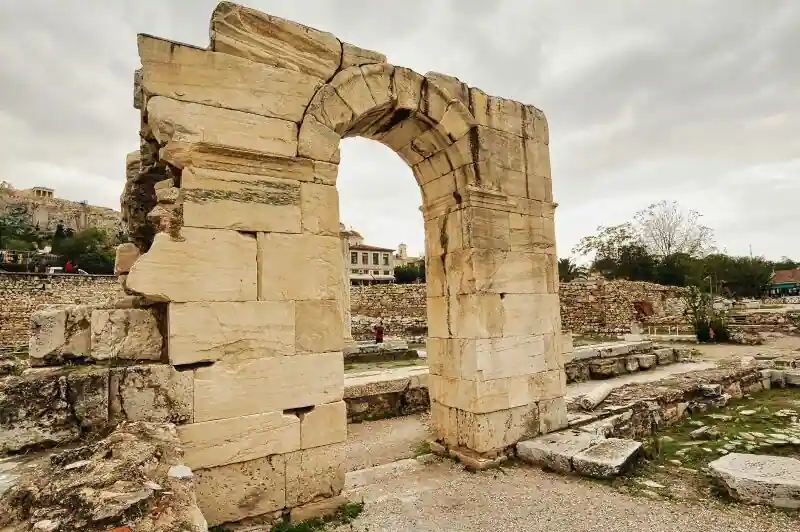
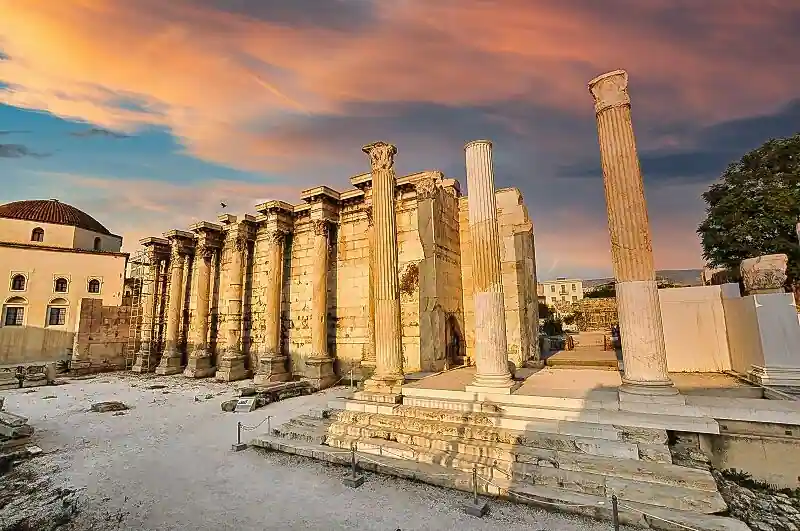
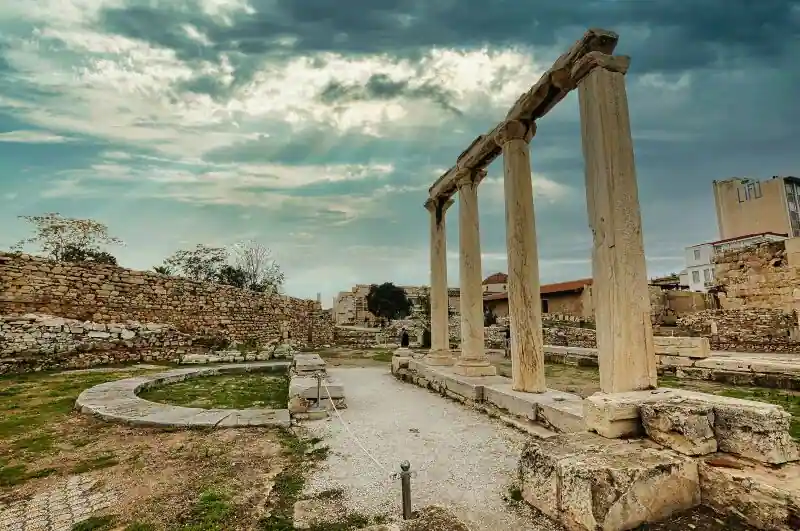
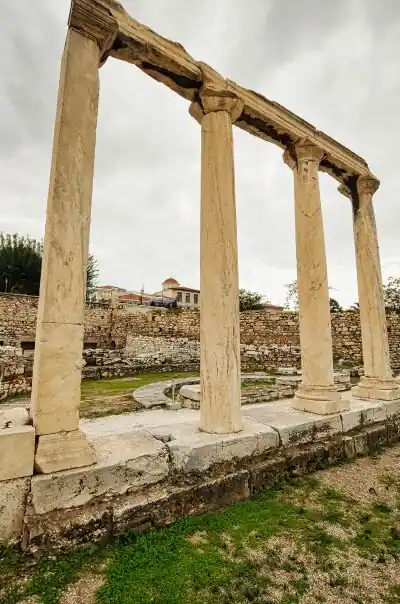
The most photographed area of the complex is the western facade that can be viewed from the pedestrian walkway along Areos Street. Seven of the original fourteen Corinthian columns remain; these monolithic columns reach up to the sky like fingers from the past trying to reach the present.
This was the propylon, or the main entranceway, where visitors would have entered the complex nearly two thousand years ago. The columns are made of Karystos marble, a green-veined stone that was quarried on the island of Euboea. Pay special attention to the workmanship of the column capitals. The acanthus leaves carved into the stone display the skill of an artisan that even modern sculptors can appreciate.
I enjoy standing here in the morning before the crowds arrive. The columns cast long shadows across the stone floor, and for a moment, you can almost imagine the scholars who would have passed through this gateway, their robes brushing against the marble as they entered into a world of ideas.
The inner courtyard foundations: Where knowledge once flowed
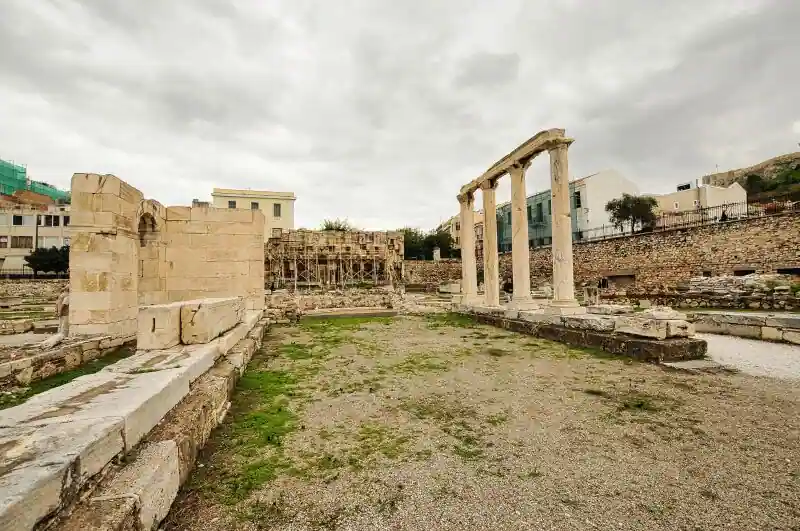
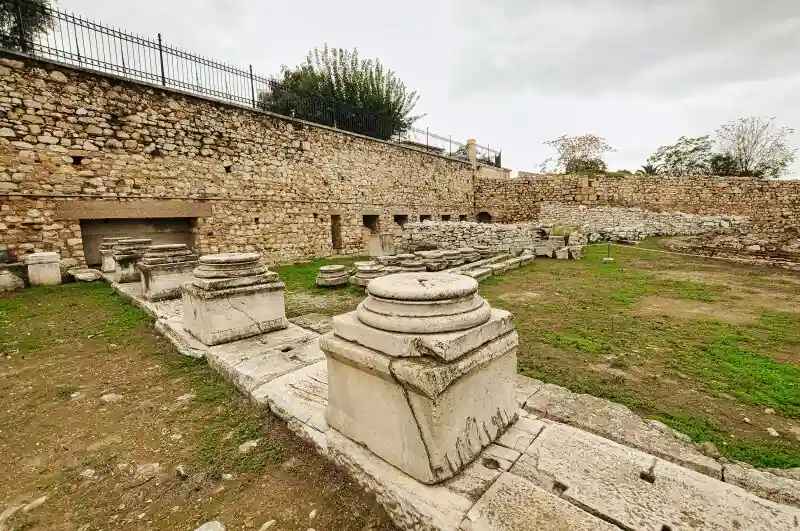
Past the entrance wall, you can make out the shape of what would have been a huge peristyle courtyard. The bases of the columns mark where a hundred columns once stood, supporting a covered walkway around a garden and central pool. The reflecting pool ran the full length of the courtyard, about 60 meters.
You could imagine yourself at one end, watching columns and sky reflected in still water. This was not something done for mere decoration. Water features in many ancient buildings were designed to cool the air and create a sense of calm. Scholars needed to have clear minds if they were to do their deep thinking.
The Eastern Library rooms: The heart of the complex
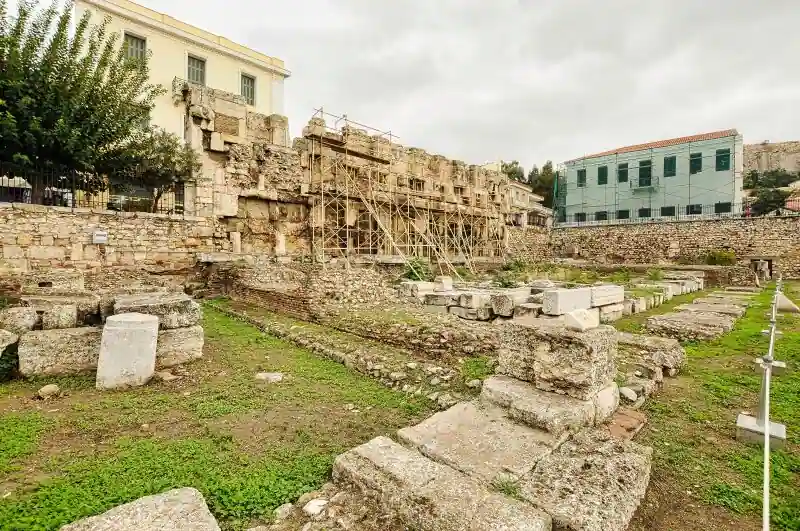
To the east end of this Roman cultural complex are the remains of the actual library rooms. In this section, the walls were much thicker. A necessary feature to keep humidity and temperature changes from damaging the precious scrolls.
The walls in these rooms are lined with niches where the papyrus and parchment texts that made this place so well-known were once stored.
Researchers have calculated that as many as 20,000 scrolls may have been stored in this library. And these were not mass-produced paperbacks. Hours of painstaking work by trained scribes to create each of these documents. The loss of such a collection to fire or invasion was the loss of knowledge that would be forever gone.
When I stand in this part of the site, I find myself reflecting on what was lost here and in so many libraries throughout the ancient world. Ideas, discoveries, how many vanished when a library burned or was destroyed? The ruins stand as a reminder that knowledge is fragile. It is something worth protecting, something worth passing down.
Byzantine church remains: Faith built on ancient foundations
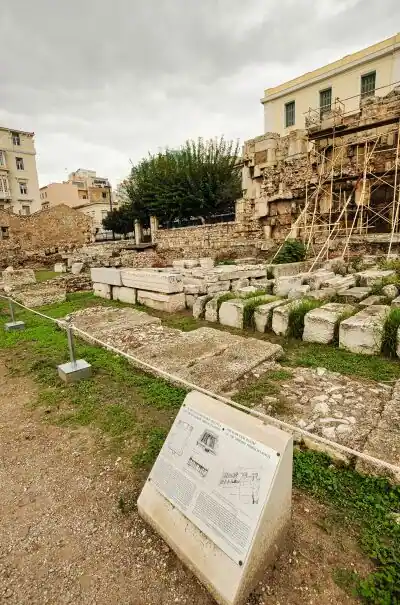
In the footprint of the monumental Roman library, you can see the remains of later Byzantine churches built on top of it. We can see floor mosaics, column bases, and the remains of walls, indicating how people from later periods used this space and adapted it for their own purposes, which in this case was as a Christian place of worship.
The latter church is dedicated to the Megali Panagia. It was built in the 12th century and was in use until 1885, when it was destroyed by fire. Some of the remains were salvaged and can be seen in museums around Athens today.
I love this layering of the past. We see here a pagan school that becomes a Christian church, which becomes an archaeological site visited by thousands of tourists from around the world every year. There's something powerful in the idea that every era used the physical structure of what had gone before to build the physical structure of what came after.
Echoes of early Christianity: The four-apsed church
Hidden among the Roman ruins is something more unexpected. Archaeologists found the remains of a tetraconch church at the library. A tetraconch church is a building with four curved arms extending out from a central room.
This shape was rather rare in Athens. Most Byzantine churches were built in a rectangular shape. The presence of a tetraconch church within the Roman ruins shows that early Christians considered the site unique enough to warrant something exceptional.
The ruins of this church date back to the 5th century AD. That is about 300 years after the library stopped functioning. The old Roman gods were no longer in use, and new religions needed new places of worship. The builders did not take down the old stones. Instead, they incorporated them into the new building and made a church.
Where is Hadrian's Library located?
Finding the Imperial Library of Hadrian is simple. It is located in the very centre of Athens, just steps from Monastiraki Square, one of the most bustling areas in the city.
If you are coming from Syntagma Square, head down Ermou Street and keep walking until you reach Monastiraki.
The main entrance is on Areos Street. Look for the tall Corinthian columns that tower over the modern streetscape. You cannot miss them.
A good solution is the Monastiraki Metro Station. Exit the metro, and you have the ancient walls practically in front of you.
I frequently suggest that visitors start their day at the site, then walk uphill toward the Acropolis. It’s a walk through layers of time from Roman Athens, to Byzantine Athens, to the ancient Greek monuments at the top of the sacred rock.
Where the path leads from here
Take a few steps south, and you will find yourself in the Roman Agora, a marketplace where one could once haggle over prices and where the Tower of the Winds is still used to tell the time in ways we have long forgotten.
Over there to the east is the Ancient Agora, where Athens really begins. Socrates walked those stones. Democracies were shaped in those gathering places. If you care to see how Athenians remembered their dead, spare some time for the Kerameikos cemetery.
The Theater of Dionysus, hewn into the southern slope of the Acropolis, is where drama itself was born. A few steps away is the Herodes Atticus theater, where performances take place on summer nights and where stone seats are filled with audiences as they were two thousand years ago.
Athletes also have their place of worship. The Panathenaic Stadium was rebuilt in gleaming white marble to host the first modern Olympics.
And if you want to leave the city behind, the Temple of Poseidon at Cape Sounion has something that no urban ruin can provide.
Frequently Asked Questions
Is Hadrian's Library free?
No, you have to pay a ticket, but on specific dates during the year, you can enter for free.
How much does it cost to visit it?
The standard ticket costs 6 euros, but you can buy a combined ticket that includes other important sites for 30 euros.
Is Hadrian's Library considered the first library in the World?
No, it is not, but it remains one of the most important and largest libraries in the ancient world. The ancient Mesopotamian archives, or the famous Library of Alexandria in Egypt, could be considered for that distinction, maybe.
Is Hadrian's Library worth it?
If you have only one day, then the Acropolis and the Acropolis Museum should be your priority; they are much more important. But if you have plenty of time, then yes, for sure.
Standing where ideas once travelled the empire
I look at them every time I walk through Monastiraki. Those columns. I look at them, and I remember how I felt when I first saw them because it is a feeling that this city is old in the right way, that it has always been a city of knowledge and ideas that have moved mankind forward.
The library of Hadrian isn’t much more than that now. Fire, invaders, and time ravaged it. Most of it is long gone. But what is left is still important. This was a place where Roman emperors respected Greek intellect, where philosophers gathered to discuss, and where books were important enough to defend.
To walk through the remains of this library today is to walk where many walked before you. Some to read. Some to pray. Today we walk to remember. To remember them. To be surrounded by their history, their city made present in this place.
If you are ever in Athens, visit it. In the midst of the bustling crowds and vendors, in the sea of energy and colour and noise, make time for this quiet spot. Stand where the pool of the courtyard once reflected the heavens, where the columns have looked over the city for nearly two millennia.
Travel, after all, isn’t just seeing new things. It’s feeling them. Knowing them. The ancient library of Athens can do that for you, if you are willing to stand still and listen.