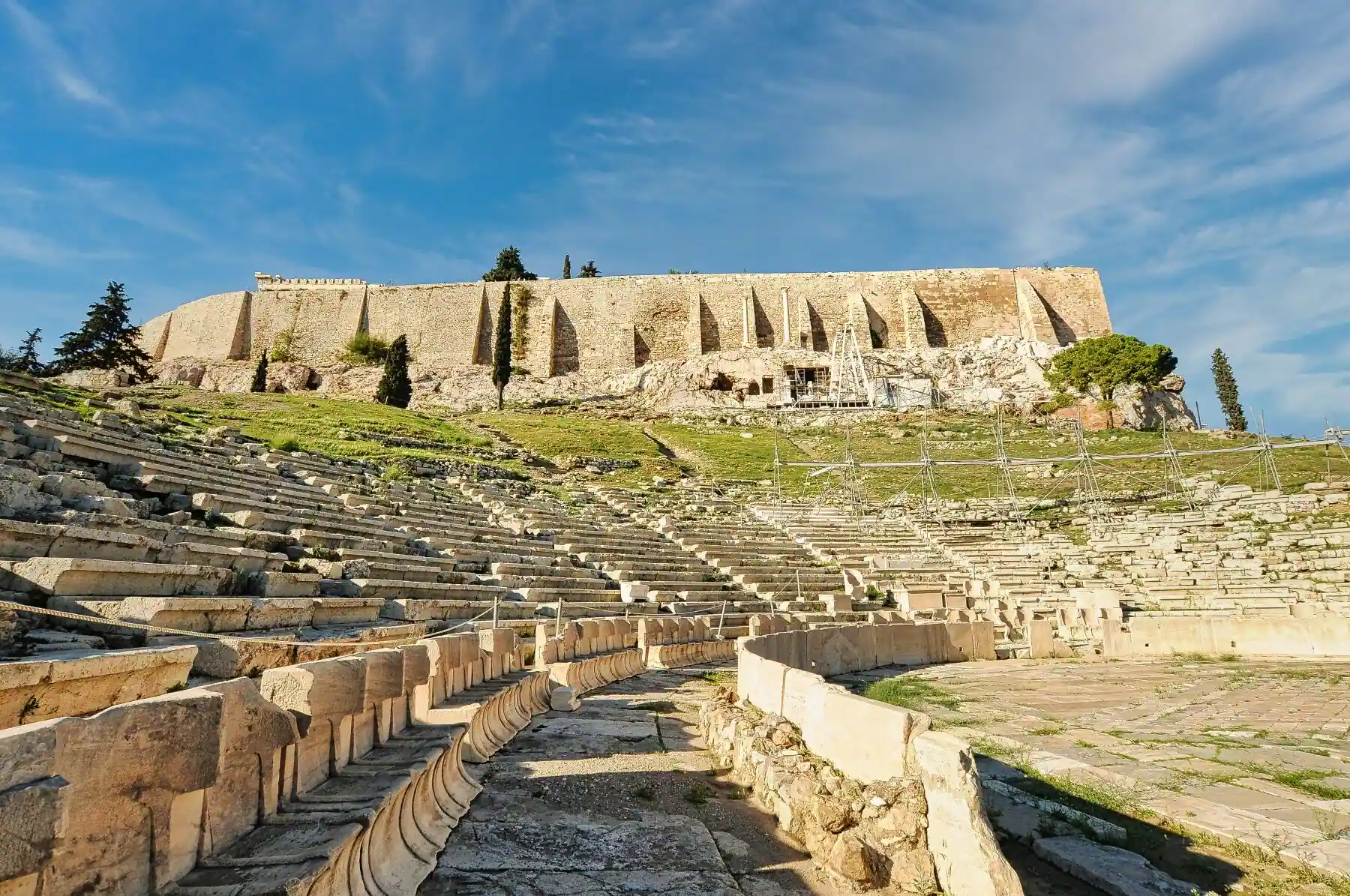
If you've ever wondered what is the theatre of Dionysus then you will find out where theatre itself began. There is a place in Athens that I frequently visit. Not because I have to, but because something always draws me back. It sits on the south slope of the Acropolis, overlooked by visitors bustling past as the Parthenon looms above. You would hardly know it was there if you weren't looking for it. It isn't the loudest structure in Athens. In fact, it is one of the oldest. But this theatre is the most important in all of history. This is where it all began, where tragedy learned how to speak, where comedy mastered the art of making people laugh until they cried.
It's an ancient open-air theatre that is considered to be the birthplace of Greek drama. Many would say it's the world's oldest theatre still standing. Construction began as a holy shrine to Dionysus, the Greek god of wine, fertility, and religious ecstasy. Walking through those stone seats and onto that stage fills me with wonder. Imagine standing in the same orchestra where people gathered 2,500 years ago. The plays they wrote revolutionized our modern-day storytelling. The emotion performed on that stage can be felt in every movie, play, and performance you've watched since.
Table of Contents
What was the ancient Theatre of Dionysus used for?
The historic site was where ancient Athenians watched dramas. It was a place to celebrate religious festivals and hold civic meetings. But above all else, it was home to the City Dionysia.
Each spring, Athenians celebrated Dionysus, the god of wine, with a festival. The city invited playwrights to perform their works in competition for prizes. Tragedians would present a trilogy of plays, followed by a comic satyr play to lampoon the others. Comedies had their own contest. Every citizen attended! If you were poor, didn’t worry -the state gave out money so everyone could go.
It wasn't entertainment the way we think of it. It was communal. Spiritual, almost. The stories explored ideas about destiny, justice, power, and humanity. The citizens saw together. They thought together. They felt together. Theatre held up a mirror to its society.
I like to think about this when I'm there. Today, we stream movies alone on our phones. We watch without speaking. Silence glued to our ears. But here, 17,000 people gathered in the open air and watched performances that moved their souls. We've lost something. Something that the Theatre of Dionysus is still trying to tell us if we’d only listen.
What is the significance of the theatre in ancient Athens?
The Theatre of Dionysus was Athens’s cultural and spiritual center. It had a major role in shaping Athenian identity during the classical period. If you want to understand the site's significance to the ancient world, imagine your entire civilization in one place.
The 5th century BC was a time of Athens at the height of its power. Democracy was coming into existence. Philosophy was taking root. Architecture was being pushed to new heights. Drama was being invented here and used to examine the toughest questions the city had to answer. Would justice prevail? Was their city/state/rightful in going to war? Were they suffering as punishment from the gods for being too prideful? How could they appease the gods?
Aristophanes poked fun at politicians, questioned military expeditions, and held Athens accountable through his comedies.
When you walked into the Theatre of Dionysus, you did not leave your life as a civic-minded person. The Dionysian festivals began with civic ceremonies. The children of soldiers killed in battle were honored as “orphans of the state.” Tributes from the other city-states under Athens's rule were paraded for all to see. Only then did the plays start.
When was the Theatre of Dionysus built?
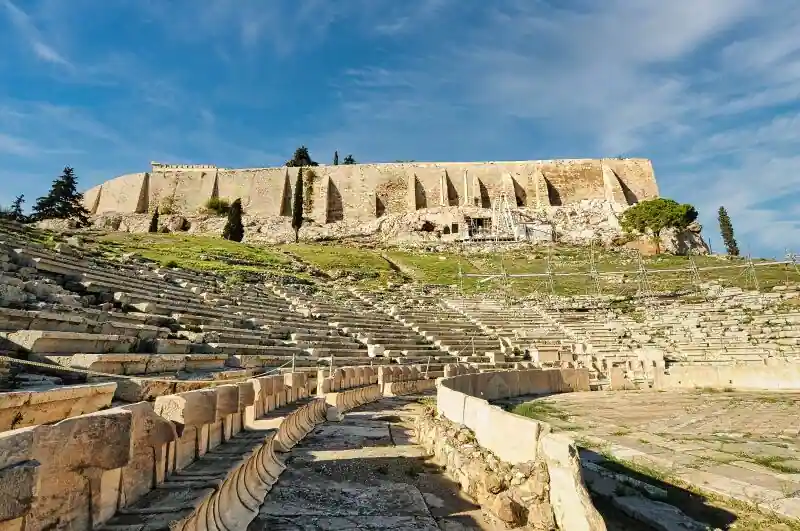
Construction of the Theatre of Dionysus began in the 6th century BC. With major modifications finished by the 5th century BC, the theatre started as a mere place to perform. Historians believe it was likely just a flat space with wooden benches. As the city of Athens grew to embrace drama as one of its focal points, so too did the theatre.
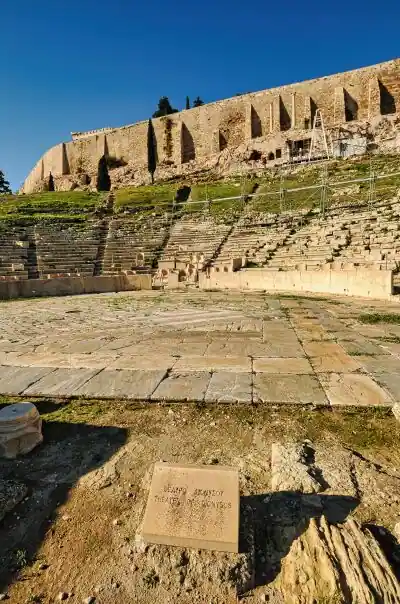
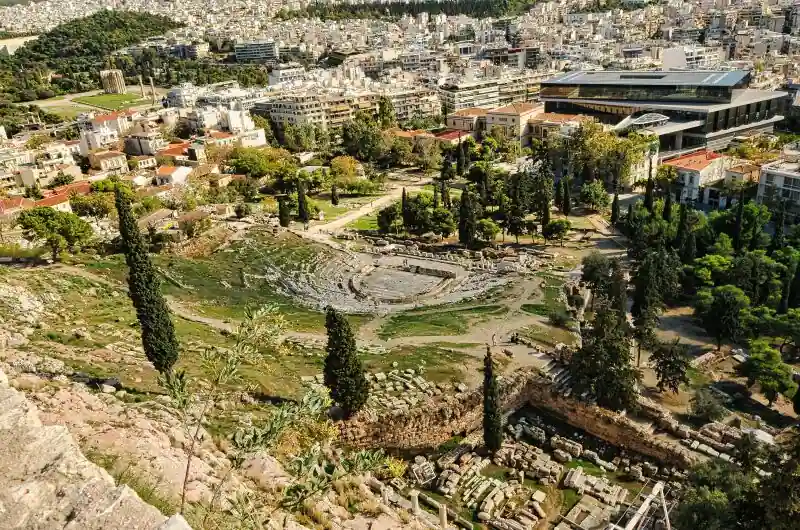
Stone seating was not installed until the 4th century BC, under the Athenian statesman Lycurgus. It was around this time that the theatre became the shape that we can view its remains today. The stone seating areas cut into the hillside. A permanent stage building was also erected. At capacity, the theatre held close to 17,000 people. That made it one of Athens’ largest places to gather.
As I wandered around the remains, I tried to picture it full of people. Marble seats filled with Athenians. The chorus runs across the orchestra. Masks worn by the actors amplify their facial features for all to see, even in the highest seats. It must have been mystical to experience.
The theatre saw use throughout the Roman period as well. The Romans altered the stage building and added more ornamentation. So while it is of Greek origin, what we see today is blended with Roman touches. It is quite common to find layers of history all over Athens. Every stone has more than one story to tell.
Where is the Theatre of Dionysus located?
The Theatre of Dionysus sits on the south side of the Acropolis hill, just below the Parthenon. Most tourists visit it and do not know it. They keep hiking up past it towards the top. Don't make that mistake.
When I first saw it, I was blown away. I was a teenager walking along the pedestrian path that skirts the hill. The setting sun was turning the stone seats a warm, honey-gold. I had walked past this place hundreds of times as a kid. I sat down on the ancient marble and gazed out over the city that stretched out in front of me. Modern life faded away. The silence seemed ancient.
You can also see the Herodes Atticus Theatre to the west from here. The two theatres sit near each other, both perched high above Athens. And yet they could not be more different. Built in two worlds. One Greek. One Roman. One gave birth to tragedy and comedy. The other merely echoed them.
Which famous playwrights were connected to the Theatre of Dionysus?
The greatest playwrights in history were played here. Aeschylus. Sophocles. Euripides. Aristophanes. Their work premiered here, and their influence will never end.
Aeschylus wrote about fate and justice, developed the characters that would drive the action of a play, and began the history of democracy in tragedy with his Oresteia trilogy. Sophocles added a third actor to the stage and gave us some of literature's most iconic characters: Oedipus and Antigone. He pushed characters to their limits and showed us what happened when someone's will clashed with the gods'.
Euripides gave voice to women, to slaves. He tested tradition and featured real human emotion, grief, and rage on stage. And Aristophanes, the master of comedy, used humor to criticize politicians, mock social norms, and speak truths that tragedy could not.
Oedipus Rex premiered here. Medea premiered here. The Frogs premiered right here. So did Antigone. People sat in the seats of this theatre and had no idea they were watching some of the most influential works of literature in history. They had no idea that 2,500 years later, their children's great-great-great-grandchildren would still be reading these plays and producing them in stadiums all over the world.
Sometimes I like to pretend that Sophocles is sitting somewhere out in the theatre, watching his play. I wonder if he knew. If he knew that he was sitting on top of literary history, that people would be reading his work for generations to come. If he knew that his characters would survive the test of time, that thousands of years later, we would still be talking about Oedipus and Antigone. I doubt it. But we do. And we can thank him for it, right where he sat.
How did it shape the ancient Greek drama?
The theatre's design affected how stories were told. The expansive circular orchestra was made for the chorus. Dancing and song drove early tragedy, so the chorus needed room to perform. The sloped seats wrapped around the orchestra closely. The effect created intimate acoustics, where voices need amplification to reach every row. The skene, or stage building, gave writers a background to work with and space to enter and exit. Writers were building their plays for this structure. The staging, pacing, and implementation of the chorus all arose from the space's capabilities.
But more than that, they were pushed to innovate by the competition. Yes, they wanted to tell great stories. But they also wanted to win the competition. Writers tried new structures, added actors, and pushed the emotional limits of their characters. Because of the festival style, there was a great risk in playing it safe. Fail, and your play dies in shame. Succeed, and you enter the halls of history. Pressure can inspire greatness.
Drama was built there. Literally, but more than that, it was tested there. New ideas by artists were met with reactions from the public. Through a process of trial, failure, and victory, we watched Greek drama grow year after year, generation after generation.
How did the theatre of Dionysus change over time?
In its early stages during the 6th century BC, the theater was likely nothing more than an area cut into the hillside, with temporary wooden seating for viewers. As drama became something noteworthy and valuable to the people, they expanded upon the original orchestra. In the 5th century BC, architects began to put more permanent structures around the orchestra. However, it wasn't until the 4th century BC that Lycurgus had thousands of seats cut into the rock, as seen in the theater today.
During the Roman era, more improvements and fixes were made to the theater. The Romans rebuilt the skene stage, added many sculptures and reliefs, and added decorations such as statues of Dionysus and satyrs. Some of the marble thrones in the theater today, which were reserved for priests and important guests, are from the Roman alterations.
Can you visit it today?
Yes! The theatre of Dionysus can be visited today and is one of the most impactful places you’ll visit in Athens. Located within the Acropolis archaeological site, admission to the Theatre is included with your regular admission ticket to the Acropolis. You do not need a separate ticket. Most people enter through the front gate near the entrance of the Acropolis Museum and take the walking path up the south slope. It’s one of the first major sites you’ll see.
Experiencing the theater as a visitor
Wondering if the Theatre of Dionysus is worth visiting? It is. Absolutely. But that depends on who you are as a traveler. Once you know what it used to be, you will see the ruins differently.
If you expect spectacle, grand columns, and perfectly preserved monuments, you may walk past this site unimpressed. Stone seats. Faded foundations. A few stray sculptures are all you’ll find.
However, if you are someone who feels emotion when you visit historical sites, if the threads of the past still tug at your heart when you’re standing in ancient cities, you’ll understand what I mean when I say that this place will wow you. It wowed me. Overwhelms me. Every time I go back, I discover something new. Catch a glimmer of something in the stones. Notice how the sunlight hits just so at a certain time of day. Hear how quiet it sounds with no one sitting in the seats.
A place where stories began
Although this ancient site is far from the largest ruin in Athens, it’s not even the most photogenic or most famous. But you could argue that it’s the most significant. Because right here on this hillside, people figured out how to tell stories. They invented characters. Conflict. Tension. Tragedy. Comedy.
They learned to make people cry, laugh, and think. All our stories grew from the seeds planted in this theatre. Every play that has ever been written. Every movie. Every piece of storytelling that has ever been performed.
A small chapel where ancient and sacred meet
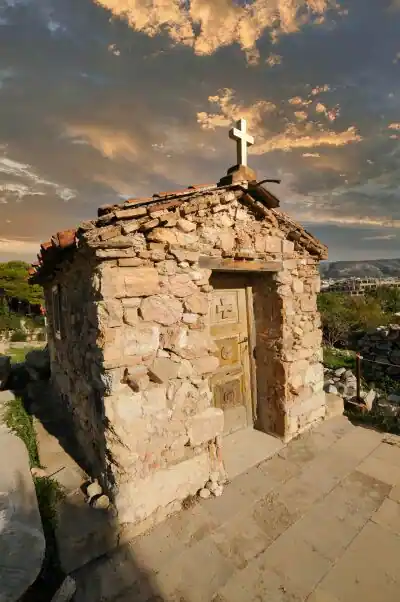
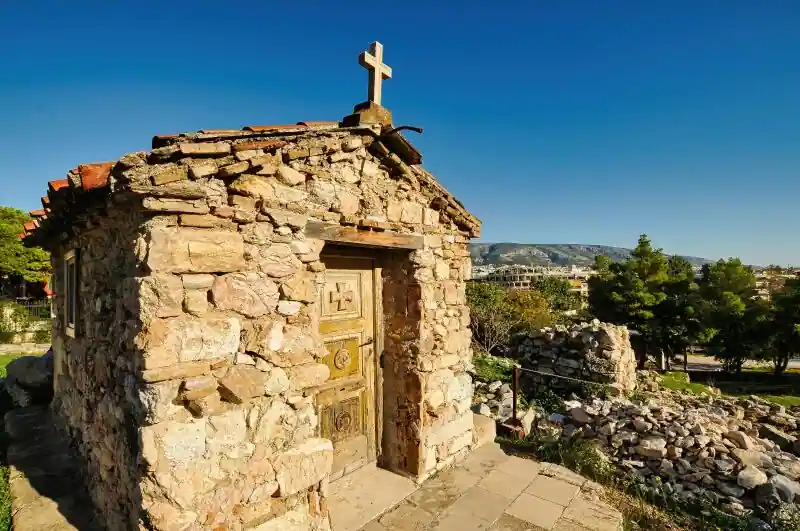
Hidden among the ruins, just a few meters away from the Theatre of Dionysus, is a tiny stone chapel that most visitors hurry past without a second glance. At first, it is easy to miss: the Church of Saint George is smaller than it looks, and one could walk by in one look. But once your eyes fall on it, you cannot turn away.
The chapel is made of roughly cut stones, old and weathered, and in the light of an afternoon, they seem to glow warm. There is a wooden door, unremarkable and plain, carved with a cross. A white cross on the roof, its arms pointing to the sky.
The chapel is locked most of the time, and this does not matter. It is enough to know it is here. The Church of Saint George asks nothing of you. It is only, as it has been for hundreds of years, a little stone witness to all this hill has seen.
Frequently asked questions about the ancient site
Is the theatre free?
No, you have to pay a ticket, but there are some days of the year when the entrance is free.
Was the Theatre of Dionysus the first theatre worldwide?
Yes, it claims the title of the oldest theatre we know of, where drama was actually performed. Sure, other cultures staged celebrations and performances, but this is where plays, actors, dialogue, and storytelling took place.
How long will it take me to visit it?
Expect to spend 20 to 40 minutes or more here. You can see everything in 30-45 minutes if you walk around, but if you want to sit in the theatre and ponder life in Ancient Greece, you might linger longer.
Is the monument covered by the Acropolis ticket?
Yes, it is included with one of the combo tickets for the Acropolis, which also includes access to Athens' other large archaeological sites.
When is the best time to visit the Theater?
As with most outdoor attractions, go in the morning or later in the afternoon if you can. This avoids the harsh sun in the middle of the day; there is very little shade in the area.
Can you sit in the ancient seats?
Some parts of the theatre are roped off, and others are open for walking around and sitting. Just pay attention to the signs and don’t touch the ancient rocks.
A theatre worth sitting in
Athens is full of monuments that insist on your attention. The Parthenon looms overhead. The Temple of Zeus spans impressively wide. The Panathenaic Stadium gleams white under the sun. But the Theatre of Dionysus requires less. It only asks you to pause. To sit down. To listen.
Over the years, I’ve led friends here. Some “got it.” Others shrugged and walked away. I don’t fault them. Ruins aren’t always easy to interpret. Devoid of imagination, they become antiquated rubble.
But if you give this place a chance, it gives back. It teaches you where stories come from, how we have always crowded into seats to laugh, to cry, to examine life through performance. The works that premiered here echo the questions we still ask today. What is justice? What do we owe each other?
The Theatre of Dionysus does not offer easy answers. Neither did the tragedies performed here thousands of years ago. But it offers something else. A connection. A thread that ties you to everyone who ever sat in these seats and watched a story come to life.
To me, that is priceless. More than any postcard-worthy landmark or picture-perfect photo. It’s why I come back. And it’s why I hope you will visit too.