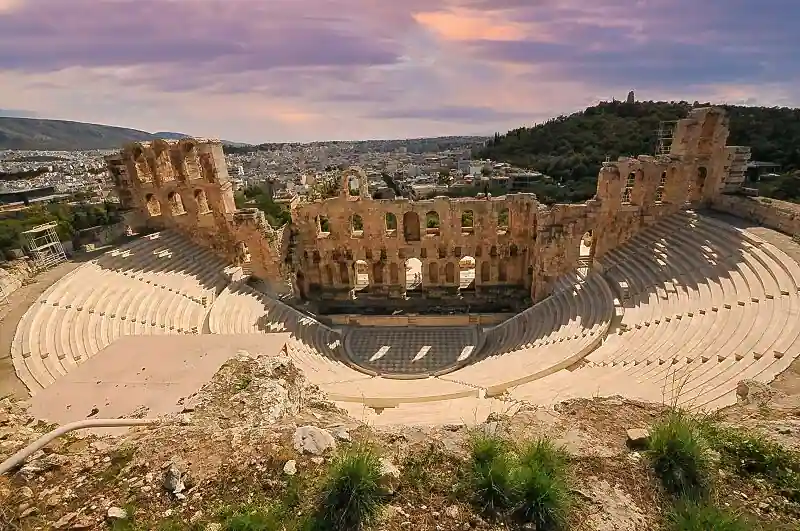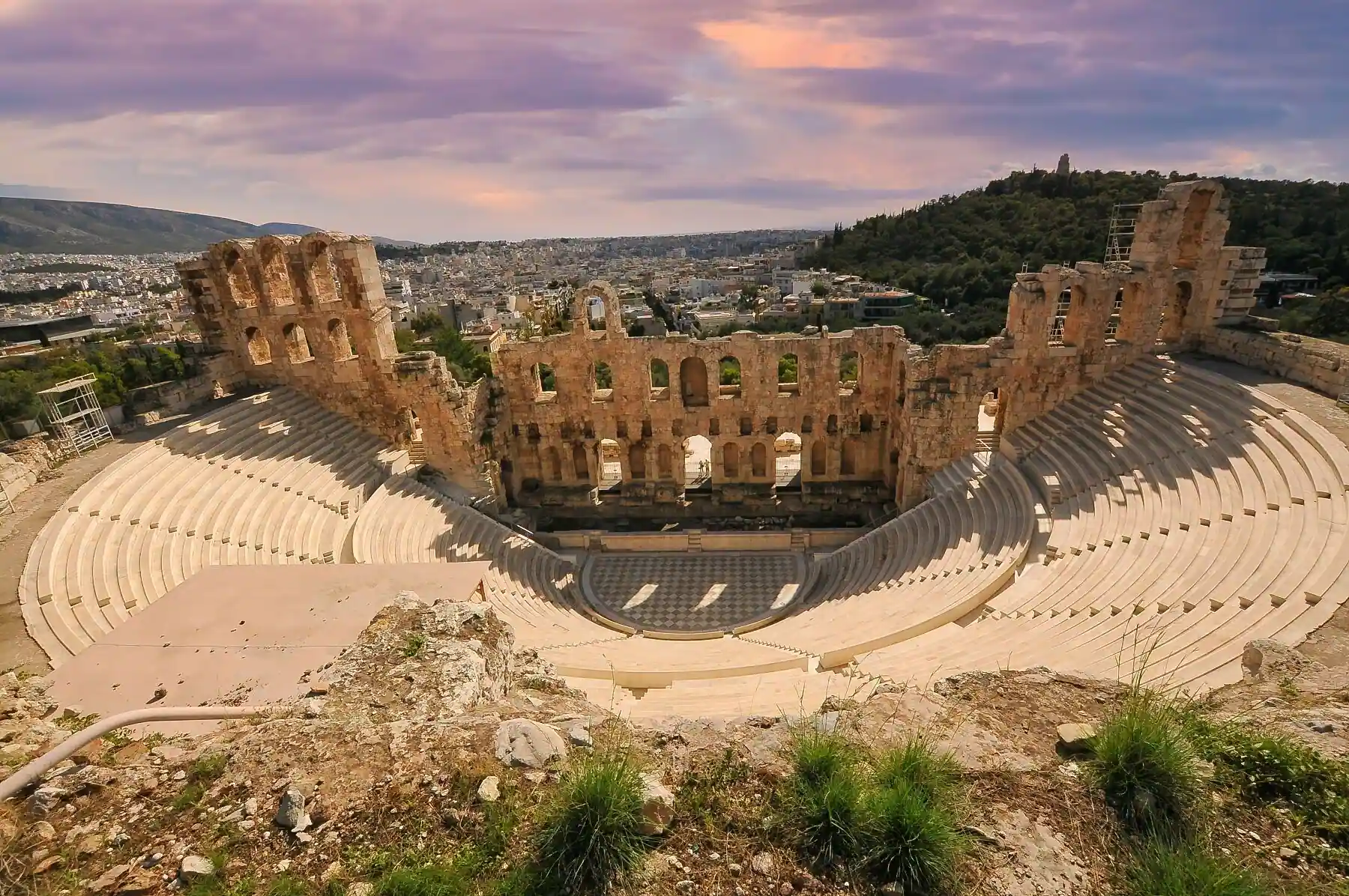
As the sun sets behind the Acropolis, there comes a moment when the marble seats of the Odeon of Herodes Atticus glow orange. I’ve sat in those marble seats dozens of times during sunset. I’ve watched the sky melt from blue to orange to violet a thousand times. But every time I sit there, I feel like it’s the first.
This ancient theatre is not another ruined monument. It’s alive. Music still echoes into the Athenian night. Voices still fill the seats as they did almost two millennia ago. The Odeon of Herodes Atticus is a living, breathing piece of ancient culture that sits just outside the city of Athens. And if you travel to Athens, you can see it for yourself.
When in Athens, you can easily spend weeks learning about the beauty and wonder of Ancient Greece at the city’s many museums and historical sites. But seeing ancient Greece alive and well, entertaining thousands of people just like it did thousands of years ago? That is a chance many tourists will never have.
Table of Contents
What is the Odeon of Herodes Atticus?
The Herodes Atticus Odeon or Herodion is a stone-built theatre cut into the south slope of the Acropolis. Odeon comes from the Greek word oideion, meaning song. While dramatic performances were held in large open-air theatres, odeons were smaller, roofed structures that mainly focused on musical performances, poetry readings, and lectures.
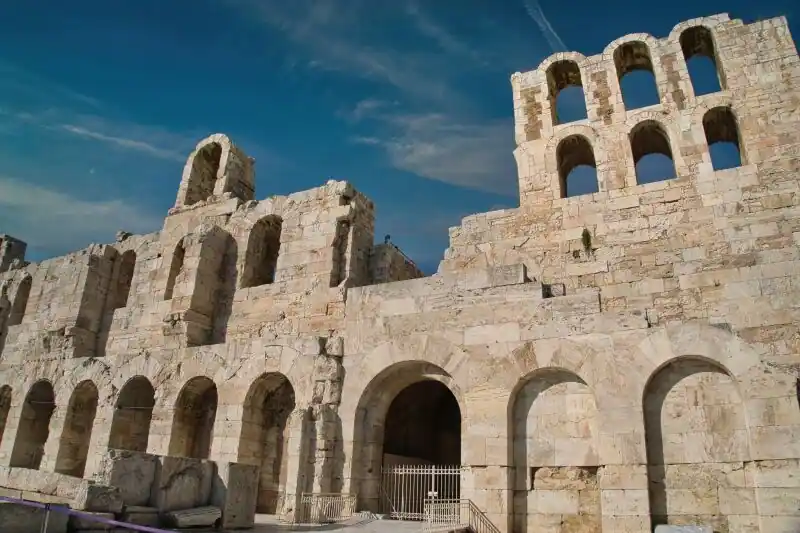
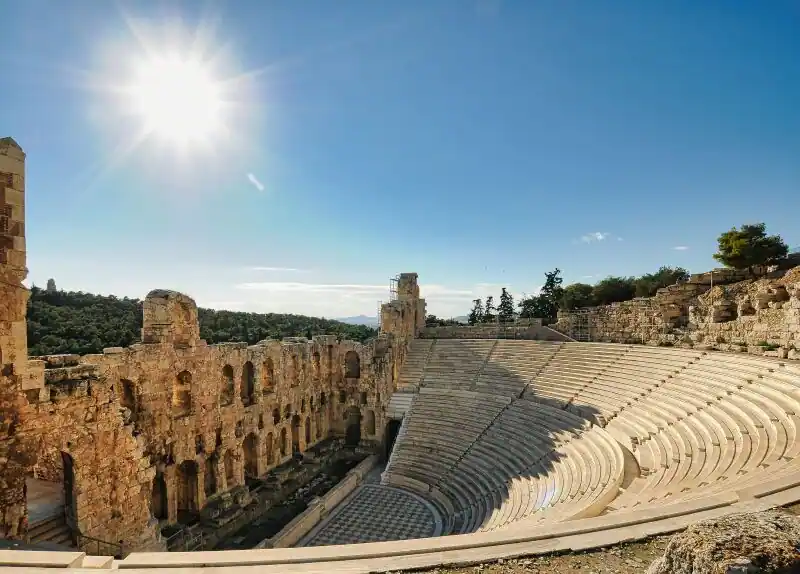
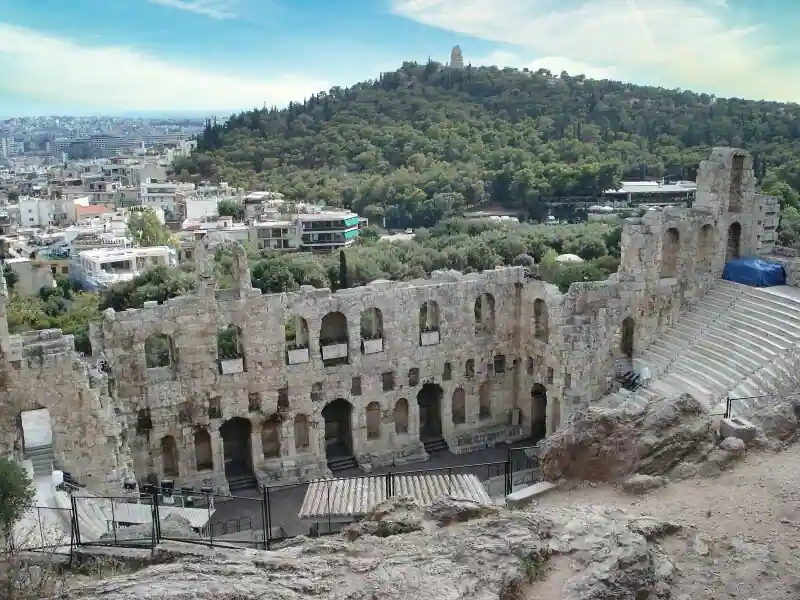
As you can probably guess by now, this odeon is one of the largest ever constructed. This odeon could seat around 5,000 people for intimate concerts and performances. The semi-circle-shaped seating area, also known as the cavea, faces a raised stage with a giant, tall stone wall behind it. This stone wall was originally three stories tall.
As you can imagine, the Odeon of Herodes Atticus doesn’t have its original roof covering it these days. However, the marble and limestone seats have been repaired. We have parts of the stage area to allow for performances these days. Walking around the ancient theatre in the daylight, you can see both old Roman stonework as well as new modern replacements where needed.
Technically, this theater is more Roman than Greek, as it was built by a Greek man in the centre of ancient Athens. The Odeon stands right next to the older and much larger but less preserved Theatre of Dionysus.
Who built the Odeon of Herodes Atticus and why?
The Odeon was constructed by one of the richest men in the Roman Empire, a Greek aristocrat, philosopher, teacher, athlete, and arts patron named Herodes Atticus.
He constructed the theatre in commemoration of his beloved wife, Aspasia Annia Regilla, who died in 160 AD. According to some historians, she died while giving birth to their child. Herodes commemorated her death by constructing many beautiful public buildings and monuments for his people, and the odeon was the grandest of these.
How old is the Odeon of Herod Atticus?
The Odeon of Herodes Atticus was completed around 161 AD, which makes it approximately 1,860 years old.
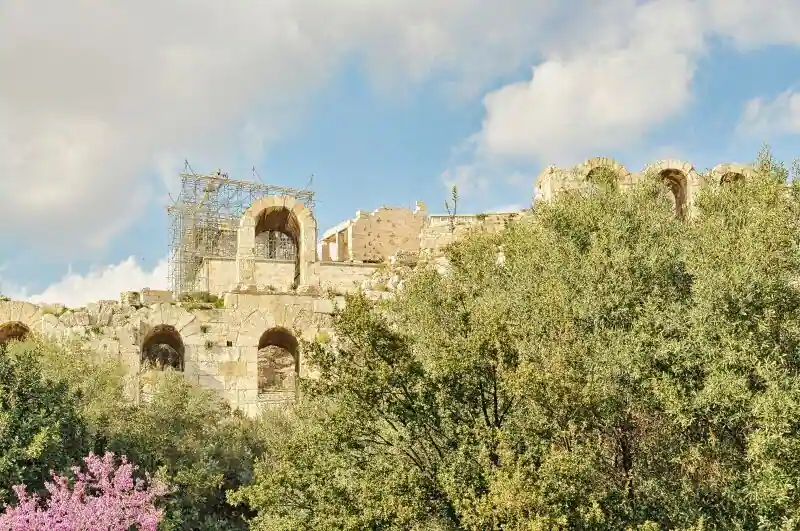
The structure we see today is not entirely original. Over the centuries, the Odeon suffered significant damage. The wooden roof collapsed or burned at some point in antiquity. The Herulians, a Germanic tribe, sacked Athens in 267 AD and likely damaged the theatre. For long periods, it fell into disuse and decay.
Major restoration work began in the 1950s, when the Greek government decided to bring the Odeon back to life as a performance venue. The marble seating was repaired, the stage was reconstructed, and modern sound and lighting systems were carefully integrated into the ancient structure. The goal was to preserve the historical character while making the space functional for contemporary performances.
Why is the Odeon of Herodes Atticus important?
So why is the Odeon of Herodes Atticus important? Well, it is important because it is one of the best-preserved ancient Roman theatres in the world. It is also still used today for performances, as it was almost 2,000 years ago. Preserved and still used. That, in a nutshell, is what makes it so special.
Rarely can any ancient monument make that claim. So many Roman and Greek theatres across Europe and Asia are ruins. Beautiful, haunting ruins, but ruins nonetheless. Not the Odeon of Herodes Atticus. You see, its existence is a testimony of continuity. When you watch a concert or a show there, you are not simply a tourist – you are keeping history alive. You are doing what people have done there since 161 AD.
For me, personally, it is important for other reasons too. Ancient monuments like the Odeon are crucial for our understanding of what ancient Athens was like. By 161 AD, Athens was no longer the centre of the ancient world. It had been reduced to a shadow of its former glory by the Romans. But Athens was still one of the intellectual capitals of the ancient world, and rich Romans wanted to beautify their honorary hometown. The Odeon is a reminder of that fact. It reminds us that great Greek culture was still appreciated under decades of Roman oppression.
It reminds us of the incredible knowledge the Romans and Greeks had of architecture and engineering. The Odeon is proof of what they could accomplish. Even now, scholars study the Odeon's construction to learn about its incredible acoustics. Professionals can barely replicate what the Greeks did naturally. Listen closely during a performance, and you’ll hear a person whisper on stage and be able to hear them from your seat halfway back. How did they do it? No one knows for certain. All we can do is marvel at their accomplishments.
Where is the Herodion located?
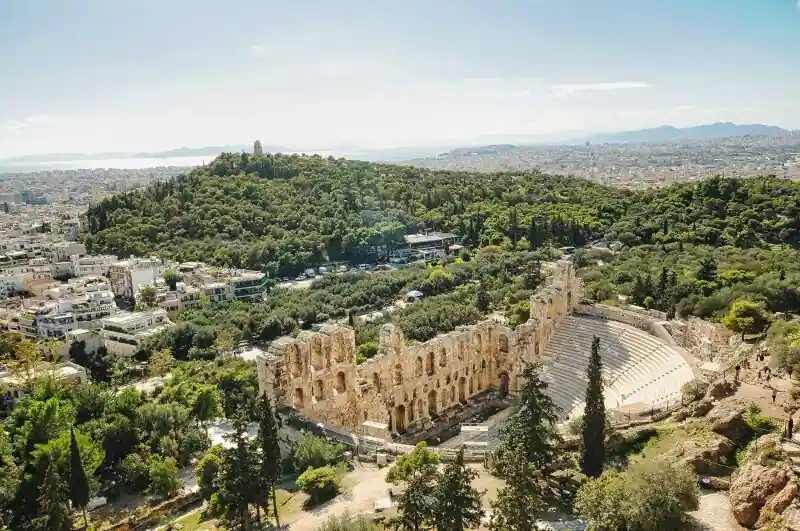
The Odeon is located at the southwestern foot of the Acropolis, across from Dionyssiou Areopagitou pedestrian street. The theatre is a part of the Acropolis archaeological area right against the bedrock that has dominated the city for millennia.
It’s located in a well-trafficked area. You can walk from the Acropolis metro station in minutes. Visitors will find themselves heading towards the large eastern entrance to the Acropolis. Walk around to the south side, and you will be greeted with a birds-eye view of the Odeon. For me, one of the coolest parts about this ancient theatre is standing atop the Acropolis looking down upon it.
One tip I always give friends visiting Athens is visit around sunset. Walk along Dionyssiou Areopagitou and watch the light change as the sun sets. Grab a coffee while overlooking the ancient ruins. You might even get lucky and catch a night performance at the Odeon.
What was the Odeon of Herodes Atticus used for in ancient times?
Ancient buildings like the Odeon hosted musical performances, poetry readings, and philosophical lectures. Even the building's name gives us a clue about its intended use. The second part of the word “odeon” means song.
Life in Ancient Athens revolved around culture. Festivals, competitions, and public meetings drew Athenians out of their homes to celebrate art. The Odeon of Herodes Atticus offered an impressive backdrop for all these events. The covered roof (now destroyed) meant better acoustics and shelter from the elements. People could gather there year-round to listen to performances.
Events were probably held at the theatre during the Panathenaic Festival and other holidays. Wealthy patrons like Herodes Atticus often erected public structures as evidence of their generosity and love of civic life. By providing Athens with a beautiful venue for musical and artistic performances, Herodes ensured the continued intellectual vigour of his beloved city.
How to visit the ancient concert hall?
Odeon can be viewed from the Acropolis above during the day. As you approach the southern retaining wall, stop and look down. Enjoy one of the best views of the Odeon Theatre. From here, you will get a feel for the theatre's size and how it relates to the sacred rock.
Entry into the Odeon during visiting hours is prohibited. Most ancient attractions in Athens are open only when they are hosting a performance. If you’d like to see the seats up close and from within, you must attend an event.
What events take place at the Herodion today?
Today, the historic open-air theatre is used for the Athens and Epidaurus Festival. From June to August each year, there are classical concerts, opera, ballet, modern dance, and theatre performances. World-renowned Greek and international performers take the stage under the summer stars with a backdrop of a lit-up Acropolis.
Attendees of the festival come from all over the globe. Tickets often sell out for popular shows, and people say that going to a performance here is a once-in-a-lifetime experience. Ancient world wonders mixed with world-class entertainment and an Athenian summer night equals magic.
When there is no festival, the Odeon will sometimes hold special events. Memorial concerts, celebrations, or national ceremonies may be held at the Odeon. If Greece has something to say to the world, chances are they’ll say it at the Odeon.
For me personally, going to see a show at the Odeon will never get old. I remember the first time I sat in those marble seats and watched some world-class ballet under the stars. As the dancers performed on that ancient stage, the music floated up into the warm summer night air, and I knew why the place has stood here for so many centuries. Some things are meant to last forever.
A few more helpful details
Is the Herodion worth visiting even without an event?
Yes. Visitors enjoying sunset from atop the Acropolis should still make time to see the Odeon. The Odeon is one of Athens' most photographed sites. As the sun sets, it lights the stone in a beautiful golden hue.
How can I purchase tickets for a performance?
Tickets can be purchased through the Athens and Epidaurus Festival website. Popular concerts sell out weeks in advance, so reserve your tickets early.
Is the Odeon roofed or outdoors?
Today, the Odeon is open-air. The original wooden roof that covered the seating area was destroyed in antiquity and has never been rebuilt.
Other sites worth visiting
Not far from the Odeon is the Ancient Agora. The Agora was the center of public life in classical Athens, where Socrates wandered. The Roman Agora is next door and also tells a similar story – but with Roman influence and different architecture. It was built when the city was under the control of the Romans, and it is interesting to see how the city made room for new rulers while still retaining its identity.
If you’re looking for something calmer and more reflective, I usually suggest Kerameikos cemetery. An ancient burial ground located outside the ancient city walls, this is a place of marble tombs and tranquil walkways.
Hadrian’s Library can be found in the Plaka neighbourhood of Athens, and its tall columns give some hint of the splendour it must once have been.
The Temple of Olympian Zeus is one of those sites in Athens you really don’t want to miss. The columns are so wide that they are a testament to the ambitions of Ancient Athenians.
Outside the center, at Cape Sounion, you’ll find the Temple of Poseidon on a cliff above the sea. The journey there takes about an hour and is well worth it.
In the center of modern Athens, on Panepistimiou Street, is the Athenian Trilogy. Three neoclassical buildings – the Academy, the University, and the National Library – were built in the 19th century to represent Greece’s rebirth as a nation.
The feeling of being there
Before I go, I want to leave you with one personal thought. Facts and dates are wonderful, but they don’t convey what it feels like to stand at this stone theatre on a summer evening. Picture this. The sun is setting behind the mountains and casting a purple hue across Athens. Lights begin to twinkle on, spreading across the city basin towards the sea. You are sitting on a stone seat carved nearly two thousand years ago. Thousands of other people surround you, and together you have come to hear music. The stage below you illuminates. The performers walk out. And then the music begins.
It doesn’t matter what type of music is played. I’ve heard classical orchestras, Greek folk music, American rock bands, and Italian tenors perform at the Odeon. They are all different, but the feeling is the same. You feel connected to the music, to those who sat in these seats thousands of years ago, to the city spread out below you, and to the people up on that stage giving their heart and soul to the ancient stones.