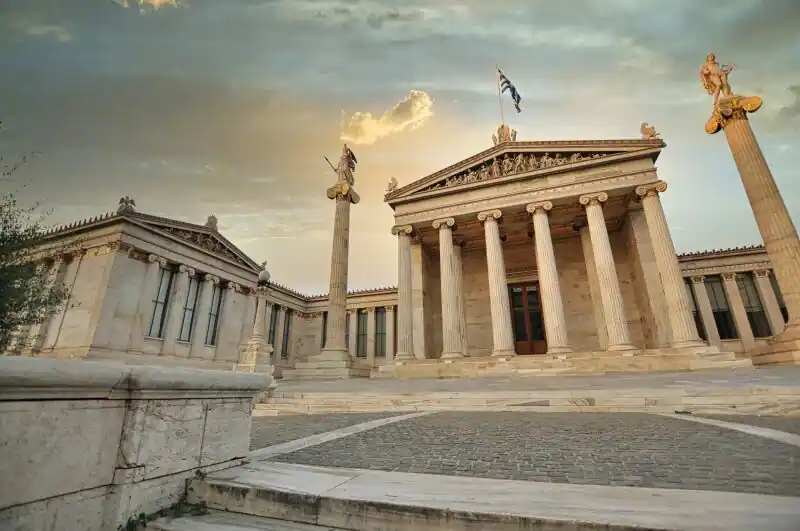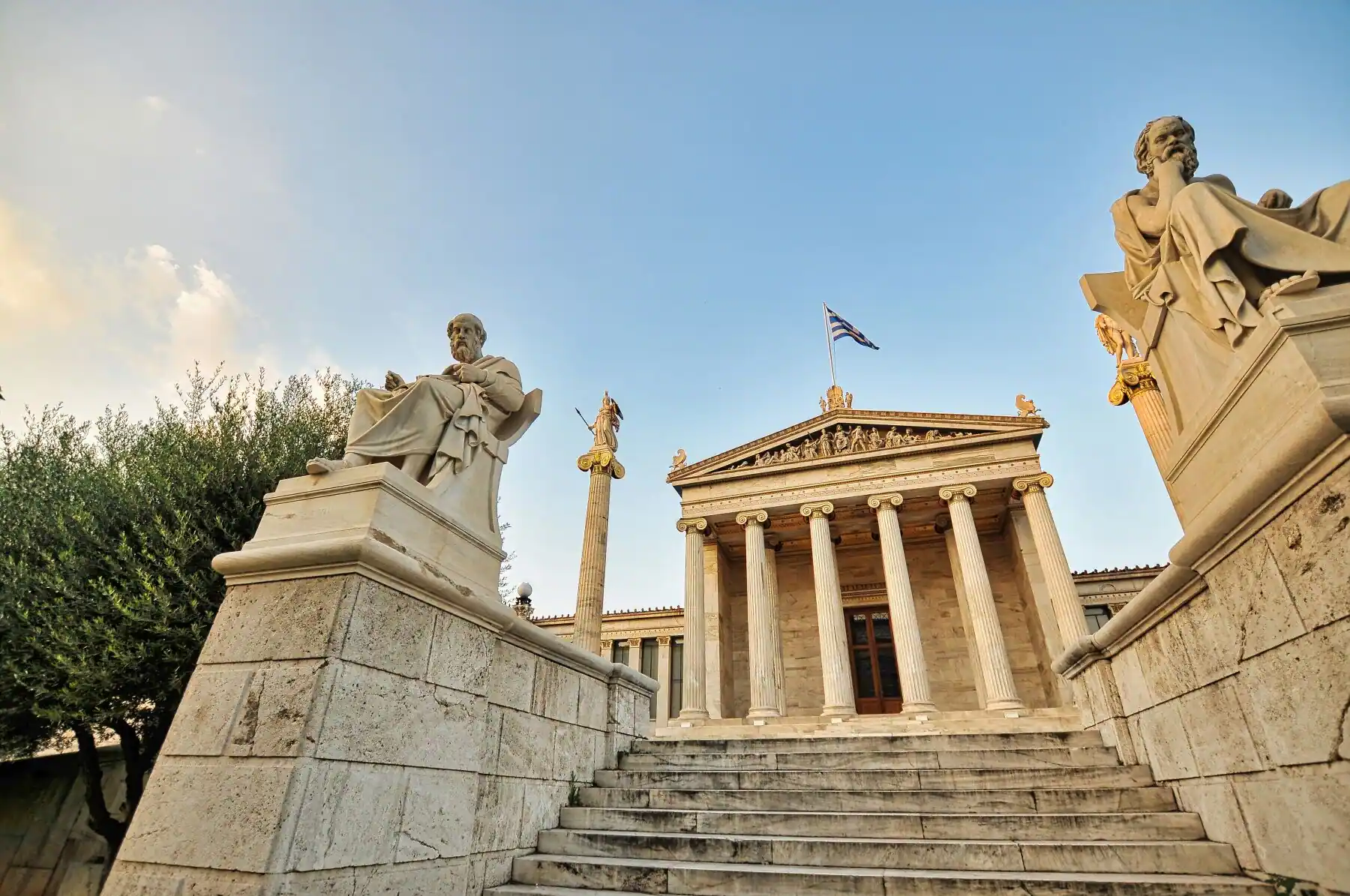
There are some Sunday mornings that I desire to walk down Panepistimiou Street. Central Athens quiets down for a moment when I come to a halt in front of these three neoclassical buildings. They're beautiful, solid, and elegant. Three columns standing next to each other like siblings, calm and patiently waiting for someone to look their way again. This is the Athenian Trilogy. The Trilogy that Athens has ever constructed. None of them is ancient. But built when Greece wanted to remember who they were and decided to imprint that memory into marble and stone.
You may know Athens well. But even if you've walked the streets your whole life as I have, you'll find these buildings somewhere unexpected every time. Despite seeing them so frequently, every time I glance up at their columns and sculptures, something settles inside my chest. It isn't loud—just pride.
If this is your first time in Athens, you'll make a beeline for the city's famous attractions: the Acropolis of Athens or the Ancient Agora. And yes. Please do. See those wonders because they are. But before you go, take a moment to walk by Athens' neoclassical Trilogy. It will teach you about Greece in a different yet equally important way.
Table of Contents
What is the Athenian trilogy?
The Athenian Trilogy refers to three buildings in the center of Athens: the Academy of Athens, the University of Athens, and the National Library of Greece. Standing side by side along Panepistimiou Street, they are inseparable from one another. Together they convey the principles upon which the new Greek state wanted to build its society: knowledge, education, arts.
They are sometimes known as the neoclassical trilogy, or sometimes as Athens' architectural trio. Whatever you want to call them, don't forget what they symbolize. Designed to resemble Greece's classical era reimagined in the 1800s, they were intended to send a message. Greece had found its independence after years of Ottoman oppression, and it wanted icons. Icons of intellect as much as strength.
The trilogy gets its name quite literally—three buildings that had three functions, yet signified one collective ideal. A trilogy is a story divided into three parts. Each building is significant on its own, but when combined, we see what Athens aspired to be.
Did You Know?
 Did You Know?
The three buildings symbolize knowledge, science, and culture in modern Greece, and the statues of Athena and Apollo in front of the Academy represent wisdom and arts.
The Academy of Athens, where wisdom stands tall
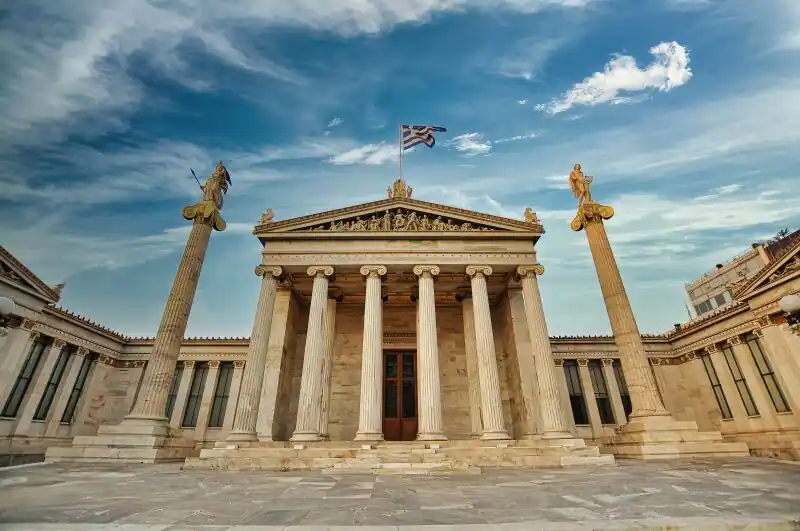
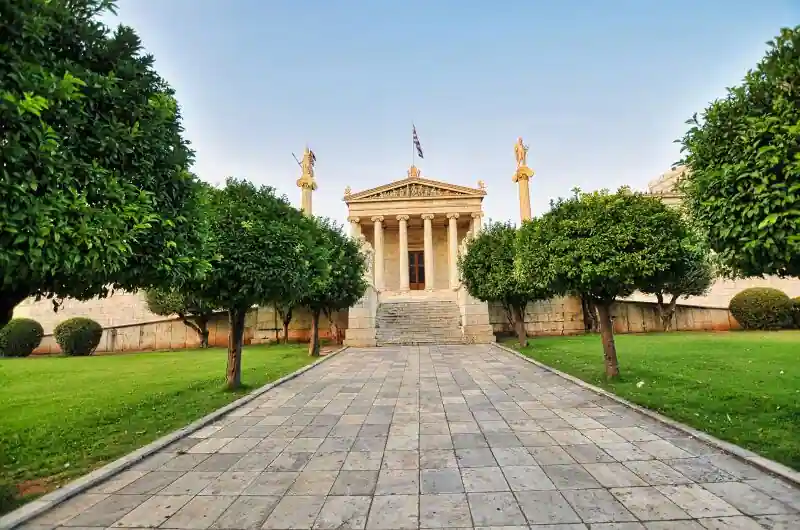
The Academy of Athens is the centerpiece, both visually and symbolically. It occupies the left side of the three (if you face the buildings from the street) and is by far the most adorned of the three buildings. Two tall columns stand in front of it with statues of Athena (goddess of wisdom) and Apollo (god of light) at the top. Between the columns, there is a wide staircase that ascends to the front door, and painted into the pediment above the door are Greek mythological scenes.
The Academy building was Greece's national research organization. It still serves as Greece's highest academic authority. Visitors cannot enter the main rooms but can approach the entrance and see up close the sculptures, painted details, and overall awe-inspiring neoclassicism.
I love that about the Academy. It doesn't whisper. It boldly declares: this is a country that thinks. The marble used in the neoclassical building shines in the afternoon sunlight, and the statues standing guard at the top seem to protect not only the building but that notion as well.
The university, where a nation learned to dream
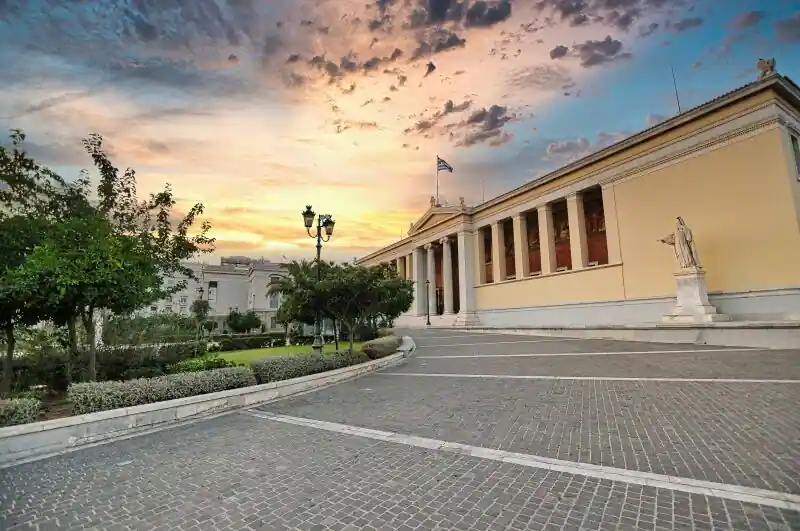
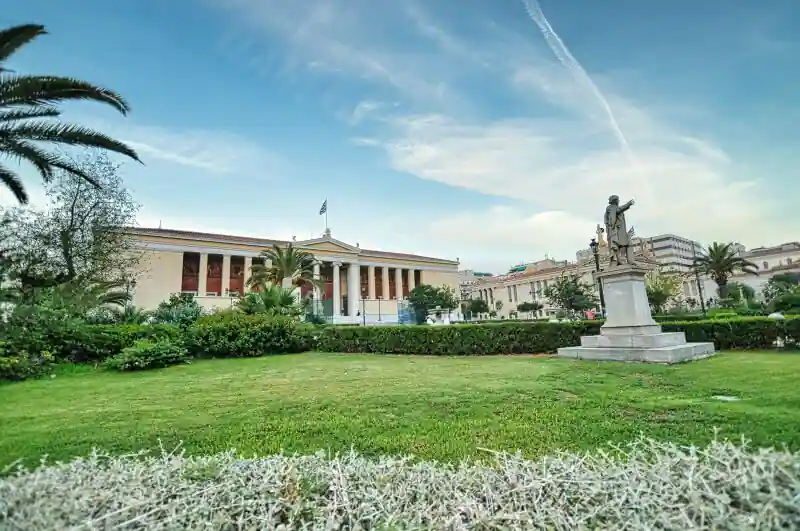
Located in the center of the three is the original building of the University of Athens. It's the oldest building of the trio and by far the most reserved when it comes to decor. Columns are Ionic and run the length of the facade with an expansive staircase.
Completed in 1842, this building was literally one of the most significant buildings in what was still a very new Greek state. It was the first university of liberated Greece. For that reason alone, it's a monument to education and scholarship in Greece that transcends the architecture itself.
Today, the building remains part of the National and Kapodistrian University of Athens, but the school itself has spread to several newer campuses. The original structure does, however, remain in use for ceremonies and as an event space. Visitors can walk through the front courtyard and into the main entranceway. Here you'll find the walls of the entry hall frescoed with paintings by Carl Rahl. The paintings are allegories of the arts and sciences.
For me, every time I pass the University, I'm reminded that young students were once here with bright minds and a hope that education could rebuild their country. I think it did.
The national library, keeper of words and memory
On the right, you'll find The National Library. This is the most elegant of the three. The sweeping marble staircase that ascends from the street level to the entrance is one of the most photographed spots along Panepistimiou Street.
Designed by Theophil Hansen, the Library was constructed to house Greece's most significant collection of books, manuscripts, and historical documents. The facade is accented with Doric columns and exudes a quieter, more reflective mood than its neighbor, the Academy.
In recent years, the collections were transferred to a new home at the Stavros Niarchos Foundation Cultural Center on the southern outskirts of Athens. The historic building on Panepistimiou now hosts exhibitions and cultural events. You can visit during open hours (they're free) and go inside. It's worth it. Marble floors. High ceilings. An aura of silence that borders on the divine.
I've always felt that the Library was the most sentimental of the trio. There are no gods perched on top. No painted pediment full of historic stories. Just an unspoken promise that words matter.
When was the Athenian trilogy built?
While the buildings weren't constructed concurrently with each other, they were designed to be together as one single entity. Construction took place over multiple decades during the 19th century.
The University of Athens building was completed first in 1842. Since it was the first university in the newly liberated Greek state, finishing its construction was understandably made a high priority. The National Library came next, with groundbreaking occurring in 1888 and construction completed in 1903. Lastly, even though it was designed first, the Academy of Athens didn't finish construction until 1885.
From conception to completion, the neoclassical campus took upwards of six decades to build. Just let that sink in for a moment. These structures were not put together quickly and slaved one brick at a time by master artisans who took great care with every column, every piece of carved marble.
How were Greeks in the 1800's able to fund the construction of such an extravagant trilogy of buildings? The credit goes to a group of wealthy Greek philanthropists who lived overseas. Georgios Averoff, Panagis Vallianos, and Simon Sinas were Greeks of the diaspora who wanted to give back to Greece. Thanks to their generosity, we have Athens' architectural trio.
The hands that shaped the trilogy
Two Danish architects were responsible: Theophil Hansen and his brother, Christian Hansen. Christian designed the University of Athens. Theophil designed the Academy and the National Library.
Of particular note, Theophil Hansen went on to become one of the 19th century's most important architects. He lived in Athens for years studying ancient Greek architecture, then went on to Vienna to design some of that city's most famous structures. But you could make the argument that his masterpiece is this Athenian Trilogy.
Notice how these architects borrowed from antiquity without being beholden to it. These are not recreations of ancient Greek temples. These are 19th-century buildings that use the architecture of classical Greece (columns, pediments, symmetry) to create something new. They say something unique while still paying homage to the greats. The symmetrical façades are breathtaking, but also inviting. They're nothing cold or lifeless about them.
Why are these neoclassical buildings important?
You have to consider when these buildings were constructed to understand why they are important. Greece had won its independence just a few years prior in the 1830s. The nation was newborn, weak, and trying to find its place in the world. Athens was made the capital city, but really it was little more than a village on the hill of the Acropolis.
The government wanted to construct a symbol that would tell everyone (and Greeks especially) that this was a country built on philosophy, science, and art. The Neoclassical buildings on Panepistimiou Street were part of that message. These buildings were more than impressive architecture. They were a promise. A promise that education and culture would be crucial to Greece's future.
I feel that when I stand in front of them. The buildings have heft, not from the marble that encases them, but from the idea they represent. They have been woven into the cultural fabric of Athens in a way that most buildings cannot. They remind us all of the Greek Enlightenment.
How do these monuments reflect neoclassical architecture?
These monumental buildings are considered among the best examples of classical revival architecture in Europe. Not only do they borrow from the forms of ancient Greek temples, but they actually use all three orders (Doric, Ionic, and Corinthian) on their facades. Columns, pediments, symmetry, and proportion become the vocabulary of the buildings.
However, the Athenian architectural trilogy doesn't simply mimic ancient Greece. They borrow from it. Painted decoration on the Academy, for instance, was a revolutionary idea based on archeological discoveries that proved the ancient Greeks actually painted their buildings bright colors (they were not white marble after all). The Academy is actually one of the few neoclassical buildings in Europe to incorporate this find.
Compared to other neoclassical buildings in Europe, what makes our Athens landmarks unique is their proximity to the source material. After all, these buildings were actually designed in the place where Classical Architecture originated. The buildings have an authenticity that you can't find in Berlin, London, or Vienna. The marble came from here. The light shines down on them from Athens above. And the overall spirit of the place is undeniably Greek.
You see this in the sculptures and symbols adorning the buildings. Owls (the symbol of Athena), laurel wreaths, lyres, and mythological scenes are carved into the stone. Everything means something, and no column is out of place.

Where is the Athenian trilogy located?
The neoclassical trio is located in central Athens, on Panepistimiou Street, which is one of the major arteries crossing Athens' historic center. The street links Syntagma Square with Omonia Square, and the three buildings stand facing each other right in the heart of it.
If you are approaching from Syntagma, it takes you around five minutes. Start with the University building, the middle one. On its left is the Academy, on its right the National Library. They are practically next to each other. You can count the steps between one building and the other. This neoclassical triumphal arch is impossible to miss.
It's one of those parts of Athens where everyone and everything is rushing around. Taxi drivers honking, buses lining up people to and from work, crowds of workers eager to get a sip of their overpriced coffee. Yet there is something timeless about those buildings that keeps the chaos around them from penetrating. It's part of their magic. The city center lives at a thousand miles per hour, but those three calmly stay there, unperturbed, silent, like wise older men that have seen everything and don't need to scream.
Can visitors enter the buildings?
Visiting the inside depends on the building. The Academy is generally closed to the public, but you can see the entrance and its sculptures if you stand on the steps. Sometimes the University opens its courtyard and entrance hall. The National Library has exhibitions on occasion, so it will also open its doors to the public during those times. You can always double-check ahead of time, though.
My favorite time to visit is late in the afternoon when the sun begins to set. The marble takes on a warm, gold tone, and if you stand across the street, you can see all three buildings together. That is the view you will remember.
Small questions before the visit
Are the three buildings still used today?
The three buildings are still in use today. The Academy is Greece's highest academic body, the University's building hosts official ceremonies, and the National Library hosts occasional exhibitions since the main collection was moved to the Stavros Niarchos Foundation Cultural Center.
How long does it take to see the Athenian Trilogy?
Plan to spend about half an hour to an hour exploring the Trilogy. Walk down all three buildings, taking photos and reading the historical info on each.
Is the Athenian Trilogy worth seeing for first-time visitors?
If you have time, definitely visit the neoclassical landmarks. It's one of the most beautiful architectural sights in the city, and it provides an insight into Greek history that you won't get anywhere else.
What street is the Athenian Trilogy on?
All three buildings are located on Panepistimiou Street, exactly in front of the metro station Panepistimio.
Is the Athenian Trilogy close to other major attractions?
Yes. The Trilogy is within walking distance of Syntagma Square, Monastiraki, the Temple of Zeus, and several museums.
Three buildings, one feeling
I don't know how many times I passed by the Athenian Trilogy. Hundreds, for sure. Even if you see it every day, it has a way of taking you by surprise. There's something quietly magnificent about these buildings that doesn't scream for your attention. It just… waits for you to look closer.
Athens is a city of layers. Ruined temples. Byzantine churches. Spray-painted walls. Glass skyscrapers. Everything is piled on top of everything else. It's one of the things I love about this city. The neoclassical building complex on Panepistimiou Street is one such layer. And for me, it's also one of the most significant. To me, it symbolizes the moment Greece decided that yes, the country could learn. That, yes, Greece could become beautiful again at a time when it really had neither.