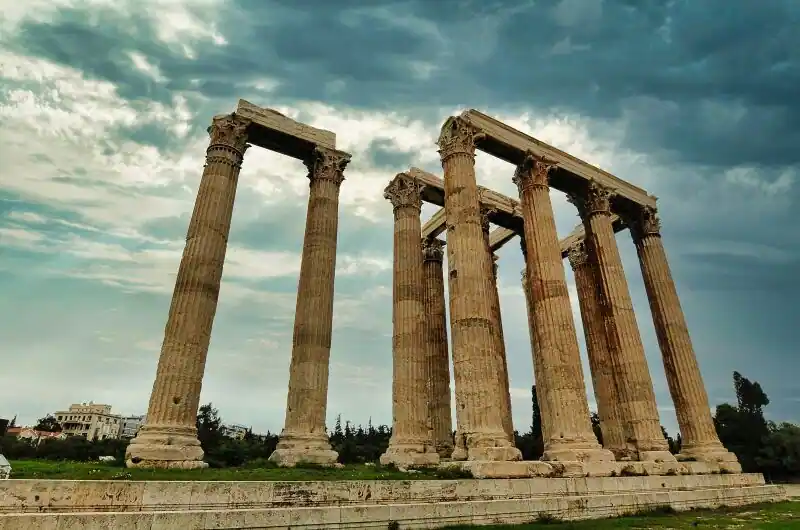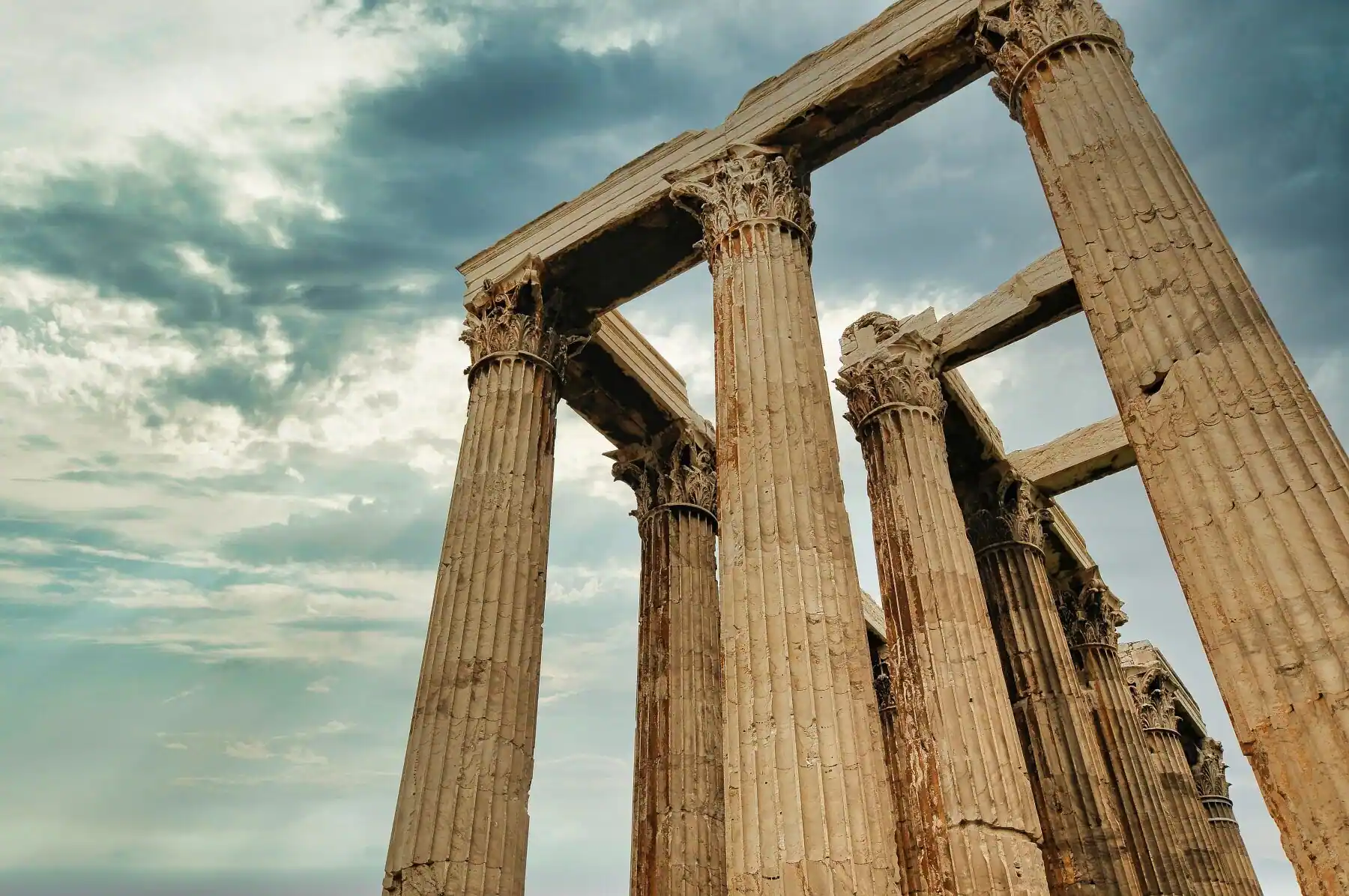
There’s a place in Athens where time seems to slow down. Where fifteen silent columns reach up to the Attic sky and whisper of times past, of more than two thousand years of history. I walk past the Temple of Olympian Zeus almost every week, but every time I pause, a part of me stirs in my chest. This is where the largest temple in all of Greece once stood—a temple built to enshrine the king of the gods.
If you’re planning a trip to Athens and you ask yourself, what was the temple of Zeus used for? Then you’re asking the right question. Because to understand this sanctuary, to fully appreciate it, is to understand how the ancient Greeks perceived the world around them. Their gods. The space between earth and heaven.
Table of Contents
When empires rise and fall, columns wait
I find myself wondering about the workers who laid the first stones in this place. Did they realize, on this first day of work, that their great-grandchildren and their great-grandchildren after them would still be working on this same building? Did they know they were starting something they would never see finished?
The history of this sanctuary teaches us about patience, ambition, and the odd rhythms time keeps moving through ancient places. Tyrants dreamed it, democracies abandoned it, kings revived it, and an emperor finally completed it.
The history of the temple
The history of this sanctuary is far longer than most visitors would imagine. The temple was begun around 515 BC by the tyrant Peisistratos the Younger, who wanted to build the largest temple Greece had ever seen. The family of Peisistratos was soon overthrown, and the work came to a halt.
The remains of the unfinished temple then sat on the Athenian landscape for centuries. As a symbol of tyranny, the democratic Athenians who had overthrown the Peisistratids had little desire to finish the building. The columns were left to wait.
The Hellenistic kings had a different attitude. Around 174 BC, the Seleucid king Antiochus IV Epiphanes decided to continue the construction and employed a Roman architect named Cossutius to design a truly monumental building. But Antiochus died, and the temple was left to silence for the second time.
The person who would finally complete the building was a Roman emperor. The great admirer of Athens, Hadrian, finished the Temple of Olympian Zeus in 131-132 CE. That means that from the laying of the first stone to the final dedication, this sanctuary took nearly 700 years to build.
A home for the king of Olympus
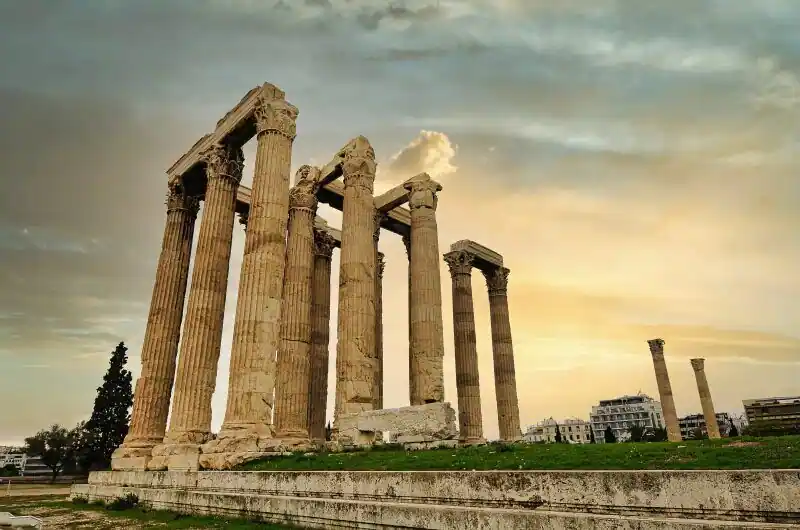
To understand what the temple of Zeus was used for, we first need to understand what Greek religion was. The ancient Greeks did not worship in the same way we would expect. The temple was not a place for the faithful to gather. It was a house for the gods.
The Temple was the earthly home of Zeus himself. Ruler of Mount Olympus, god of the sky, thunder, and justice. Inside the sanctuary was a huge chryselephantine statue of the god himself, made of gold and ivory. The Greeks believed that this image of the god could be inhabited by the god himself, that the divine essence of Zeus could dwell in the temple.
Worshippers would not enter the inner chamber. They would gather outside, at the altars where the priests would perform sacrifices. Animals, grain, and wine were burned as offerings to the god. Smoke from the sacrifice was thought to carry the prayers of worshippers to the heavens.
The temple, however, was more than just a religious place. It was a demonstration of power. Hadrian completed the sanctuary and placed a statue of himself in the temple, right next to Zeus. The symbolism was obvious: the emperor stood next to the king of the gods. Religion and politics went hand in hand, as they often did in the ancient world.
About Zeus
 About Zeus
Zeus was the chief deity of the Greek pantheon, the god of gods and mortals. He was thought to have power over the weather, particularly thunder and lightning. He was associated with order, justice, and the laws of nature that held the universe together.
Mythologically, he had overthrown his own father Kronos and the Titans, and established the age of the Olympian gods. He shared the rule of the world with his brothers: Poseidon, the seas, Hades, the underworld, and Zeus, the sky and the earth.
Zeus was the god the Greeks both feared and respected more than any other. They swore oaths in his name, prayed to him before battle and harvests, and built temples in his honor all across the Greek world. None was larger than this one in Athens.
Walking among giants: what you can see today
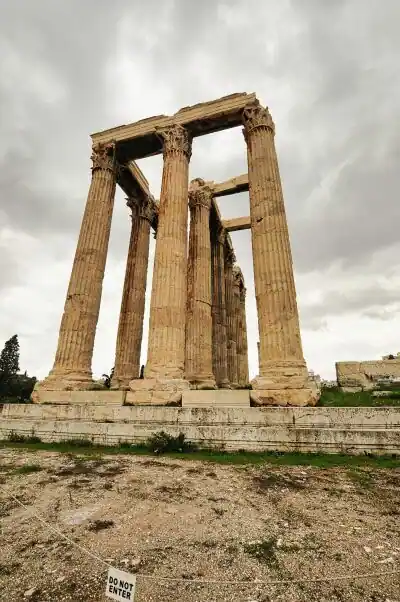
The surviving columns
Whenever I visit the archaeological site of the Temple of Olympian Zeus, I feel small. Not in a bad way. Just small in the way you feel when you stand in front of something that has outlasted empires.
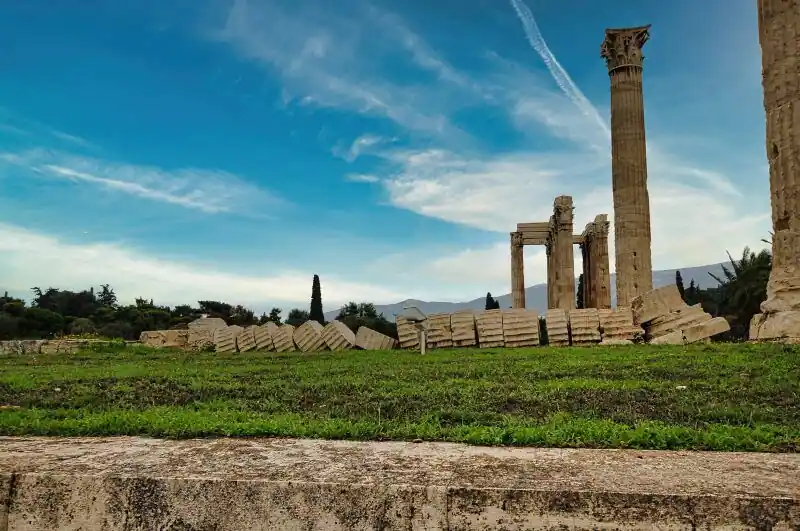
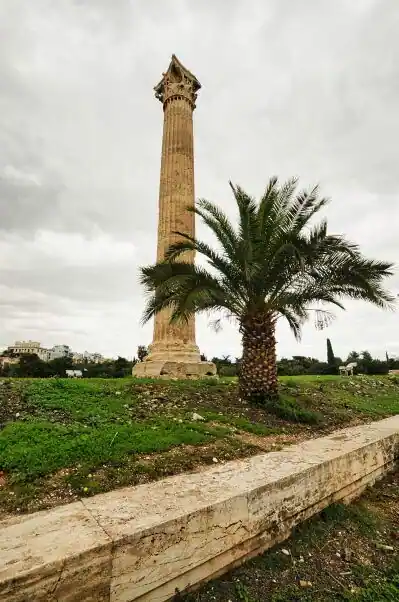
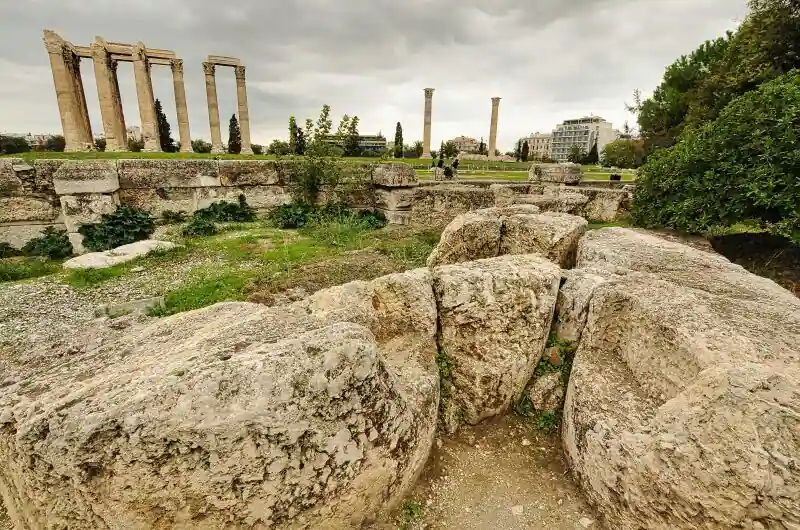
Of the original 104 Corinthian columns that stood in the open-air temple, just 15 are still standing. A 16th column has fallen and rests on the ground where it landed during a storm in 1852. Each column is about 17 meters tall. The columns are made from Pentelic marble, the same marble used in the Parthenon.
Hadrian's Arch
Northwest of the temple is a gateway known as Hadrian’s Arch. It was constructed about the same time the sanctuary was completed. The inscription on one side of the arch reads, “This is Athens, the ancient city of Theseus.” On the other side, it reads, “This is the city of Hadrian, and not of Theseus.”
The arch marked the dividing line between old Athens and the new Roman quarter that Hadrian constructed. Passing through it is like going between two worlds, two different eras in the city’s history.
The Roman baths and other remains
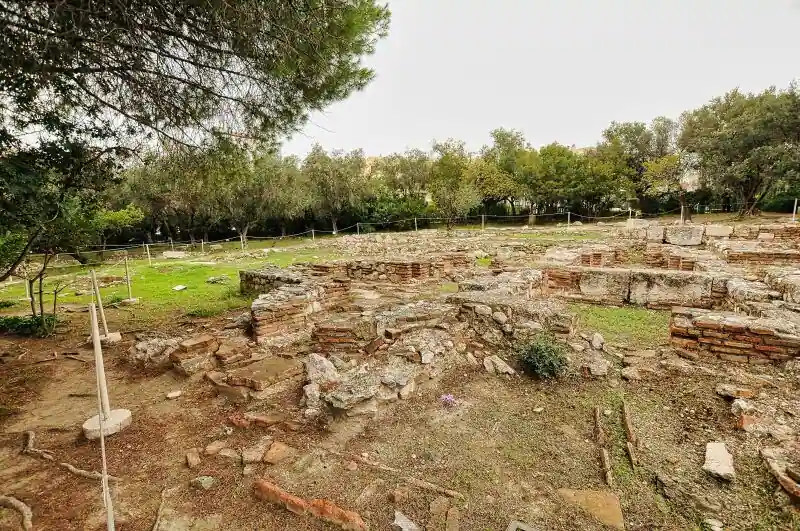
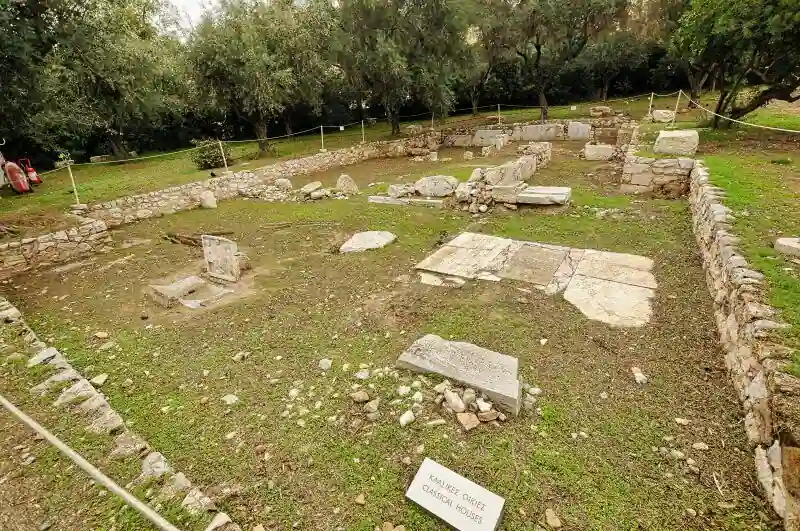
The foundations of Roman baths from the 2nd century CE and remains of ancient houses from the 5th century BCE are also visible at the archaeological site. Reminders that this place has always been at the very heart of Athens, even before the great temple loomed over it.
The fall of a sacred giant
The temple did not meet some violent or cataclysmic end. It faded gradually over a long period of time.
After the death of Hadrian in 138 CE, the temple continued to be used for worship for another 200 years or so. As the Roman Empire became more and more Christianized, the ancient gods were abandoned by the people. Emperor Theodosius I outlawed all pagan practices in the empire in 391 CE. All the great temples of Greece fell silent.
Without anyone to pay for maintenance or priests to oversee the upkeep of the sanctuaries, nature and human activity began to take its toll. Earthquakes shook and damaged the site. Stones were carried away and reused for other buildings. The huge statue of Zeus was long gone, probably taken apart for its gold and ivory.
Was the temple of Zeus ever destroyed?
There was no single apocalyptic moment in the demise of the temple. It was damaged by earthquakes, perhaps even the big one in 426 CE. During the medieval period, locals made a quarry of the site, removing marble for their own building projects.
By the 17th and 18th centuries, when Western tourists began arriving in Athens, just a fraction of the columns were left standing. The 16th column, which now lies on the ground, was still standing as recently as that storm in 1852.
Beyond the columns, walking deeper into Athens
The Temple of Olympian Zeus is only one small chapter of a much longer story. Athens is a city of layers, and once you begin peeling back the surface, you’ll discover that there is an ancient marvel around almost every corner.
Walk just a few blocks northwest, and you arrive in the Ancient Agora, the center of public life in classical Athens, where Socrates held forth, and merchants did business. Just next door, the Roman Agora shows how the city developed during Roman occupation, including the Tower of the Winds, which has been keeping time for two thousand years. For a quieter and more reflective stop, the Kerameikos cemetery is a walk among the graves and marble monuments that was the burial place of Athenians for centuries.
For an outdoor venue that conveys the bustle of ancient crowds, the Panathenaic Stadium is the only stadium in the world built entirely of marble, where athletes once competed for glory, and the first modern Olympics were staged. For an ancient spectacle of a different kind, the Theater of Dionysus is built on the southern slopes of the Acropolis, where Greek tragedy was born, and the plays of Sophocles and Euripides were first performed. Right next door, the Herodes Atticus theatre is still used for performances on summer evenings, as ancient stones resound with music under the stars.
If you’d like to see the treasures that have been better preserved over time than any other, the best Athens museums have sculptures, pottery, and artifacts that bring the ancient world closer than any ruin.
A few more helpful details
Is the temple of Zeus free?
No, but there are some days during the year when it is free.
How much is the ticket?
The ticket costs 6 euros.
How many temples of Zeus are there in Greece?
There are various, but the most important ones are the Temple of Zeus at Olympia and the one in Athens.
Closing words from the sanctuary
I have spent years living in Athens, and yet I keep coming back to these fifteen columns. I do not know why I keep coming back. There is something here that defies words. Perhaps it is the stubbornness of stone, how these pillars have outlasted everything around them. Perhaps it is the knowledge that so many generations of men and women tried to finish this temple, that it stands for the dream not of one but of many.
If you go to Athens, do not walk past the Temple of Olympian Zeus on your way to the Acropolis. Stay here. Sit on the warm stones. Let the enormity of this place wash over you.
The ancient Greeks built this sanctuary because they believed that the gods were worthy of the most beautiful things humans could create. Now, nearly two thousand years later, even in their ruined state, their temples still show their belief to be true.
And perhaps this temple was built not just as a place to worship Zeus, but to show the glory of what humans are capable of, when they build not just for themselves, but for something larger than any one person, any one lifetime.