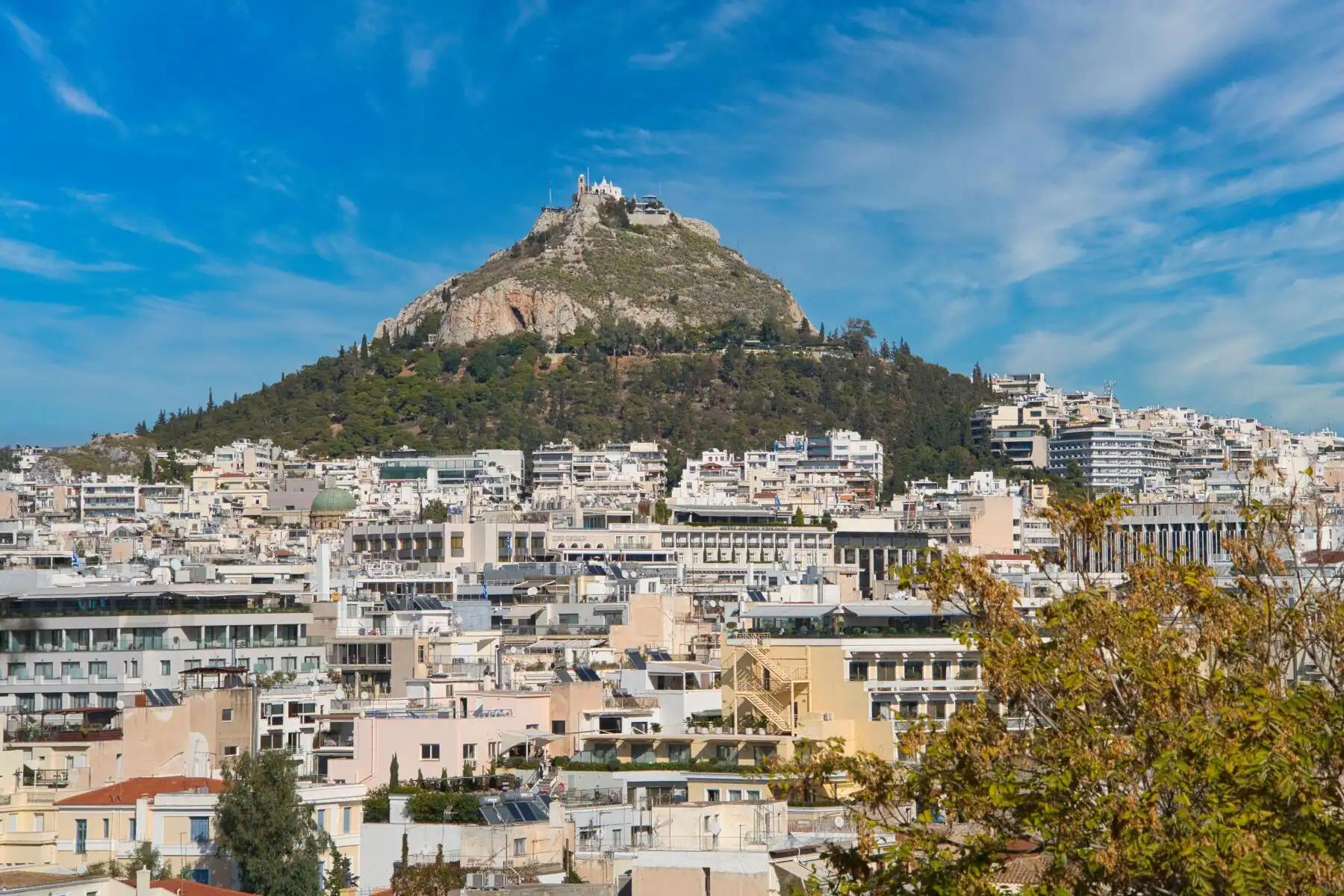
In the center of Athens, there is a hill that soars above everything. Above the apartment buildings and the traffic. Above the church domes and the satellite dishes. Above the noise and the heat and the five million people hurrying to wherever they are hurrying to on this particular day. It is visible from the streets below, almost anywhere in the city, this green slope of pine trees, this tiny white chapel on its summit catching the light and shimmering like a small bright promise.
I have ascended this hill in every season. On summer evenings when the air is thick with the smell of pine and the sky behind the mountains is copper. On winter mornings when the wind at the summit chills you to the bone and the city below is silver and still. I have climbed up alone, with friends, with lovers. And every time, when I finally reach the summit, and the whole of Athens unfurls below me, I feel the same thing. Something that hovers right on the edge of wonder. Something that hovers right on the edge of peace.
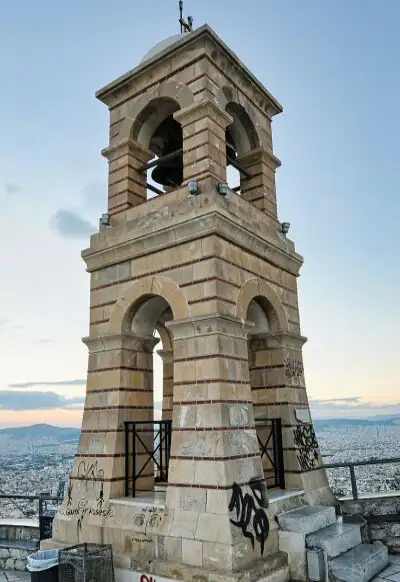
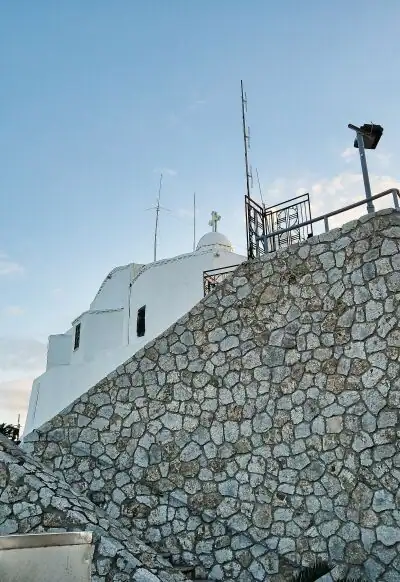
Table of Contents
The green mountain in the middle of the city
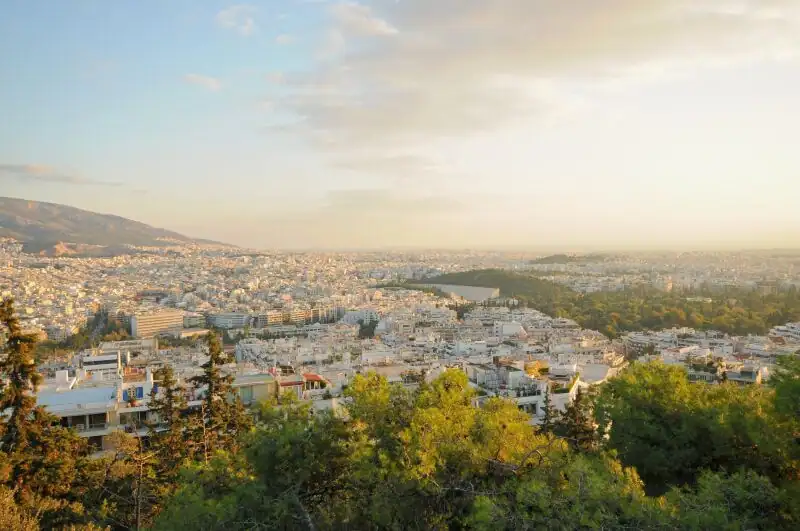
Lycabettus Hill is the tallest peak in central Athens of Greece. The limestone hill ascends 277 meters above sea level. It is located in the middle of Athens, between the neighborhoods of Kolonaki and Exarcheia, and is covered in Aleppo pine trees and crosscut by switchback paths leading to a whitewashed chapel at the summit.
Lycabettus is a municipal park, free to visit, open every hour of every day. You can visit at dawn, or midnight, or in the middle of a Tuesday afternoon. The hill does not care. It just waits.
What people come here for is the view. On a clear day, from up here, you can see all of the city in every direction. The Acropolis and the Parthenon to the southwest. The white marble curve of the Panathenaic Stadium. The Temple of Olympian Zeus and the columns of the Ancient Agora. The Hellenic Parliament in Syntagma Square. The port of Piraeus shimmered on the edge of the coast. And on clear days, the island of Aegina on the Saronic Gulf, like a blue shadow that is too still to move.
You may sometimes see it spelled differently on maps or signs. Lykavittos. Lykabettos. Lycabettos. These are all the same hill, just transliterations of the Greek name. Most English-language guides use “Lycabettus” and that is how you will find it here.
A rock that fell from the hands of a goddess
Every hill in Athens has a story to tell. Lycabettus has one of the most beautiful. Legend says that one day, while she was soaring through the heavens, the goddess Athena decided to bring the sacred rock of the Acropolis closer to heaven. She flew all the way to the region of Pallene in eastern Attica and uprooted a massive chunk of limestone. Then, she grabbed it in her hand and began to carry it all the way back through the sky toward the Acropolis.
But when she was high in the air, a raven suddenly appeared before her. He had a message for the goddess. Erichthonius, the secret child that she had given to the daughters of Kekrops, had been discovered. Furious and distraught, Athena dropped the rock. It flew from her hands and fell through the sky, down to the earth. It fell all the way down until it landed in the center of what would become the city of Athens. There, it stayed forever, rising 277 meters above the ground and forever short of its intended destination. That rock became Lycabettus.
The name itself is full of stories, and scholars are still arguing over its origins. One possibility is that it comes from the Greek word lykos, meaning wolf, and that wolves once lived on the hill in ancient times. Another says it has its origins in a very old Pelasgian word meaning 'breast-shaped hill'. A third and much more poetic possibility is that it comes from the word lyx or lyki, for light or dawn, because, of course, anyone who lived in ancient Athens would have seen the sun rise right behind Lycabettus each morning.
Whatever its name, the hill’s real history is just as interesting as the myth. For centuries of Ottoman rule, the mountain was left bare and neglected. The city replanted it between 1880 and 1915, when the hillside was covered once again in Aleppo pine trees, the same pine forest you walk through as you approach the summit today. Those trees are not ancient. In fact, they’re barely over a hundred years old. But they transformed the hill completely, turning a dry limestone ridge into a green urban forest in the middle of a rapidly growing city.
In the years that followed, the hill became an ever more popular part of Athenian life. A plan to build a casino on the summit in 1925 was quickly abandoned after a public outcry. In 1929, a Peace Beacon was installed at the top of the hill to commemorate an international peace conference held in Athens. It stood at the top for more than a decade, until the Nazi occupation destroyed it in 1941. The hill even served as a bunker in the First World War.
What to see at Lycabettus Hill
The journey is also part of the reward, which I will get to later. But first things first, what awaits at the summit, and en route.
Saint George: The white chapel that glows above the city
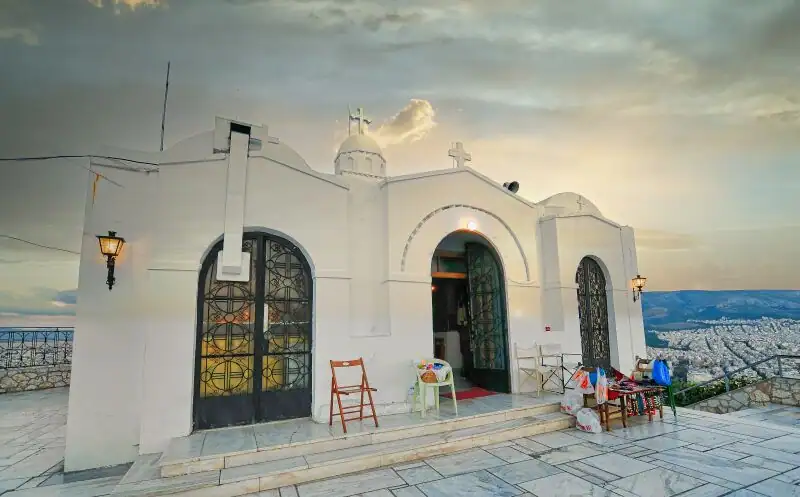
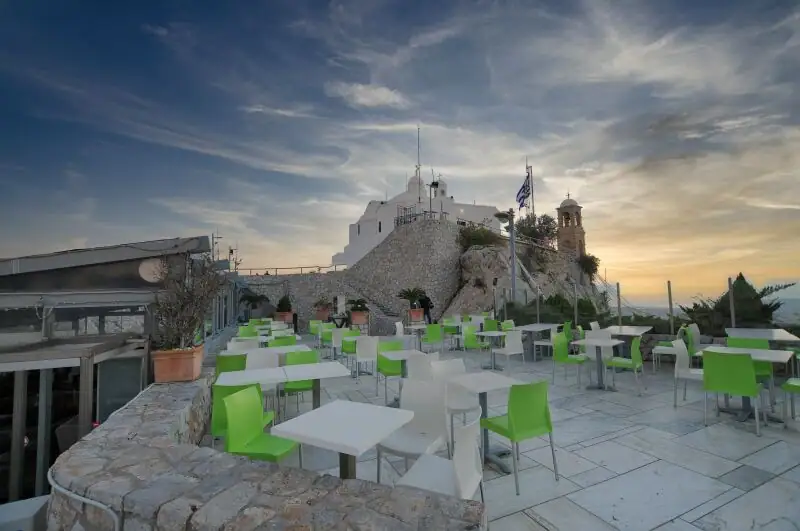
The first thing you encounter at the top is the tiny white church of Agios Georgios, Saint George, which appears to glow against the blue sky like a relic of the Cycladic islands somehow transported and stuck in the middle of Athens.
The chapel was constructed in the late 18th or early 19th century on the site of an older church, quite possibly a former church of the Prophet Elias, as was tradition with most churches on Greek hillsides. The building itself is small, whitewashed with a low bell tower and domed roof. Inside, the space is intimate and cool. Parts of the walls are covered with colorful frescoes, and metalwork icons of Saint George on horseback flicker with candlelight. It is not a grand cathedral. It is something better. A place of quiet and simplicity on the highest point of the city.
On Easter night, this chapel becomes one of the most special places in Athens. Hundreds of Athenians make the climb up the hill in the dark, candle in hand, to attend the Resurrection service. You can hear the voice of the priest carried over the hilltop, and when the time comes, and the church bells ring, you can see the lights of other churches flickering all across the city below. I have been there to celebrate Easter more than once. It is one of those memories that you keep warm inside you for years.
The panoramic view from the top
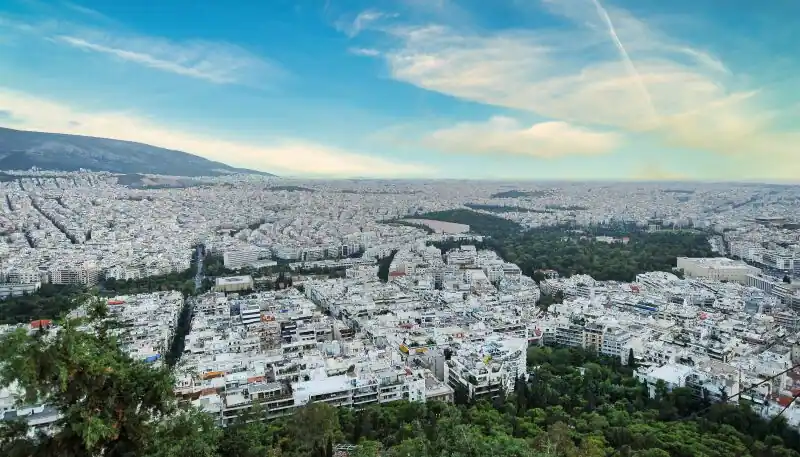
This is why most visitors come. It’s worth the hike. The viewing platform next to the chapel is surrounded by 360-degree views of Athens, the Attica basin, the mountains beyond them, and the sea. To the southwest, you can see the Acropolis on its rock. Up here, you can see its full majesty. The Parthenon, the Propylaea, and even the Odeon of Herodes Atticus, carved into the hill below, can be seen from here. To the south, the Panathenaic Stadium nests in its marble nest. The columns of the Temple of Zeus remain erect, standing shoulder to shoulder like elderly friends who’ve forgotten how to sit down.
North and east, the mountains of Parnitha, Penteli, and Hymettus rise to surround the Attica basin like a guardian’s embrace. Southward, past rooftops and construction cranes and the glitter of the coastline, you can see the wide blue expanse of the Saronic Gulf. On clear days, you can make out the islands of Aegina.
Α theater carved from stone and memory
On the upper slope of the hill, nestled into the hollow of an abandoned limestone quarry, is the Lycabettus Theater. It’s a semi-circle open-air amphitheater, with about 3,000 seats and a view of the city skyline.
Constructed in 1964 by architect Takis Zenetos with support from Greek actress Anna Sinodinou, this little theater has hosted some legendary performances over the years. Bob Dylan played here. Ray Charles played here. Joan Baez played here. B.B. King played here. Black Sabbath played here. For years, this place was one of Athens’ most magical concert venues. Songs drifted out over the pine trees and up into the night sky.
For safety reasons, the theater was closed in 2008. For 15 years, the Lycabettus Theater sat silent. It reopened in September of 2023 following many years of renovations. Summer concerts are back on the hill. If you find yourself in Athens during the warm season, see if there’s anything playing. Watching a show here with the bright city lights behind the stage is an unforgettable experience.
Saint Isidore: A hidden chapel carved into the rock
Few visitors see this one, and that's part of its magic. Nestled in the rocky hillside below the summit, the Church of Saint Isidore is a small, rock-cut chapel hewn into the natural stone. It's not always open, and there are no signs to guide you.
You have to know it's there, or find it by accident, while meandering along the paths. But if you do, pause for a moment. The silence here is different from the silence at the top. It feels older and more private. Like the hill is hiding something for itself.
The pine forest and walking paths
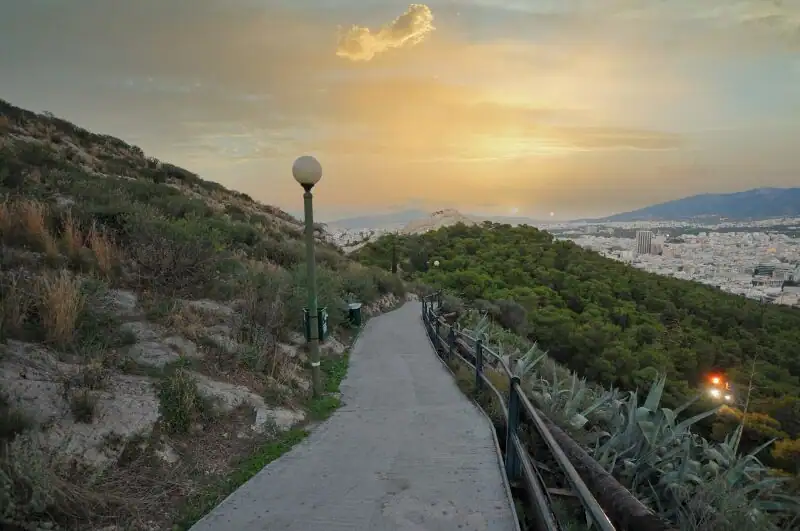
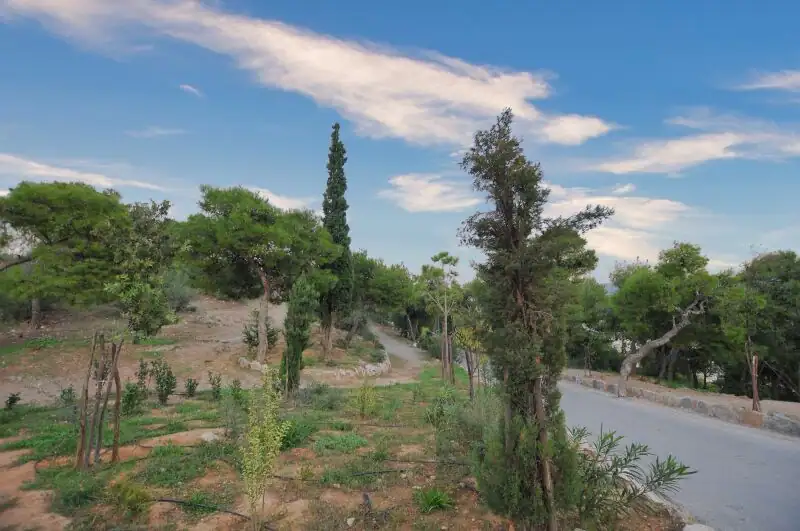
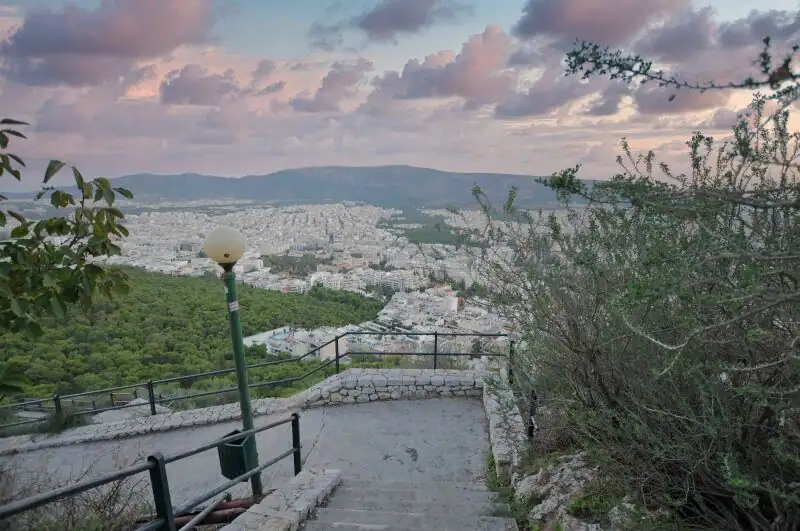
You don't have to hike all the way to the top to enjoy Lycabettus. Some of my favorite moments on this hill have been halfway up, where the pines are thickest, and the shade is deepest. The whole hillside is honeycombed with paved paths that meander through the Aleppo pine forest planted on this slope in the late 19th and early 20th century.
In the spring, wildflowers have forced their way through the rocky soil. In the autumn, the light streams through the trees in long bars of gold. In the middle of a July heatwave, the forest is still cool with a freshness that the streets below have long forgotten. You can see joggers here in the early morning, and dog walkers in the evening. Couples sit on the benches that look down on the rooftops of Kolonaki. It's a good place to walk slowly, to listen to the birds, to remember that a city of five million people can still hold these deep pockets of quiet.
How to get to Lycabettus Hill
There are a few ways to get up there, and each offers a different experience.
On foot (walking up)
Hiking up the hill is by far the most rewarding way to get to the top. The most popular path begins at the upper end of Aristippou Street in Kolonaki. From here, a paved trail winds through the pine forest in a series of gentle switchbacks. The total climb takes about 15 to 30 minutes, depending on your pace, and the shade from the trees makes it quite pleasant in the spring and autumn. During the summer, try to visit early in the morning or later in the afternoon to avoid the worst of the heat.
By funicular (the teleferik)
The Lycabettus funicular begins at the corner of Ploutarchou and Aristippou Streets in Kolonaki and takes you right to the top in about three minutes. The ride itself travels through a 210-meter tunnel. There are no views, so it feels more like a rather steep elevator than a scenic funicular, but it is super fast and very convenient.
The funicular usually runs from around 9: 00 AM to 2:30 AM, every 30 minutes. A round trip is around 10 to 13 euros, one way about 7 to 10 euros.
By taxi, car, or metro
A taxi from Syntagma or Monastiraki will take you to the base of the hill for about 5 to 7 euros. If you want to drive, just follow the Lycabettus ring road all the way to the parking area at the open-air theater. From there, you just have to walk a short distance to the summit.
The closest metro station is Evangelismos on the Blue Line, about 20 to 30 minutes uphill on foot through Kolonaki.
Is Lycabettus Hill worth visiting?
It's one of the most rewarding things you can do in Athens, and it won't cost you a thing if you walk.
Lycabettus gives you something the Acropolis doesn't. From the Acropolis, you gaze out over the city. From Lycabettus, you can see the Acropolis. It is a sacred rock in the center of your vista, framed by rooftops and sea, and you see its relationship to everything. The way the city grew up around it, the hills, the coast, and the mountains create a basin that has contained civilization for millennia.
The hill is also a respite from the frenzy of sightseeing. No information boards, no people elbowing past you, no tour guides with loudspeakers. Just the ascent, the trees, the breeze, and the panorama. For couples, it is one of the most romantic places in the city. For photographers, it is the best viewpoint in Athens. And for anyone who wants to experience what it is like to stand above a city that is 3,000 years old and still very much alive, Lycabettus provides that feeling like no other place.
The sunset that turns Athens into gold
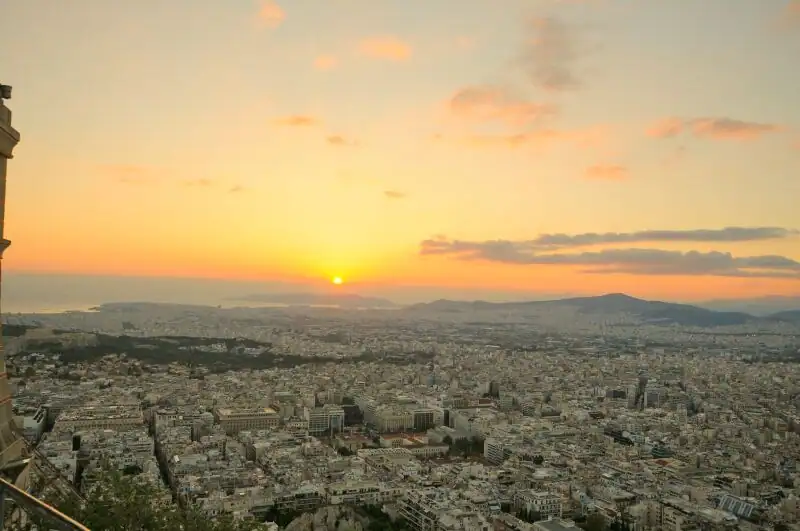
The evening is the reason people climb this hill. About an hour before sunset, the light changes. The white buildings in the city below turn warm, nearly golden. The Acropolis catches the last light, as if it was constructed to capture it. Then the sun sinks behind the mountains in the west, and the sky flares gold, pink, copper, violet in a slow and wordless symphony that no photograph can do justice.
When the dusk deepens, the city lights come on. First a few, then hundreds, then thousands of lights flicker from the hills down to the coast like a shattered constellation. The Parthenon begins to glow in its evening lights, and the streets below fill with soft amber light. It is the kind of moment that stills you, makes you forget for a little while that you have any other place to be.
Eating and drinking above the rooftops
You don't have to be at the top to enjoy the view. At Orizontes, the fine-dining restaurant just across from the chapel, you can eat Greek with a view that stretches all the way to the sea. A short walk downhill, Prasini Tenta reemerged after 18 years of radio silence to serve coffee, wine, and light bites on a terrace overlooking the rooftops of Kolonaki.
Lycabettus Hill vs. Filopappou Hill
If you only have time for one hill in Athens, the choice depends on what you want. Philopappos Hill is the lower of the two; it is closer to the Acropolis, and you get that classic front-on view of the Parthenon from it (the one you see on all postcards and travel magazine covers). You also see the ancient ruins, the Philopappos monument, and part of the old city walls. The Philopappos walk is gentler, the vibe more laid-back, and the sunset view of the Acropolis from Philopappos is incredibly moving.
Lycabettus is the higher of the two; it is further from the Acropolis, and it gives you something completely different: the whole city from the mountains to the sea, all laid out in front of you in every direction. It’s a wider, more dramatic panorama. The climb is more strenuous, but the view is a bigger reward.
If you ask my honest advice? If you have the time, do both. They are two different experiences, and taken together they give you two sides of the same city. Read more about the best parks and hills in Athens.
What to see near Lycabettus Hill
The best thing about Lycabettus is that the climb both begins and ends in two of the most fascinating parts of Athens. On the southern side of the hill is Kolonaki, Athens’ most elegant neighborhood. It’s full of tree-lined streets, high-end boutiques, sidewalk cafes, and stylish regulars.
It’s also home to some of Athens’ best museums. The Museum of Cycladic Art, the Byzantine and Christian Museum, and the War Museum are all a few minutes’ walk from the foot of Lycabettus. If you follow one of the smaller streets downhill towards Dexameni Square, you will end up in one of Athens’ most charming little squares. Nestled under the shade of old plane trees, the cafes have been in business longer than most people can remember.
At the other end of the hill, to the north, lies Exarcheia, the counter-cultural heart of the city. Street art adorns entire buildings, independent bookshops line the streets beside vinyl record stores, and tiny bars stay open until the early hours. If Kolonaki is Athens’ shiny side, Exarcheia is its honest, unfiltered side. Both neighborhoods are well worth visiting before or after your climb, and both will help you to understand how a single hill can straddle two completely different worlds and be part of both.
The hill that holds the whole city
Some parts of Athens have become history. They are ancient and untouchable, preserved behind glass, or roped off with signs warning you not to step on the marble. They are important, those places. They have the weight of a whole civilization on their shoulders, and I have spent my life writing about them and walking among them.
But Lycabettus is not one of those places. Lycabettus belongs to the present. It belongs to the couple who sit on the rocks at sunset and watch the Acropolis light up. To the jogger who runs up every morning before work. To the grandmother who walks slowly through the pine trees with her grandchild. To the teenager who listens to music on headphones and stares down at the city with a look of boredom or maybe of something much more difficult to put into words.
This is the hill where Athens is not a ruin, a museum, or a lesson in a history book. It is just home. Vast, and warm, and lit up, and alive. And standing up here, with the wind in your hair and the whole city spread out below you like a gift you never even asked for, you understand why people have lived in this place for three thousand years and never wanted to leave.
I hope you will climb it. I hope you will get to the top and feel what I feel every time. That the world is vast, and beautiful, and full of things worth walking towards.