There is a path that starts where the crowds stop. Walk down Apostolou Pavlou away from the cafés and the souvenir shops, where the tourist groups are making their way up to the Acropolis. Turn off onto the marble walkway as it meanders gently uphill through the pine trees. The noise fades. The air changes. You can smell resin and dry earth and something older, something that the trees have been holding for a very long time.
I have walked this path hundreds of times. As a child with my parents on Clean Monday, a kite in my hand, and the whole sky open above me. As a teenager, I sat on the rocks at sunset with my friends, watching the Parthenon glow orange across the valley.
Philopappos Hill is not the most famous hill in Athens. It does not have the ancient temples of the Acropolis or the white chapel of Lycabettus. But it is the one that Athenians love the most. This is our hill. The one we come back to when we need to breathe.
This is my guide to Philopappos Hill. Not just what you will find there, but what it feels like to walk these paths, to stand at the top with the whole city at your feet, and to understand why this quiet, pine-covered slope has been sacred for over two thousand years.
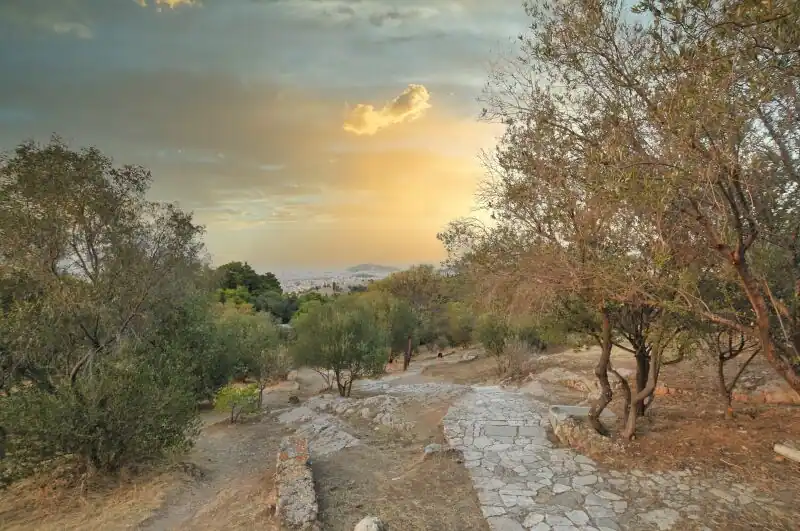
Table of Contents
Philopappos, a hill of muses, marble, and memory
Philopappos Hill is a 147-meter limestone hill southwest of the Acropolis, one of Athens’s most significant green spaces and viewpoints. Also known as the Hill of the Muses, after its ancient name, it forms a three-hill complex with the Pnyx and the Hill of the Nymphs, forming a forested park at the center of the city.
It is completely free, open 24 hours a day, and there’s no ticket or gate to get in. You can come for sunrise, sunset, or midnight. Walk its marble paths, sit on its rocks, picnic, or simply stand at the top and look out over rooftops to the Saronic Gulf.
The hill is named after Philopappos, a Roman prince and benefactor of Athens whose marble monument still towers over the summit. But the history of this hill goes much deeper than Rome. Before Philopappos, before the fortification walls, before the assemblies that met on the neighboring Pnyx, the ancient Athenians believed that the nine muses lived on this slope. The poet Musaeus, a disciple of Orpheus, was said to be buried here. It was a place of art and memory long before anyone carved their name into stone.
Today, it’s a place of pine shade, rocky trails, wildflowers in spring, and one of the finest views of the Parthenon you will ever see. It is also one of the quietest corners of central Athens, often overlooked by visitors who never look past the Acropolis gates.
The story behind the hill: From the muses to a Roman prince
The hill’s story is Athens’ story, written in layers. The northern slope of this hill was known in ancient times as Mouseion, the Hill of the Muses. The Greeks imagined the nine goddesses of art, poetry, and music residing here. Pausanias, the geographer who made the second-century AD pilgrimage to Athens from Rome, wrote that Musaeus, the mythical poet and disciple of Orpheus, was buried on the summit.
For a thousand years or more, the hill had been a place of worship, and of inspiration, a holy section of the city where the border between the earthly and the divine seemed porous and fleeting. The hill was also a place of defense. In 338 BC, when Philip of Macedon advanced on Athens, the city constructed the Diateichisma, the great fortification wall that ran 900 meters across all three of the city’s hills, linking up with the older Themistoclean walls at the north and south.
The wall was built again, this time by the Byzantine emperor Justinian, in the sixth century. You can still see its course today, poking out of the undergrowth along the lower slopes of the hill, half-hidden in the grass and pine needles.
The surrounding hills formed the neighborhood, or deme, of Melite. In ancient Athens, it was one of the largest and most significant neighborhoods. Themistocles had a house here. Kimon had a house here. Alcibiades. Epicurus. You can walk the same ground they did; you just have to know where to look.
The story behind the name
The hill’s modern name comes from one Gaius Julius Antiochus Epiphanes Philopappos, a prince of the Kingdom of Commagene, an ancient state in what is now southeast Turkey. When Rome annexed Commagene as a province in the first century, Philopappos moved to Athens. He was granted citizenship and religious and civil office, and he gave much to the city in return. A man of two worlds, Roman by rank and Greek by instinct, the Athenians adored him. When he died, in 116 AD, the love was sincere.
Philopappos’ sister Julia Balbilla and the people of Athens raised a marble tomb on the very summit of the hill, on the axis of the Parthenon, as if the ancient city were bidding farewell to this friend of hers, as if the city were shouting to the sky, ‘He’s one of us, he belongs.’ In the medieval period, under the Franks, the hill was known as Seggio Hill. In the twentieth century, it was covered by Aleppo pines, planted by Princess Sophia. In the 1950s, an architect called Dimitris Pikionis made the paths what they are today, but I will get to that.
What to see: The monuments, churches, and caves that time left behind
This is not a tourist destination. This is a place you walk, slowly. With your eyes open and your phone in your pocket, you let each turn of the path surprise you with something you weren’t expecting. The three hills (Philopappos, Pnyx, and the Hill of the Nymphs) are linked by an intricate network of trails. You could spend an hour here or an entire afternoon.
The Pikionis pathway: A path made from a city's broken pieces
The marble pathway that winds from Dionysiou Areopagitou to the summit of Philopappos Hill was constructed between 1954 and 1957. Architect Dimitris Pikionis designed it. It is not just a pathway. It is a modern architectural landmark, one of the most significant works of modern architecture in Greece, a monument of cultural heritage listed by UNESCO.
Pikionis was born in Piraeus in 1887. He was a professor at the National Technical University of Athens and one of those rare men who know what he wants to say. He thought that architecture should listen to the land. When the Greek government commissioned him to redesign the area around the Acropolis and Philopappos Hill, ridding it of the ugly asphalt roads that had been installed and replacing them with something more worthy of the landscape, he didn’t draw plans. He called his students and the local stonemasons and set to work, improvising on site.
They gathered marble fragments from demolished neoclassical buildings in Athens. Bits of ancient columns, broken ceramic tiles, stone blocks, and discarded paving pieces from archaeological excavations. They placed the pieces by hand into the ground, one at a time, a collage of the city’s own history, all under your feet. Every stone is different. Every few steps, the pattern changes. You walk on bits of the past, of Athens, rearranged into something that feels both ancient and completely new.
The path loops in two directions. One spirals down to the Acropolis, the other to the Philopappos Monument. Along the way, Pikionis created resting places, small terraces with stone benches and open views of the Parthenon, places meant for pausing, thinking, and looking. He restored the Church of Agios Dimitrios Loumbardiaris, which had been built along the path, and designed a small pavilion next to it.
The Philopappos Monument: The prince who came from far away and never left
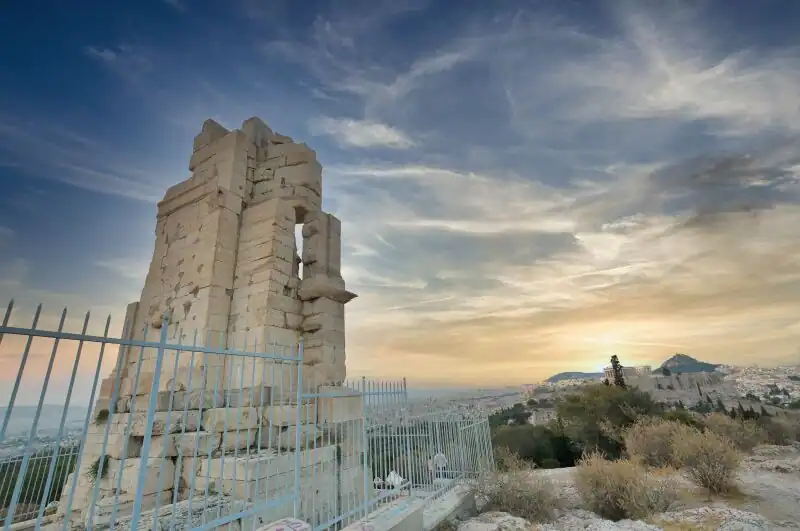
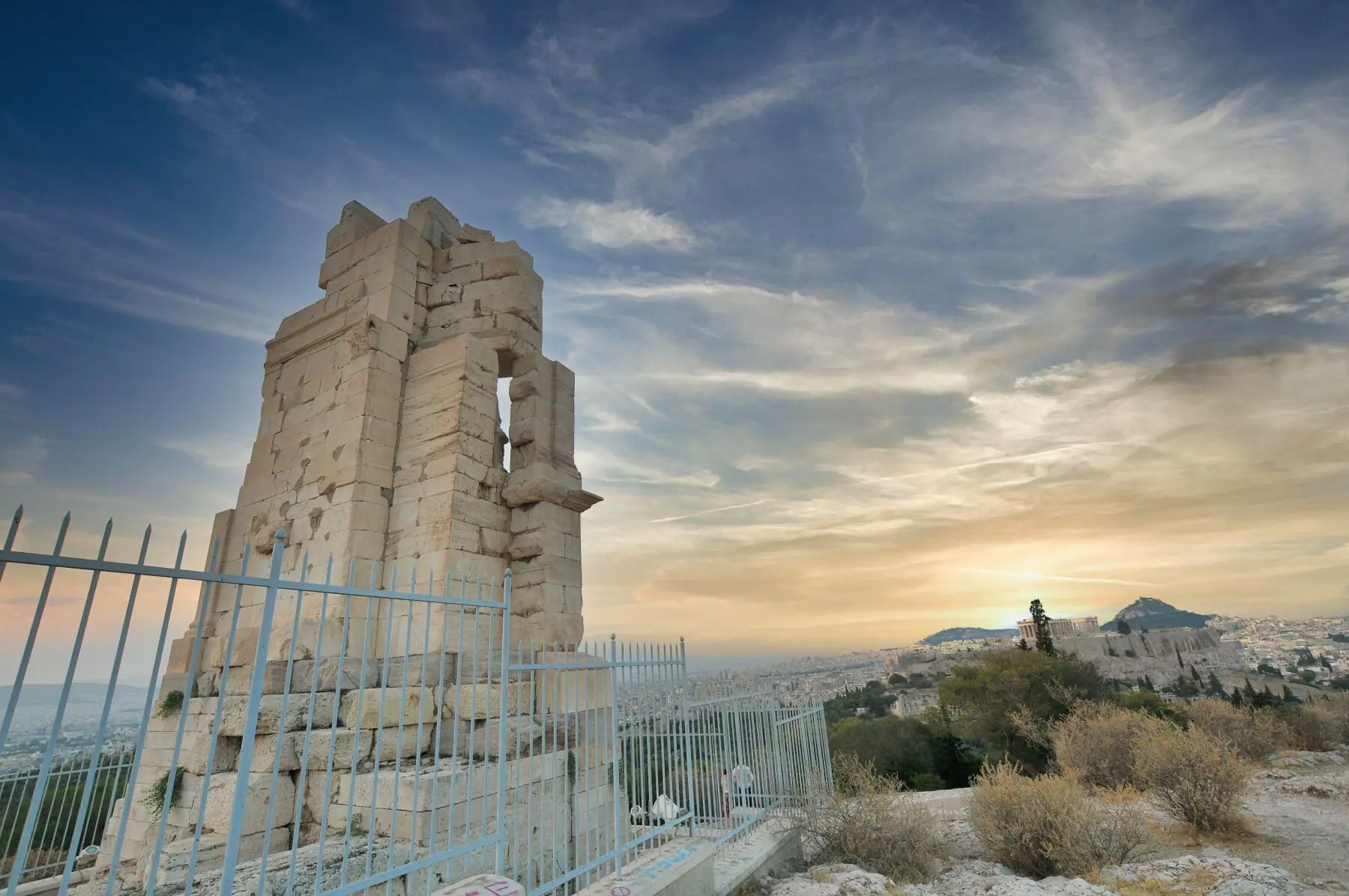
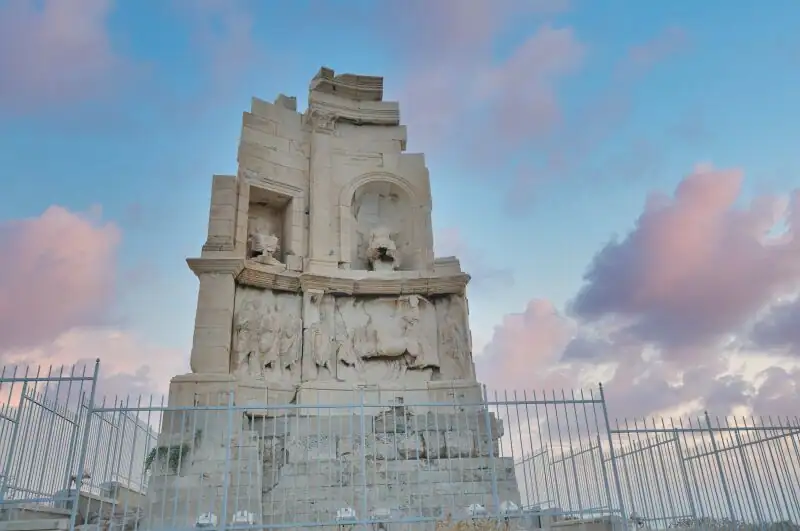
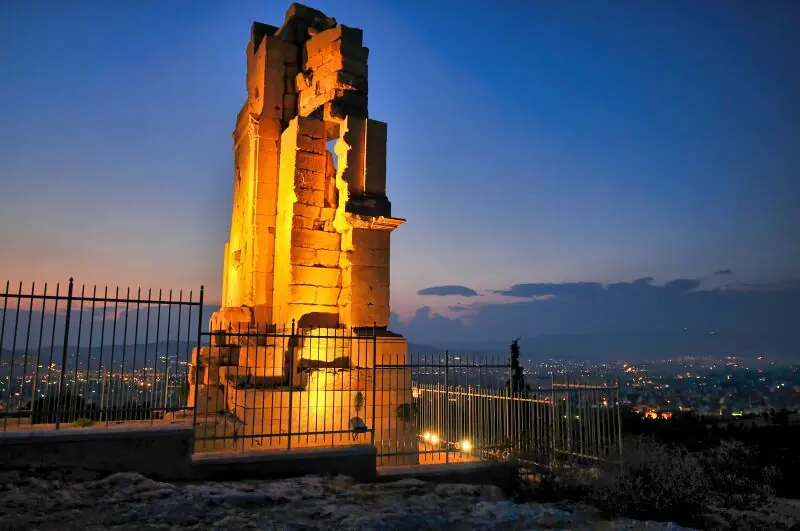
At the top of the hill, where the pines give way to sky, is the monument that gave the hill its name. The Philopappos Monument was constructed between 114 and 116 AD. It’s a Roman mausoleum, carved out of white Pentelic marble on a base of Hymettian marble.
It’s two stories tall. The frieze on the lower level depicts Philopappos riding a chariot as a Roman consul, preceded by lictors. The upper level has three statues in niches: Philopappos in the center, his grandfather Antiochus IV on the left, and Seleucus I Nicator on the right (these are lost). The inscriptions are his double biography. In Greek, he’s Philopappos, son of Epiphanes, of the deme of Besa, an Athenian citizen. In Latin, he’s listed by his Roman names and titles: consul, member of the Arval Brotherhood, and praetorian rank during the reign of Emperor Trajan. Two identities, two languages, one man who lived a life in two worlds and wanted to belong to both.
The monument was still standing in the fifteenth century, when it was visited and sketched by the traveler Ciriaco de’ Pizzicolli. It suffered from looting after that: the Ottomans took pieces of the marble for building projects, among them some used for the minaret they built inside the Parthenon. The structure that remains is about two-thirds of the original facade, pitted and worn by the centuries, but still commanding the skyline.
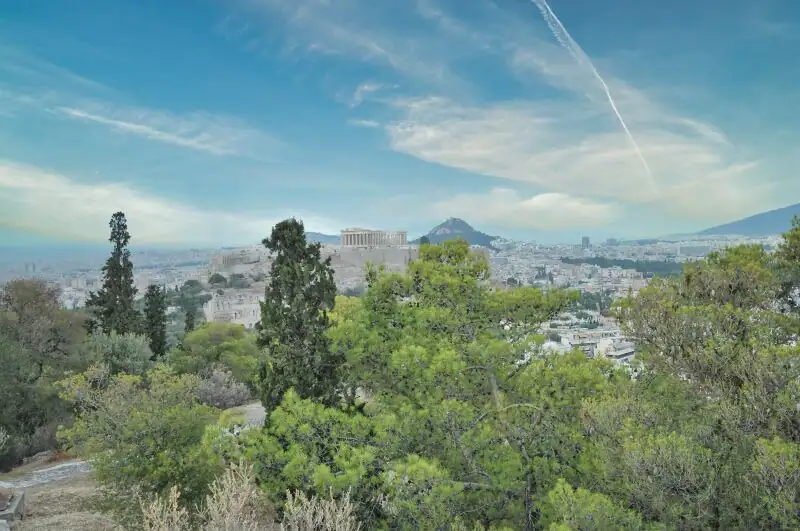
But most visitors come here for the view. It is extraordinary. The Acropolis looms across the valley, close enough that you half expect to be able to touch it. The city of Athens stretches in every direction, all the way to Piraeus and the Saronic Gulf, where on a clear day you can see the islands of Salamina and Aegina shimmering on the water. At sunset, the light turns the city gold, and for a few minutes, it looks the way it must have looked a thousand years ago. This is one of the best photography spots in Athens, and it is far less crowded than Areopagus Hill.
The prison of Socrates: The place where myth and history argue in the dark
Halfway up the eastern slope of the hill, cut into the bedrock, is a series of cave chambers known traditionally as the Prison of Socrates. According to legend, Socrates was incarcerated in these caves before he was brought to trial (and then executed) in 399 BC for corrupting the minds of Athens’ youth and for impiety towards the Greek gods.
It’s a moving story, and the caves themselves have atmosphere: a series of rooms cut into the rock, with cisterns and traces of ancient murals on the walls. But I should be honest with you. Most historians believe that Socrates’ prison was located near the Ancient Agora, and not on Philopappos Hill. It’s a connection that is more legend than historical fact. There are also other caves on Philopappos Hill that are called the Prison of Socrates, which is confusing.
What is not legend is what happened in these caves during World War II. When the Nazis advanced on Athens, Greek officials sealed away priceless artifacts from the Acropolis and the National Archaeological Museum inside these caves, pouring concrete over the entrances to prevent the looting and destruction of Greece’s greatest treasures. These caves, which may not have held Socrates, held something just as precious: the memory of a civilization.
The site is free and accessible to anyone. There are no barriers, no tickets, no guides. You walk in, you touch the walls, you stand in the cool dark, and you think about the things that happened here, both the myth and the truth.
Agios Dimitrios Loumbardiaris: The church saved by lightning
If there is one place on Philopappos Hill that epitomizes Athens, it is probably this little church, tucked among the trees at the base of the slope.
Agios Dimitrios Loumbardiaris nestles in a wooded glade on the Pikionis path, with pines and Mediterranean scrub around it, and the Acropolis above the treetops. It was built sometime between the ninth and sixteenth centuries (scholars don’t agree), and was partially constructed from nearby ruins, including columns from the surrounding area that were incorporated into the altar and the courtyard.
Its name translates to “Saint Dimitrios of the Cannon,” and the story behind it is one that Athens tells with a silent smile.
In 1658, during Ottoman rule, the commander Yusuf placed a cannon in the Propylaea on the Acropolis, and planned to fire it on the church the next day, during the feast of Saint Dimitrios, while the Greek congregation was gathered inside for worship. On the eve of the celebration, a lightning bolt struck the gunpowder magazine on the Acropolis, killing Yusuf, his family, and several soldiers. The church was spared. The congregants called it a miracle. The name stuck.
Frescoes inside, from 1732, cover the walls, including a beautiful depiction of Saint Dimitrios on horseback, in a pose that’s an echo of ancient paintings of Alexander the Great. The altar is built on an ancient column with Greek inscriptions. Everything in the church is layered, century upon century, faith upon ruins upon stone.
Dimitris Pikionis restored the church in 1955, as part of his work on the hill, adding marble and ceramic decorative elements on the exterior, and designing the churchyard with a wooden gate and bells that give the whole space an almost Japanese calm. It is one of the most popular spots in Athens for weddings and baptisms, and on quiet mornings it feels like one of the most serene places in the city.
The Pnyx: Where democracy was born
Directly north of Philopappos Hill, connected to it by walking paths, is a rocky clearing that altered the course of world history.
The Pnyx is the birthplace of Athenian democracy. Beginning in 508 BC, when Athens became a democracy, the citizens gathered on the Pnyx ten times a year for the ekklesia, the assembly where they discussed laws, declared war, and voted on the future of the city.
The bema, the stone speaker’s platform, is still visible, smoothed down by centuries of wind and weather. Standing on this podium, Themistocles rallied the Athenians to build a fleet that would conquer the Persians at Salamis; Pericles spoke of glory and sacrifice; Demosthenes roused the Athenians against the threat of Macedonia.
At its height, the Pnyx seated between 6,000 and 13,500 citizens in a semicircle on the rocky slope, with later additions of wooden benches to improve comfort. The very word “Pnyx” means “the place where people are packed together.” In the fourth century BC, the assemblies moved to the larger Theatre of Dionysus, and the Pnyx was gradually forgotten.
Today, it is one of the quietest places in the immediate vicinity of the Acropolis. Most tourists never stumble upon it. You climb a gentle slope, pass through low walls and random scatterings of stones, and suddenly you are standing on the same ground where the principle of government by the people was first put into practice. The view of the Parthenon from here is direct and powerful, and the silence is haunting.
Nearby are the Sanctuary of Pan, a rock-cut underground chamber with a relief of Pan and a dog on the bedrock; wall paintings and a mosaic by the entrance; and, above the sanctuary, the remains of houses with subterranean cisterns.
The hill of the nymphs and the national observatory
The third hill lies to the northwest, separated from the Pnyx by a shallow saddle. The Hill of the Nymphs is named for an ancient shrine to the nymphs, which once graced this spot. The hill, at 103 meters, is the smallest and lowest of the three. At its summit is the National Observatory of Athens, constructed in 1842 on this prime spot of ground by the architect Theophile Hansen, at the behest and expense of the Greek-Austrian Baron Georgios Sina.
The Observatory, the oldest research institution in modern Greece, occupies a lovely neoclassical building set in landscaped grounds. It houses a collection of rare astronomical books, antique instruments, and a historic refracting telescope. On some evenings, the Observatory opens its doors for a public visit. When inside, you can look up at the night sky through the same sort of telescope as the astronomers who worked there nearly 200 years ago.
Perched on the flank of the hill just below its summit, easily missed by most visitors, is a small Chapel of Saint George Alexandrinos. The chapel nestles among the rocks and pines, a place of calm and quiet. Looking from the Hill of the Nymphs, you can see across to the Pnyx, to Philopappos, to the Acropolis, and you can see how the three hills form a single landscape, a green triangle in the middle of a stone city.
Dora Stratou Theatre: The living museum of Greek dance
Snuggled into the hillside between the two knolls, and tucked away among the pines, is an 860-seat open-air garden theatre that has been preserving Greek tradition since 1953.
The Dora Stratou Theatre is the museum of Greek dance alive and well. Dora Stratou, a woman who traveled to villages throughout Greece for decades, collecting costumes and recording local dances, was determined to preserve folk traditions that were otherwise being lost. It is a very different performance from any other you are likely to see in Athens.
A troupe of 75 dancers, musicians, and folk singers wear original costumes made in individual villages (a collection of over 2,000, most of which could not be reproduced, as the craftsmen and fabrics no longer exist), and do not dance to music choreographed by professionals. They learned the dances directly from villagers and have passed them on from body to body the way they have been for centuries.
The stage is set up to resemble a village plateia (the open square where dancing takes place during festivals in rural Greece). Sitting in the audience on a warm summer evening, under the pine trees, with the sound of a Cretan lyra wafting through the air, you get a sense of something that no museum will provide. This is not history behind glass. This is history still breathing.
Performances are Thursday through Sunday evenings during the summer months. The theatre is up on the western side of the hill, and can be reached from Apostolou Pavlou. Visit their website for show times and ticket prices.
The view from Philopappos Hill
The view from the summit is among the very best in Athens. It is the reason why most people make the climb. At the top, as you stand by the Philopappos Monument, you are looking directly across at the Acropolis. The Parthenon fills your field of vision. It is closer here, more intimate, than from anywhere else in the city.
Down below, the Ancient Agora and the Temple of Hephaestus fan out in the valley. To the northeast, Lycabettus Hill looms, a white chapel perched on its crown. To the south, the city falls away towards Piraeus, and beyond the Saronic Gulf, pale silver, the outlines of Salamina and Aegina float in the haze.
In summer, the sunsets are spectacular: the sky turning pink and orange while the Acropolis drinks in the last light of the day and holds it. At night, the monument is lit up, and the Parthenon glows across the valley, and the city below becomes a sea of warm light beneath your feet.
Philopappos is not the highest point in Athens. Lycabettus is higher. But Philopappos has something Lycabettus cannot: the Acropolis at eye level, face to face, without crowds, without fences, without noise. Just you and the oldest skyline in the western world.
The small details that make the walk easier
The hill is open to all without admission, 24 hours a day, 365 days a year. No gate. No ticket booth.
The main entrance is at the crossing of Apostolou Pavlou and Dionysiou Areopagitou, near a small periptero (kiosk) where the pedestrian streets meet. A Pikionis path takes you uphill. The nearest metro stations are Thissio (Line 1, green line), 10 to 15 minutes on foot, and Acropoli (Line 2, red line), also 10 to 15 minutes. Bus 230 stops at the "Akropole" stop next to the hill.
Give yourself one to two hours if you are going to walk to the monument and back at a leisurely pace. Two and a half to three hours or more if you intend to hike to and from all three hills (Philopappos, the Pnyx, and the Hill of the Nymphs). There is no single path. The trails branch and loop, and getting a little lost is part of the fun.
The best time to come is early morning or late afternoon. The light is softer, the temperature is gentler, and the hill is at its most serene. In summer, go early in the morning or after 5 or 6 p.m. to avoid the midday sun: the upper slopes have almost no shade, and the heat up there can be brutal. The most beautiful season is spring, when the hillsides are carpeted with wildflowers and the air is sweet with thyme and wild oregano.
Walk comfortably. Wear shoes with a good grip. Some paths are rocky and uneven, and the marble slabs become slippery when wet. Bring water (there are no facilities on the hill) and a snack if you fancy sitting and picnicking.
The hill is safe during the day. If you come for the sunset or the evening vista, however, stick to the main paths and consider bringing someone with you. Petty theft has been reported, though it is rare, especially during the day.
For families: the main paved path is not very steep and therefore manageable for children, and kids love the caves of Socrates' Prison, the open spaces for running around, and the tortoises that sometimes wander on the trails. It is an easy walk even for younger children, as long as you avoid the more precarious paths at the top.
One more thing. If you find yourself in Athens on Clean Monday (Kathara Deftera), the first day of Orthodox Lent, come to Philopappos Hill. It is one of Athens’ most cherished traditions. The whole hill is filled with families flying kites, eating lagana bread and taramosalata, laughing and gazing at the sky as it fills with color. I have been coming here on this day since I was five, and it is still one of my favorite days of the year.
The walk continues: What surrounds the hill on every side
Philopappos Hill is at the heart of Athens’ densest archaeological neighborhood, where everything is close by and within walking distance. The Acropolis is 10 to 15 minutes away to the east, via the Pikionis pedestrian walkway and the Dionysiou Areopagitou pedestrian street.
On the southern slope of the Acropolis, you’ll find the Odeon of Herodes Atticus and the Theatre of Dionysus. The Acropolis Museum is at the foot of that same slope, just a few minutes from the start of the walking path.
To the north, Areopagus Hill (Mars Hill) is an easy five-minute walk, while down from that hill, the Ancient Agora’s temples, stoas, and perfectly preserved Temple of Hephaestus await. The Thisio neighborhood is on your route with its cafés and tavernas on Apostolou Pavlou and is a natural starting and ending point for any visit.
If you are planning to spend a day exploring the attractions around here, a good itinerary is to start in Thisio and walk the Pikionis path up Philopappos Hill and then continue to the Pnyx and the Hill of the Nymphs. Then, loop back along Dionysiou Areopagitou to the Acropolis Museum and the other top things to do in Athens. Find out more about this neighborhood and other green spaces in the city in my guide to parks and hills in Athens, or browse the full list of top things to see in Athens.
The hill that holds the city's memory
Some sites in Athens demand you to see. Philopappos Hill demands that you listen. It contains all of what this city has been, all at once, without asking you to understand any of it. Ancient walls cut through grass next to a twentieth-century marble path. A Roman tomb peers at the Parthenon across the valley. A Byzantine church is perched on top of ruins older than it is. The birthplace of democracy is a five-minute walk from a theatre where village dances are still held the way they were two hundred years ago.
No other place in Athens stacks time like this. And no other place in Athens gives it to you quite so freely. There is no ticket, no gate, no guided path. Just pine shade, worn stone, and a view of the Acropolis that no photograph ever does justice. Philopappos Hill does not demand how you should feel. It gives you the space to feel it for yourself. And that, in a city this old and this loud, might be the rarest thing of all.