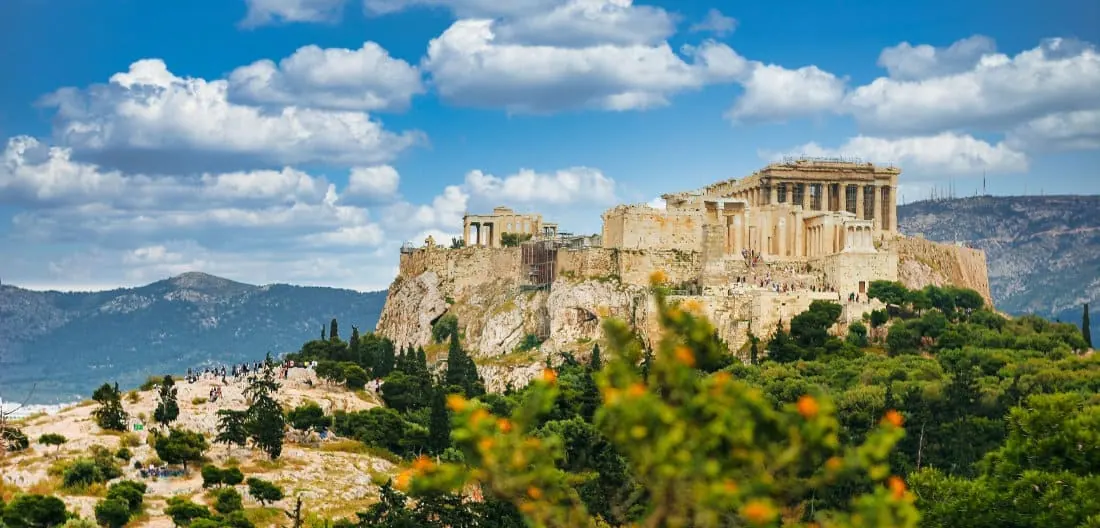
In Athens, there’s a rock that’s more silent than any museum I’ve ever been to. It’s just below the Acropolis, raw and unadorned, warm from the afternoon sun. There are no columns. No marble statues to guard the entrance. There is really nothing to see if you’re expecting ruins. But if you sit and stay a while, the rock starts to talk.
I’ve climbed Areopagus more times than I can count. In my teenage years, I came here with friends on summer nights, with cold beers and cheap snacks, watching the city glow below. As an adult, I come alone sometimes, just before sunset, when the light turns the Parthenon honey gold, and the noise of Athens below becomes almost a gentle sound.
This is Areopagus in Athens, a limestone hill that has hosted the trial of gods, the birth of justice, the words of an apostle, and the quiet laughter of every generation of Athenians who have called it their own. Locals call it Vrachakia or “the little rocks” and is one of the most popular hill of Athens. But there is nothing little about what has happened here.
Table of Contents
Areopagus: A name born from war, borrowed by justice
Areopagus is a compound of two Greek words. Areios means “pertaining to Ares,” who was the Greek god of war. Pagos means “large, solid rock.” So Areopagus is “the rock of Ares” or, as some translations have it, “the Hill of Ares.”
In Roman mythology, Ares had a counterpart known as Mars. That is how you will find the site referred to in some English-language guides. It is especially common in literature aimed at Christian pilgrims and travelers. Mars Hill. The rock of Mars.
Of course, both names refer to the same great outcrop of rock northwest of the Acropolis. Both names retain an echo of war and judgment and something more than either.
As for Athenians, when asked about Areopagus, they are likely to shrug and say, “Oh, you mean Vrachakia.” It is a gentler name, almost a fond one, the name you give a place that feels like it is your own. And in a sense it is. Not ours to be preserved as a monument behind a ticket gate. Ours to gather in and around, as we have for centuries, open and free, where the city still comes to sit and breathe.
The trial that came before all trials
Long before the first human court was constructed in Athens, the ancient Greeks believed that the gods themselves were tried on this rock.
Halirrhothius, a son of Poseidon, the sea god, had, according to the myth, raped Alcippe, a daughter of Ares, the god of war. Ares found his daughter and killed Halirrhothius in a fit of rage.
Poseidon, in mourning for his son, demanded a trial. The twelve gods of Olympus assembled on the hill. They sat in judgment, and it is in this way that the ancient Athenians believed that the first murder trial in history was held. When both parties had been heard, Ares was acquitted. The killing was deemed justified. It is a bloody origin myth. But for the Athenians, its meaning was not in the violence. It was in the notion that not even the gods can escape for what they do. That not even the son of Zeus stands above the law.
There is another myth that is attached to this rock, and in some ways, it is even more powerful. In the tragedy “The Eumenides,” Orestes is tried on the Areopagus for the murder of his mother, Clytemnestra. The Furies, the Erinyes, those ancient spirits of vengeance chase him down. It is here, on the hill, that the goddess Athena casts the deciding vote and spares Orestes.
At the foot of the hill, there was a sanctuary of the Erinyes. And in this twinning, of justice and mercy, punishment and forgiveness, Areopagus would find its purpose. It would become not only the place where Athens judges but also where Athens learns that judgment alone is not enough.
The court that Athens never truly closed
From myth, Athens created reality. As early as the 7th or 8th century BC, Areopagus became the site of the city’s highest court. The council of elders who sat here was known as the Areopagus Council. It was composed of former chief magistrates, called archons. These men were of aristocratic birth and served for life. The most serious crimes were tried here: murder, arson (destroying a tree in Athens, especially an olive tree, was considered a crime worse than murder because the city’s wealth was based on olive oil), treason, and religious law.
For hundreds of years, this council was a formative influence on the lives of Athenians. It was powerful, feared, and revered.
But then there were the reforms. In 594 BC, Solon reorganized the court as part of a political balancing act that he was effecting in Athens. He reaffirmed the Areopagus’ authority in treason cases and gave it a supervisory role over all laws. However, in 462 BC, Ephialtes removed most of the Areopagus Council’s political powers and placed them under the jurisdiction of Heliaia, or the people’s court. Areopagus became primarily a homicide tribunal from that day forward.
It is a story you can see repeated over and over again in Athenian history: the slow, sometimes painful evolution from aristocratic control to something more open. The Ancient Agora, just below the hill, became the center of that democratic experiment, with its council chambers and law courts, and market stalls.
What many visitors find surprising is that the name is still used today. The highest court for criminal and civil law in Greece is known as the Areios Pagos. Walk into any Greek courthouse, and the ghost of that ancient rock is still there, quiet but always present.
The day apostle Paul spoke to a city of gods
In 50 or 51 AD, a man named Paul came to Athens. He was not a philosopher. He was not an archon. He was a traveling preacher from Tarsus. He was on his second missionary journey. He came to a city of temples, altars, and statues to gods he did not revere.
The Bible tells us that in Acts 17, Paul walked through Athens and was deeply troubled by what he saw. Idols everywhere he looked. Temples on every corner. But then, one altar caught his attention. An altar with an inscription that read, “To an Unknown God.”
Paul took that inscription and made it the basis for one of the most famous sermons in Christian history. On or near this hill, he spoke to the Areopagus Council, and to the curious Athenians who had come to hear him. He told them that the god they worshipped without knowing was the one true God. The creator of all things. The God who does not live in temples that humans have made.
The response was mixed. Some laughed. Some were curious and wanted to hear more. And a few believed. Among them was a man named Dionysius, who later became the patron saint of Athens, and a woman named Damaris.
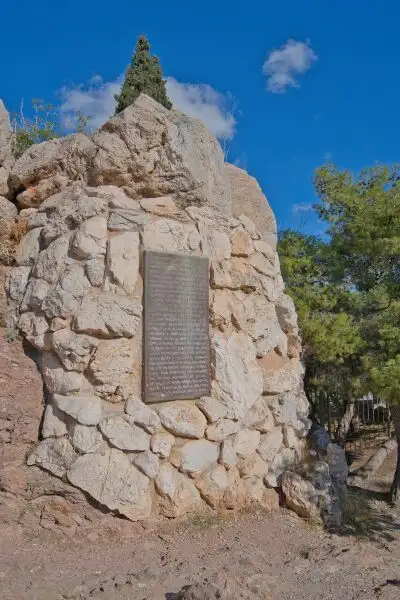
Today, at the base of the hill, near the metal staircase, there is a bronze plaque with the Greek text of Paul’s sermon engraved into it. It is a quiet memorial to a moment that altered the spiritual trajectory of an entire city.
Whether you visit Areopagus as a person of faith or as someone who simply has an interest in history, this chapter of the hill’s history is difficult to miss. It is the moment when ancient Athens, the city of Athena and Zeus, first heard a message that would ultimately remake its identity.
I have stood at that plaque many times and watched visitors silently read its words. Some gently touch the bronze. Some close their eyes. There is a kind of reverence at work there that I have not felt anywhere else at an archaeological site.
What the rock still holds after all these years
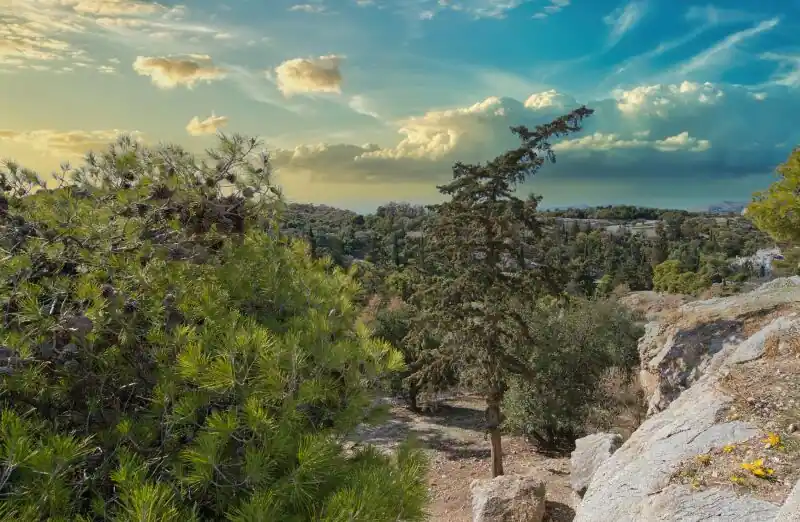
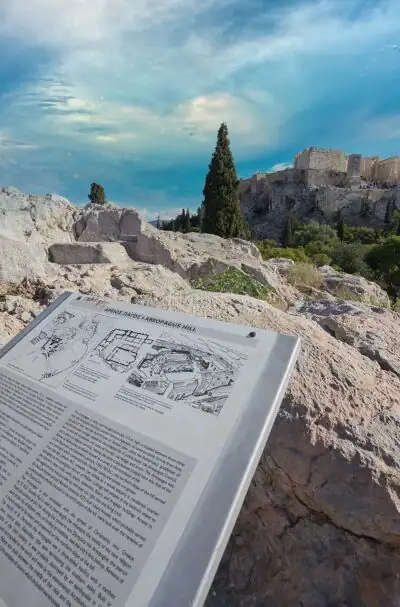
If you are coming here looking for columns and carved facades, the Areopagus will disappoint. There are no structures on the hilltop, just bare limestone worn smooth by time and by the feet of millions of visitors. But if you look closely, the rock begins to speak to you.
Cut into the surface, you can see the outline of foundations and grooves where walls once stood, channels cut for drainage. These are the remains of buildings long lost, devoured by centuries of use and erosion. On the north face of the hill, archaeologists have also uncovered tombs from the Mycenaean period, beehive-shaped burial chambers dating to as early as 1600 BC. Areopagus is one of the oldest known burial sites in Athens.
Near the bottom of the hill on the west side, you can visit the remains of the Sanctuary of Pan and the Fountain of Callirhoe, two other ancient sites that few visitors even notice. The hill and the area around it were once part of the residential district of Melite, one of the oldest neighborhoods in the city, with roads, wells, and houses carved into the bedrock.
And then there is the plaque. The bronze tablet with the text of Apostle Paul’s sermon is mounted near the southern staircase. Small and easy to miss if you don’t know it’s there, it is for many visitors the most meaningful thing on the entire hill.
The truth is, the Areopagus does not offer the kind of spectacle you see on the Parthenon or the Temple of Hephaestus. But what it offers instead is space. Space to stand where the gods were judged, and where justice was born, and where a man once spoke to a crowd of curious strangers about a god they had never heard of. Sometimes the places that show you the least are the ones that have the most to give.
The city at your feet, the Acropolis at your shoulder
I will be honest. The view from Areopagus is the reason most people come here. And I cannot blame them. From here, to the top southeast, the Acropolis looms so close you feel you could almost reach out and touch the columns of the Propylaea. It is the nearest and most unobstructed view of the ancient citadel you can get from anywhere in the city, and it costs you nothing.
To the north, directly below, the Ancient Agora stretches out like a map. You can trace the outline of the Stoa of Attalos, the round Tholos, and the perfectly preserved Temple of Hephaestus standing in the middle of the trees. Beyond the Agora, Athens stretches out in an endless white-and-grey sea of apartment buildings, antennas, and balconies, broken only by the green peak of Lycabettus Hill in the distance.
To the southwest, Philopappos Hill and the Hill of the Pnyx rise gently on the horizon, their steep slopes covered in pine trees and walking paths. On a clear day, you can see all the way to the port of Piraeus and the glitter of the Saronic Gulf.
There is something grounding about seeing a city from above. Not from a skyscraper or a plane, but from a rock that has been here since before the city was built. You are standing on the same stone where Athenians sat 2,500 years ago, and the view, minus the apartment blocks, is not so different.
I often tell visitors that if they only have time for one free viewpoint in Athens, this is the one. Not because it is the highest or the widest, but because no other place puts you so close to the Acropolis while still showing you the whole city at the same time.
How to visit the Areopagus Hill
The Areopagus is located between the entrance to the Acropolis and the Ancient Agora at the very heart of the archaeological district of Athens. It is open and free to visit 24 hours a day, every day of the year.
How to get there
It is very easy to reach. The three closest metro stations are Acropolis (Red Line), Monastiraki (Blue and Green Lines), and Thissio (Green Line). All three are connected by pedestrian streets. From there, it is a 10 to 15-minute walk.
If you are approaching from Monastiraki Square, walk south on Adrianou Street in the direction of the Acropolis, and the hill will rise up on your right. If you are approaching from the Acropolis itself, then the hill is directly to the northwest of the main exit. You’ll see it immediately.
Best times to visit
For photographs, and quiet, early morning (just after sunrise) is unsurpassed. For atmosphere and emotion, the hour before sunset is excellent. Avoid the midday hours in the summer, when the exposed rock becomes unbearably hot, and there is no shade at the top.
How long to spend
Most visitors spend 20 to 30 minutes. If you are coming for sunset, plan for an hour.
What to combine it with
Areopagus works very well in a walking tour through the historic center. You can visit the Acropolis first, then walk down to Areopagus for sunset, and continue the pedestrian path toward Thissio and Philopappos Hill.
Or do it the other way around, and start in the morning at the Ancient Agora and work your way uphill. The Areopagus is at the center of Athens, and it is surrounded by some of the city’s most important sights. Two within a very short walk are Hadrian’s Library and the Roman Agora.
Safety note
The surface of the polished rock at the top is very slippery, especially for children and older visitors. There are no barriers or railings at the edge. Stay focused, watch your footing, and avoid the hilltop in wet weather or after dark.
A rock that remembers everything
I return to Areopagus again and again because it keeps reminding me of a thing I too easily forget. That a city is more than its monuments. That is also the ground on which they stand.
This rock held the weight of gods on trial, of judges deciding who lives and who dies, of an apostle speaking about a god no one had met. On this rock, Persian armies once camped before they surrounded Athens, and Byzantine monks built a church at its foot. On this rock, bored teenagers long ago found a place to sit in the dark because they had nowhere better to be. And on it I sit, and you sit, and whoever sits after us.
There is no ticket booth. There is no audio guide. There is no gift shop. Only a rock and a view and the kind of silence that makes you want to stay. If you ever find yourself in Athens with an hour to burn and nothing to do, go up to Areopagus. Sit down. Watch the city go on doing what it has always done: living, and fighting, and forgiving, and living again. It is, I think, the most honest place in Athens. And on the right night, it might be the most beautiful.